

Barcelona, 1 November.
On 28 October, ServiceNow's chief financial officer, Gina Mastantuono, put two facts in one sentence. Quota-bearing heads are "up double digits, while sales operations, for example, is down significantly".
More people facing customers. Fewer people behind them.
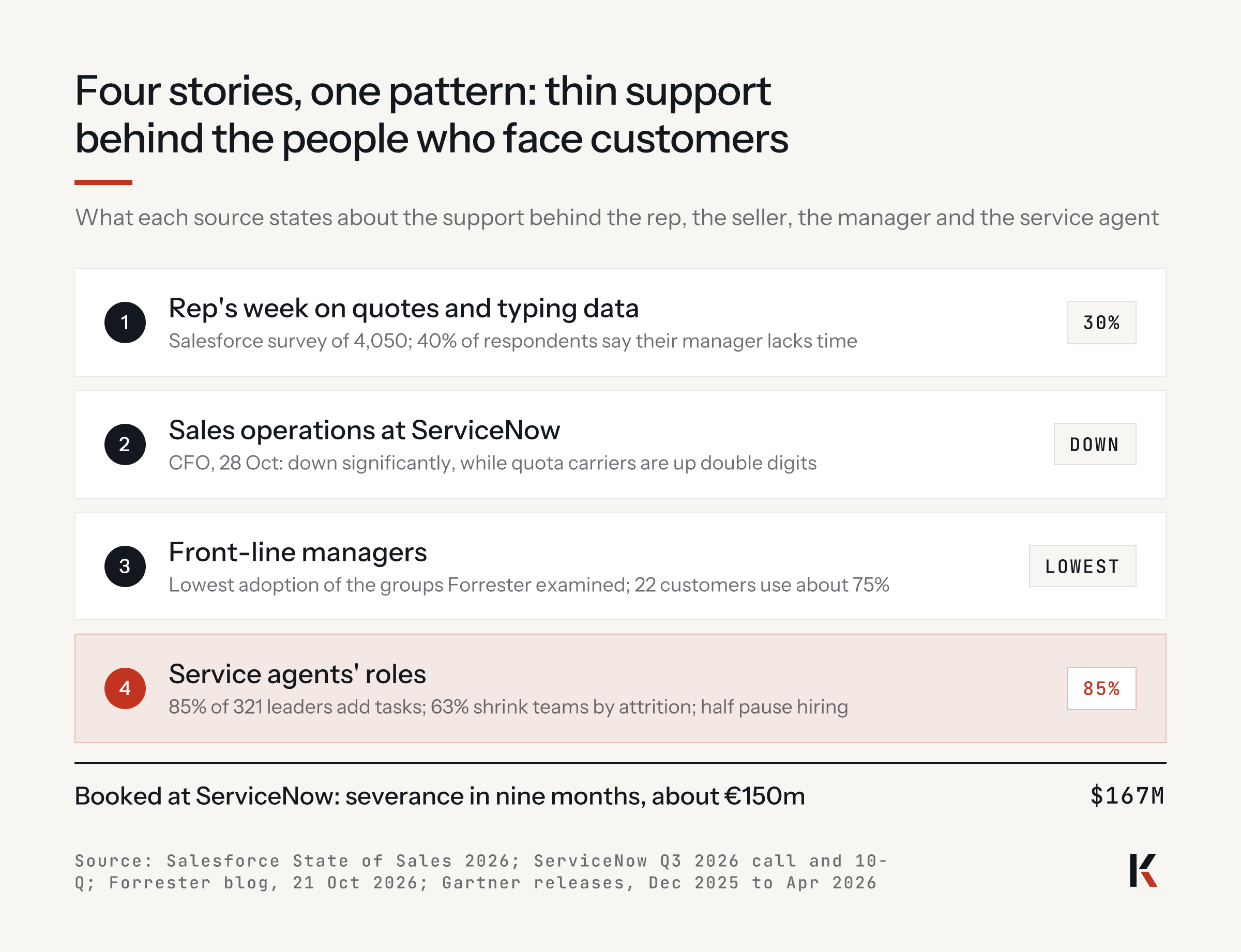
A Gartner survey of 321 service leaders shows the same shape. 85% add tasks to their human agents. 63% let the team shrink as people leave.
Four of this week's six stories show one pattern: the people who face your customers have thin support behind them. ZoomInfo, on Wednesday, went the other way and counted what changed.
I read the six through six lenses, from time management on Monday to working conditions on Saturday. The lenses come from the socio-economic approach, SEAM, developed by Henri Savall and the ISEOR team in Lyon.
The short version
ServiceNow's quota carriers are up double digits and its sales operations is "down significantly", its CFO said on 28 October.
Of 321 service leaders, 85% add tasks to agents and 63% shrink by attrition; front-line managers rate lowest on adoption in Forrester's study.
ZoomInfo went the other way: in April 2024 it put its payment history in front of the people signing new customers.
The week in six
Monday, time management, "Sales reps spend 60% of their week not selling". In Salesforce's survey of 4,050, quotes take 17% of a rep's week and typing data by hand takes 13%. Read Monday's note
Tuesday, work organisation, "Five new customer chiefs; three answers to who owns renewals". Five companies named a customer chief in 20 days; three releases say who owns the renewal, two do not. Read Tuesday's note
Wednesday, communication, coordination and cooperation, "ZoomInfo's unpaid invoices led to a $33 million charge". Non-payment rose for 24 months before the payment history reached the point of sale in April 2024. Read Wednesday's note
Thursday, strategy implementation, "ServiceNow's flat headcount came with $167 million of severance". A flat-headcount promise, three California layoff notices, more quota carriers and fewer people in sales operations. Read Thursday's note
Friday, integrated training, "Enablement reference customers use about 75% of their platform". Forrester's 22 reference customers use about 75% of their platform, and front-line managers adopt it least. Read Friday's note
Saturday, working conditions, "85% add agent tasks; 63% cut headcount by attrition". Of 321 service leaders, 85% add tasks to agents, 63% shrink teams by attrition and half have paused hiring or plan to. Read Saturday's note
The week's teardown
Thursday was the week's teardown. The number everyone reports is ServiceNow's quarter: subscription revenue of $3,988 million, about €3.6 billion, up 21%.
The cost it books is severance: $167 million in nine months, about €150 million, against $53 million a year earlier.
The cost nobody books, as I read it, is the seller's week. That means the hours quota carriers spend on former sales-operations work, and the months new hires need to reach full rate. Read the teardown
What the six show together
Six notes, one question nobody set: who stands behind the person at the front?
In four of them the answer is the same. Fewer people, or people who are not there.
Start with the rep. In Salesforce's survey, quotes and typing data take 30% of the week. 40% of respondents say their manager's lack of time is an obstacle to enablement. It reaches revenue at the quote a customer waits for.
Then the seller at ServiceNow. Quota carriers are up and sales operations is down. The CEO says the email work of about 100 people three years ago "is now completely autonomous". As I read it, this reaches revenue at each price exception a seller needs.
Then the manager. Of the groups Forrester examined, front-line managers had the lowest adoption rating. In a pull-based set-up the seller reads the call score and decides alone. It reaches revenue at the next sales call.
Then the service agent. Of Gartner's 321 leaders, 85% add tasks. Half have paused hiring or plan to. Most say headcount is steady while they support more customers. In my reading, it reaches revenue at the renewal.
As I read the three lists, the cause is strategy implementation. A target is set above, often an AI target, and carried down as a smaller team.
The symptoms are staff turnover and lack of direct productivity. 63% of service leaders shrink by attrition. Three days in five of a rep's week go outside customer work and prospecting.
The bill is non-production: the customer hour that did not happen. It is priced at the margin it should have earned, not at a salary.
Working conditions carried the most weight. The other lenses end there, on one person's desk.
ZoomInfo went the other way. From April 2024 its payment history reached the people signing new customers.
By the third quarter, more than 55% of new business was paid upfront. More than $2 million a month, about €1.8 million, was turned away.
That is support added behind the front, and counted.
Tuesday stands apart. Five releases named a customer chief; three say who owns the renewal and two do not. That is a question of ownership, read on its own.
"But AI now does the support work, so the front needs less help." ServiceNow says that about sales operations; none of the four sources counts the front-line hours that would prove it.
Service and support leaders need a plan for how they will reshape their workforce for AI's impact, otherwise a plan will be handed to them. Kathy Ross, Gartner, 2026
Three laws from the week. Work that loses its owner usually goes to the person nearest the customer. A saving is booked once; the extra task is paid every week. A tool the manager does not open rarely teaches anyone.
To every CEO, CFO and CRO: who stood behind the person who spoke to your customer this week, and how many tasks did that person gain this year?
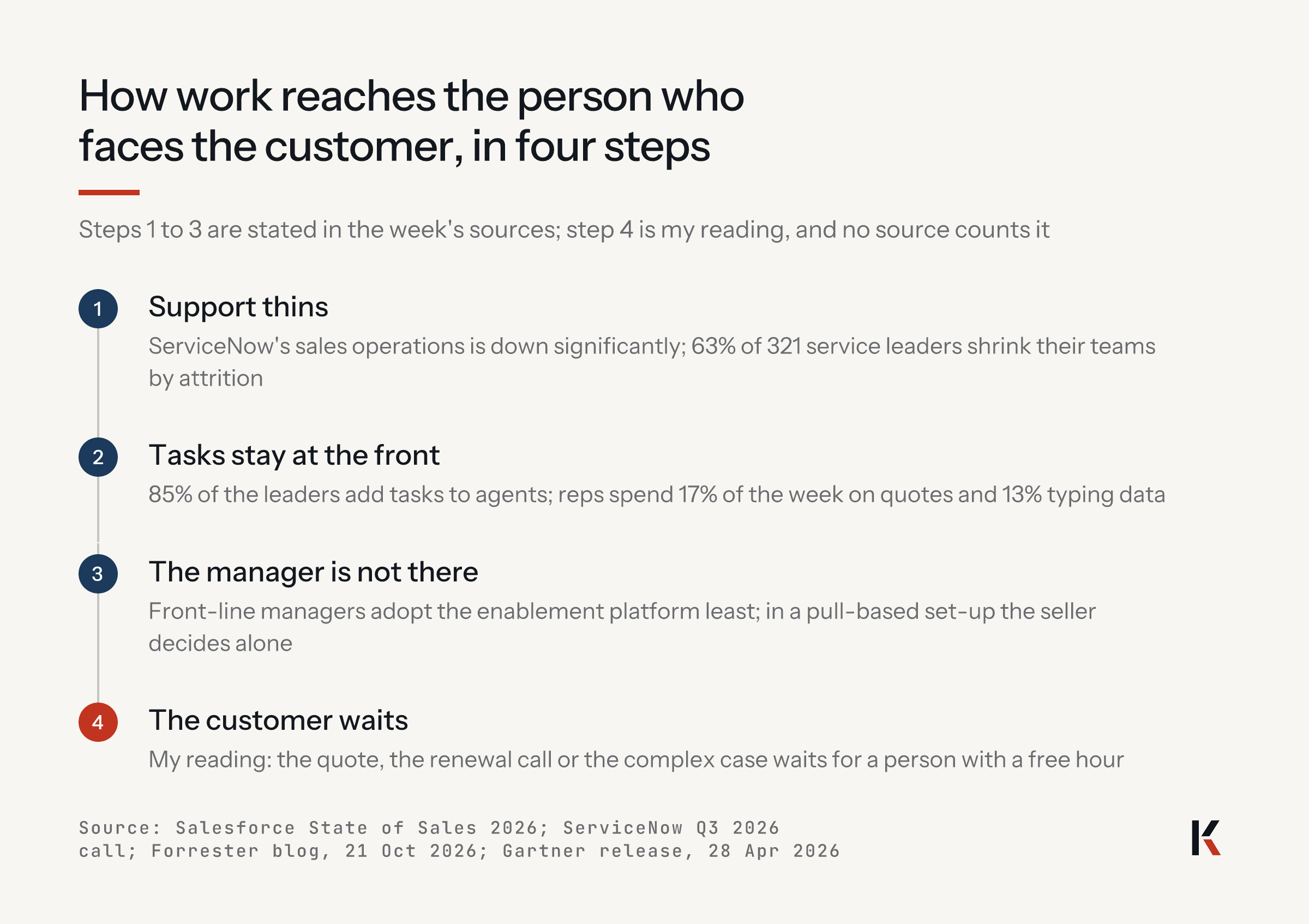
You may conclude that thin support costs revenue. The sources stop short: Gartner reads a bigger job as a possibly better one, and ServiceNow beat its guidance. A count would settle it: tasks per customer-facing person, a year before and after, beside renewal dates.
I read the week as one leak: support taken from behind the front is paid for later, in customer hours nobody books. This is the kind of leak we count.
The Diagnosis follows the tasks of each support role cut or left empty to the people who now carry them, and prices those hours at the margin a customer hour should earn.
In a scale-up, where support is usually hired last and cut first, the gap tends to open fastest. The first step is thirty minutes on your own numbers.
Before the 2027 plan is signed
- List every support role cut or left empty since January, with its tasks.
- Write beside each task the name of the person who does it today.
- Count those tasks per customer-facing person every month, starting in November.
What a CEO should ask this week
Who does the work of each empty seat?
Usually the person nearest the customer. 85% of Gartner's leaders add tasks to agents. ServiceNow says its sales-operations work is now autonomous. Ask for names.
How many tasks did our front line gain?
None of this week's sources published that figure. Salesforce measured a rep's week in shares, not hours: 60% sat outside customer work and prospecting. Ask for your own split.
Do our managers open the tools we pay for?
The 90-day usage log answers it. Forrester's reference customers rated front-line managers lowest on adoption, and in a pull-based set-up the seller is left alone with the score.
Sources
- Salesforce Research, State of Sales, seventh edition, 3 February 2026
- Noma Security, release on its chief customer officer, 26 October 2026
- Ivanti, release on its chief revenue officer and chief customer officer, 20 October 2026
- The Motley Fool, ZoomInfo Q3 2024 earnings call transcript, 12 November 2024
- The Motley Fool, ZoomInfo Q2 2024 earnings call transcript, 5 August 2024
- ServiceNow, Q3 2026 earnings call transcript (Stock Analysis), 28 October 2026
- ServiceNow, Q3 2026 results, Form 8-K exhibit 99.1, 28 October 2026
- ServiceNow, Form 10-Q for the quarter ended 30 September 2026
- Commvault, release on its chief customer officer, 7 October 2026
- Darktrace, release naming three senior executives, 13 October 2026
- Horizon3, release on its chief customer officer, 14 October 2026
- Forrester, blog by Peter Ostrow on the Revenue Enablement Platforms Wave, 21 October 2026
- Gartner, release on 85% of service leaders expanding agent responsibilities, 28 April 2026
- Gartner, release on rehiring by 2027, 2 February 2026
- CX Dive, contact centres pursue workforce redesign over mass layoffs, 5 May 2026
- Each note lists its own sources in full.
Your turn: which task moved to your customer-facing people this year with no name and no count beside it? Reply to this email, or write to cemgorer@kihonlabs.com. I read every reply. If your CFO or CRO should see this, forward it.