
On 5 August 2024, Henry Schuck, ZoomInfo's chief executive, opened the second-quarter call with write-offs. Unpaid invoices had come in above the company's estimate, "particularly with SMBs". The charge was $33 million, about €30 million.
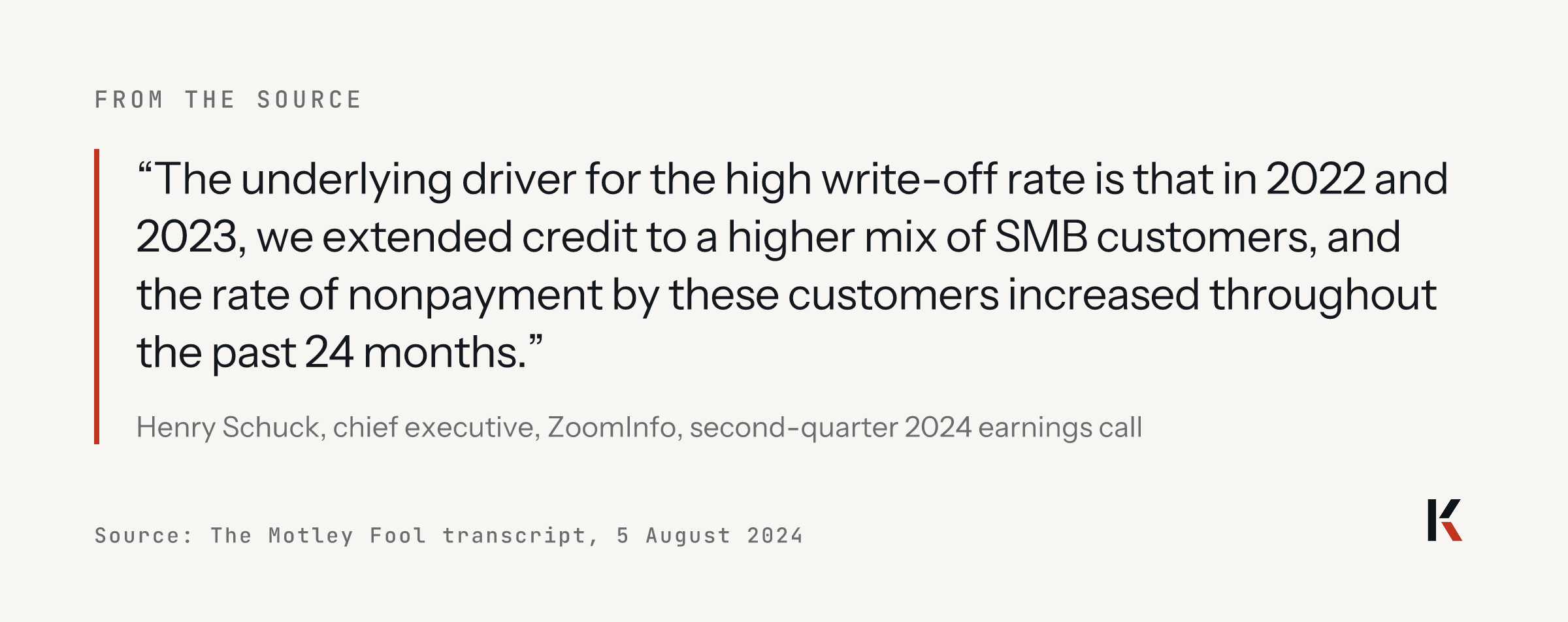
The cause, in his words, was two years old. In 2022 and 2023 ZoomInfo extended credit to a higher mix of small customers. "The rate of nonpayment by these customers increased throughout the past 24 months."
The fix had started before the charge.
In April the company deployed a risk model for new business, comparing prospects with "look-a-likes who paid or didn't pay us in the past".
ZoomInfo sells data and software to other companies' go-to-market teams; at the end of 2023 it had 3,516 employees, 1,596 of them in sales and marketing.
I read the $33 million as the price of two desks that did not share one list: who pays, and who does not. The payment history held that list for two years. It reached the point of sale in April 2024. Which desk saw the trend before then, ZoomInfo has not said.
That makes this a communication and coordination problem between finance and sales, before it is a credit problem.
The short version
ZoomInfo extended credit to more small firms in 2022 and 2023, and non-payment rose for 24 months.
In April 2024 it put a risk model at the point of sale that compares prospects with past customers who paid or did not; the $33 million charge came in August.
In the third quarter of 2024, more than 55% of new business was paid upfront, and more than $2 million a month, about €1.8 million, was turned away.
What ZoomInfo said, call by call
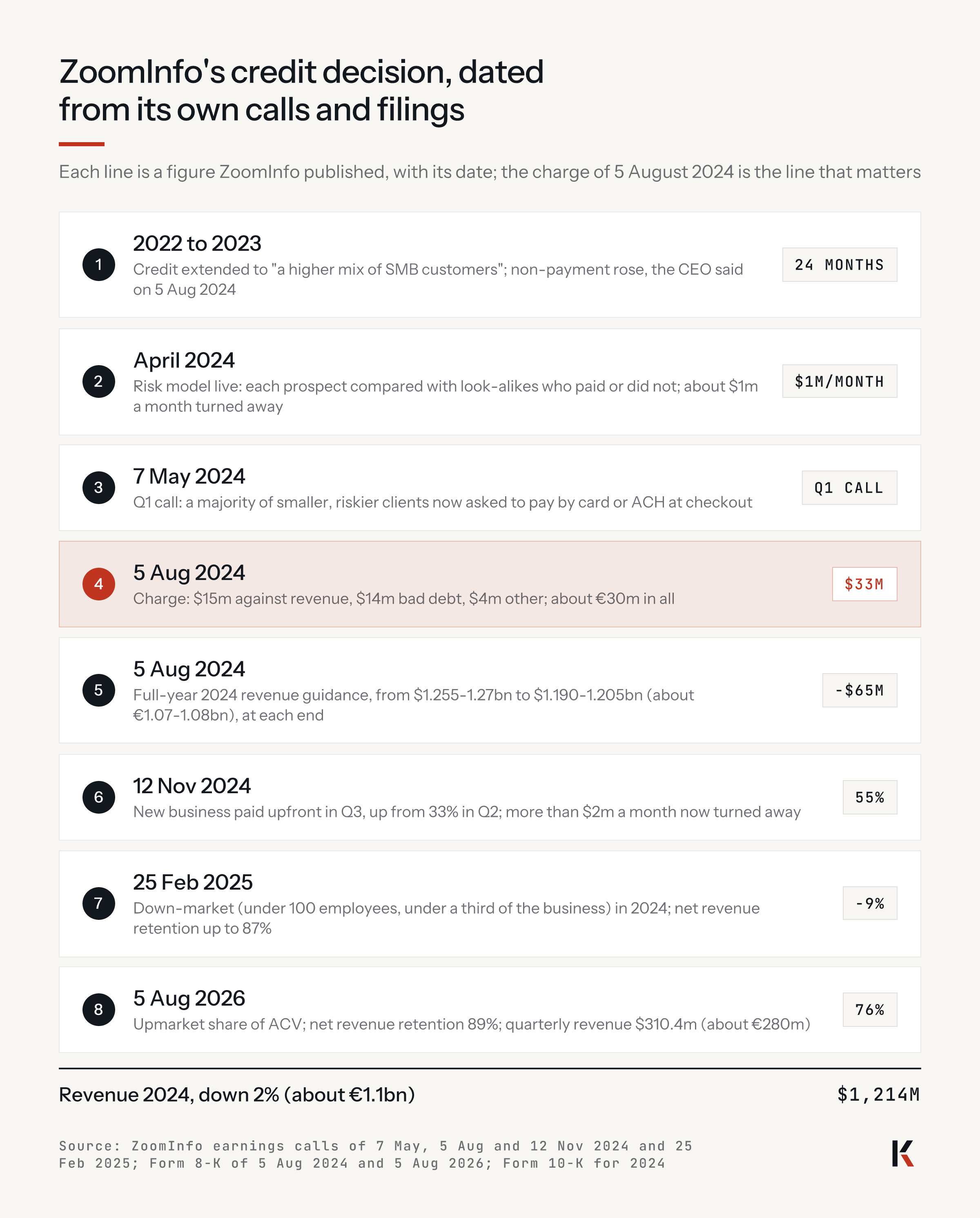
7 May 2024. Cameron Hyzer, the chief financial officer, said write-offs were lower than in the two previous quarters but still a headwind. A majority of smaller, riskier clients now had to pay "via credit card or ACH at checkout".
5 August 2024. The charge: $15 million off revenue already booked, $14 million of bad debt, $4 million of other items (about €13 million, €13 million and €3.6 million). Hyzer spoke of "escalating write-offs that we incurred in June", and was "disappointed and surprised" that the company's estimate for non-payment had to rise. In Q2, he said, smaller, riskier customers paid before access, and new-business sellers were split to sell more to larger companies.
Full-year revenue guidance fell from $1.255 to 1.27 billion to $1.190 to 1.205 billion, about €1.13 to 1.14 billion and €1.07 to 1.08 billion, $65 million lower at each end. Of "the full $60 million", as Hyzer called the change, "roughly half" came from write-offs.
In the same quarter $11 million of annual contract value, about €9.9 million, was paid upfront, against $1 million in any earlier quarter, and about $1 million a month of new business, about €0.9 million, was turned away.
12 November 2024. In the third quarter, more than 55% of new business opportunities went through upfront prepayment, up from 33%. The company was disqualifying "more than $2 million of higher-risk new sales per month".
25 February 2025. Down-market, defined as firms under 100 employees and less than a third of the business, fell 9% in 2024; net revenue retention rose to 87% in the fourth quarter, its first rise from one quarter to the next since early 2022. The model was "working as intended, resulting in improving write-off and collection trends".
Revenue for 2024 was $1,214.3 million, about €1.1 billion, down 2%, with 3,508 employees at year end.
On 13 May 2025 the Nasdaq symbol became GTM. On 5 August 2026 ZoomInfo reported a quarter of $310.4 million, about €280 million, up 1.2%, with 76% of contract value upmarket and retention of 89%. That release also records a $650.5 million goodwill impairment, about €580 million; it gives no reason for it.
One small customer, from signature to write-off
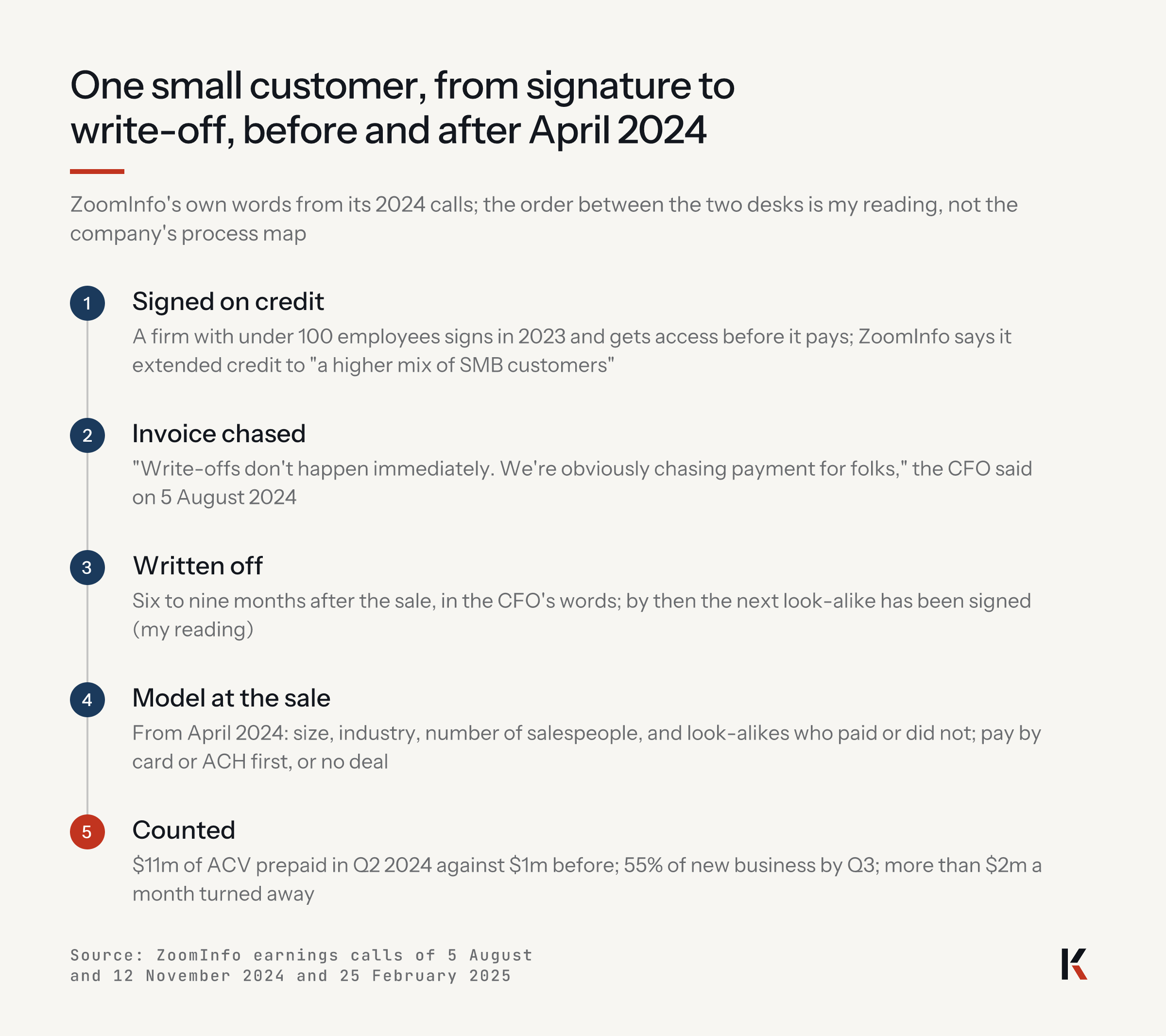
Take one firm with under 100 employees that signed in 2023. It got access before it paid; that is what credit meant here. When the invoice went unpaid, ZoomInfo chased it.
"Write-offs don't happen immediately. We're obviously chasing payment for folks, and it does take us in a period of time," Hyzer said.
Deals sold today "we would potentially write off in six to nine months", in his words.
In those months the people signing new business kept signing. How the file moved between the two desks is my reading from outside; ZoomInfo has published no process.
What it has published is the fix. From April 2024 the look-alike history was used at the sale, and prospects at the greatest risk had to prepay, or were turned away.
In plain words, and as my reading: the cause is information that lived on one desk and did not reach the other.
The symptom is work done twice, a sale made, chased and written off, which the method calls non-quality. Add the selling hours spent on deals that would never pay, a loss of direct productivity.
The larger cost is revenue that never arrived: $15 million of revenue already booked that the company no longer expects to collect, and the second-half revenue from those customers that ZoomInfo removed from its guidance. The hours spent chasing are priced at the margin a paying customer would have carried, not at the salary of the person chasing.
What two years cost, in ZoomInfo's own numbers
The charge is $33 million, about €30 million. Over the 3,508 people ZoomInfo employed at the end of 2024, that is about $9,400 each, roughly €8,400.
The guidance range fell by $65 million, about €58 million. Hyzer puts roughly half of the change on write-offs: the charge, and the revenue those customers would have produced in the second half. The rest, he said, was caution about the market.
What ZoomInfo did not price is the chasing.
Unpaid invoices were chased, in Hyzer's words, for "a period of time" before they were written off. I found no line for that work in the filings I read, so I give it no euro figure; it is counted in hours, and in the more than $2 million a month the company declined from the third quarter of 2024.
One objection: small firms were failing, and that is the economy, not a coordination gap. ZoomInfo says that too: harder access to capital, companies shutting down. Hyzer also named small customers who felt they had not received the value they expected. In the same call Schuck says "we extended credit to SMBs that were not creditworthy", and the fixes the company chose were information at the point of sale and a sales team split towards larger customers, not a different economy.
You may conclude that ZoomInfo's sales reps were kept in the dark. I would not go that far: the documents do not say what the sales desk saw before April 2024, or whether the collections desk raised the trend earlier and was not heard. The measurement that would decide it, in your own company, is the days between a first unpaid invoice and the next look-alike signature.
Finance's list and sales' list are the first two documents Kihon asks you for. The gap between them is usually the first leak a commercial organisation pays for without seeing it. The Diagnosis prices that gap in your own numbers: revenue written off, hours spent chasing, and deals signed that look like the last write-off, at the margin they should have carried.
The same two lists exist in a software company with its first collections hire. If your sales team has never seen the written-off list, thirty minutes on your own numbers is a fair place to start.
What a CFO and a CRO would do first
- Give the people who sign your new customers the list of every customer written off in 24 months.
- Add one question to each deal review: which paid and which unpaid customers does this prospect resemble?
- Count the days from a first unpaid invoice to the next look-alike signature, and shorten them each quarter.
Sources
- The Motley Fool, ZoomInfo Q2 2024 earnings call transcript, 5 August 2024
- ZoomInfo, Form 8-K Exhibit 99.1, second quarter 2024 results, 5 August 2024
- The Motley Fool, ZoomInfo Q1 2024 earnings call transcript, 7 May 2024
- The Motley Fool, ZoomInfo Q3 2024 earnings call transcript, 12 November 2024
- The Motley Fool, ZoomInfo Q4 2024 earnings call transcript, 25 February 2025
- ZoomInfo, Form 10-K for the year ended 31 December 2024, read 28 October 2026
- ZoomInfo, Form 10-K for the year ended 31 December 2023, 15 February 2024
- ZoomInfo, Form 8-K Exhibit 99.1, first quarter 2025 results and trading symbol change, 12 May 2025
- ZoomInfo, Form 8-K Exhibit 99.1, second quarter 2026 results, 5 August 2026
- European Central Bank, euro reference rates, 27 October 2026
Your turn: who in your company sees the list of customers who never paid before the next look-alike is signed? Write to me at cemgorer@kihonlabs.com, or answer on LinkedIn. I read every reply.