
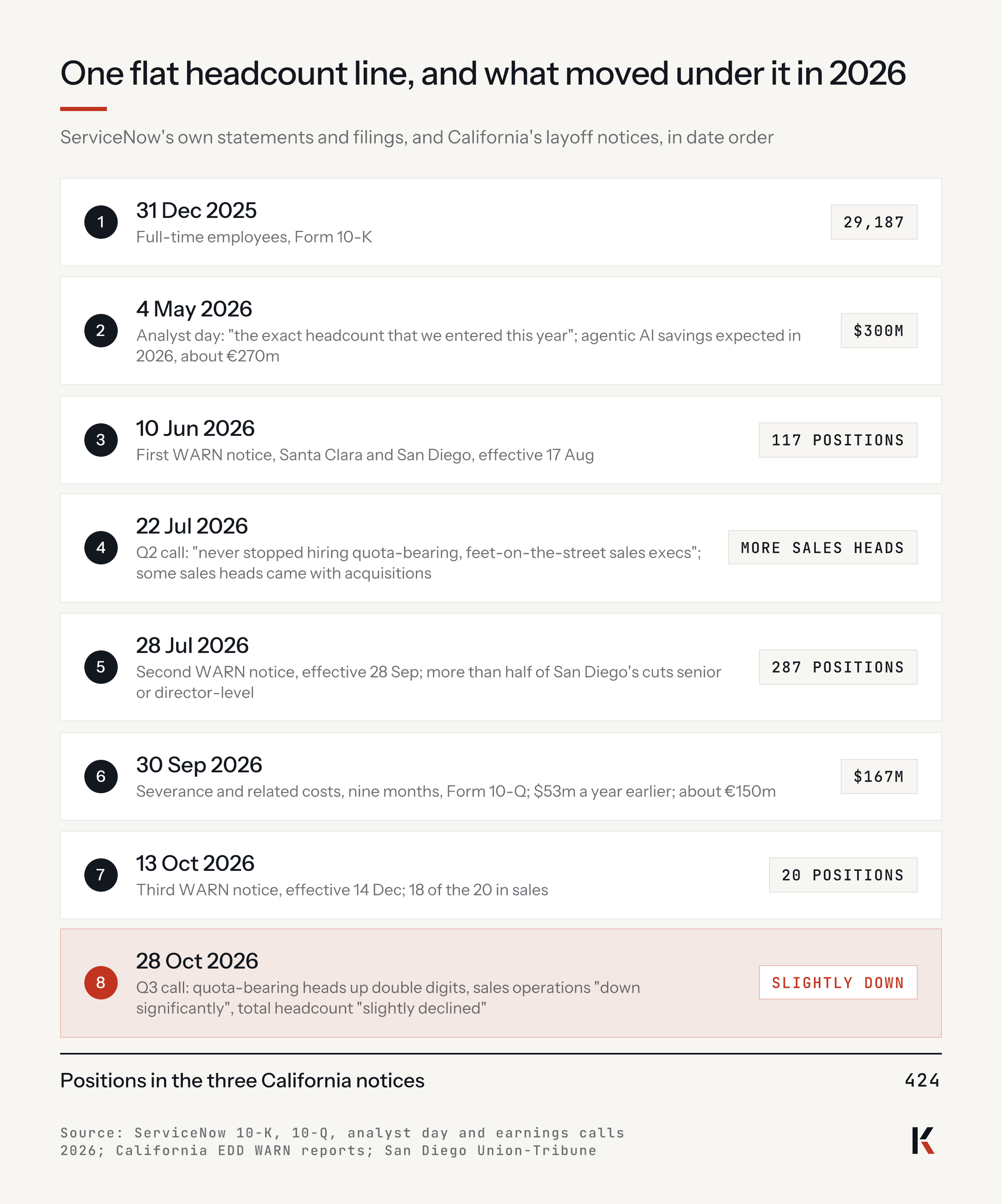
On 4 May 2026, at ServiceNow's financial analyst day, its chairman and chief executive, Bill McDermott, gave the room a promise: "we're gonna leave this year with the exact headcount that we entered this year."
The same day Gina Mastantuono, its president and chief financial officer, put a figure under it. Agentic AI would save $300 million a year in 2026, about €270 million, "flattening the hiring curve".
Five weeks later, on 10 June, California's employment department logged ServiceNow's first California layoff notice of the year: 117 positions in Santa Clara and San Diego. Two more followed, on 28 July and 13 October. A flat headcount is a plan; what reaches the people who win and keep revenue is who leaves, who is hired, and who does the work in between.
That distance, from the date a plan is set to the week it lands on a commercial team, is a strategy-implementation problem.
ServiceNow has not said how many roles the programme covers. The notices cover two offices of a company of 29,187 people on 31 December 2025.
The short version
ServiceNow promised in May to end 2026 with the headcount it started the year with, after buying Veza and Armis; by October, three California layoff notices and $167 million of severance, about €150 million, had followed.
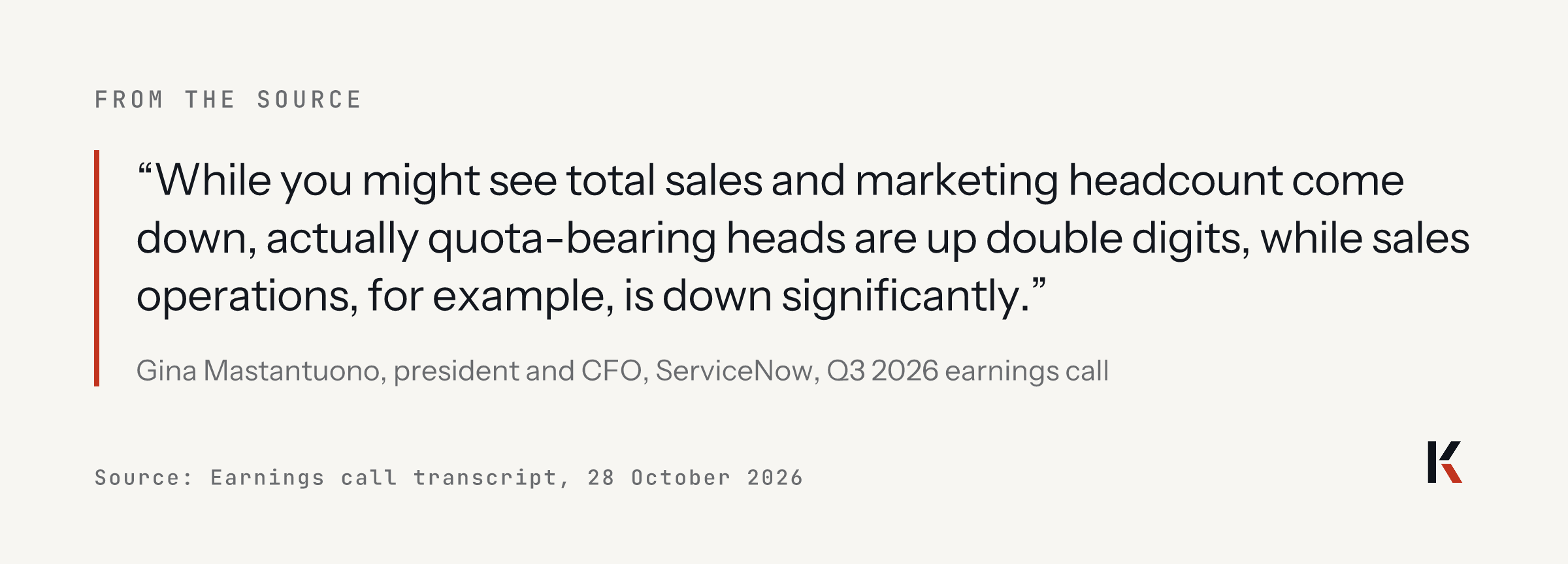
On 28 October its CFO said quota-bearing heads were up double digits while sales operations was "down significantly".
The AI savings are published in dollars; how a seller's hours have changed is not published.
Three notices sat under one flat line
On 4 March, at a Morgan Stanley conference, McDermott said the company was "taking huge headcount costs out". On 4 May came the promise and the $300 million figure, $200 million of it (about €180 million) new in 2026.
The company was also buying: its 10-Q lists Veza, closed on 2 March for about $1.2 billion (about €1.1 billion), Armis, closed on 20 April for about $7.6 billion (about €6.8 billion), and five smaller deals, without saying how many people came with them. The Union-Tribune writes that the deals added thousands of employees.
Then three notices in California's public WARN reports: 10 June, 117 positions; 28 July, 287; 13 October, 20.
The San Diego Union-Tribune read the October filing: its 18 San Diego positions are all in sales. The paper also reports that more than half of July's San Diego cuts were senior or director-level roles.
Between the first and second notices came the Q2 call of 22 July. A Jefferies analyst noted that ServiceNow had "already added more sales headcount in that line this year than all of last year". Mastantuono replied that some came with the acquisitions and that it had "never stopped hiring quota-bearing, feet-on-the-street sales execs". McDermott then called the promise "a commitment" to the capital markets: to start 2027 "with the exact same headcount before we did the acquisitions". Six days later it filed the 287.
On 28 October, asked about headcount, Mastantuono said internal AI had crossed $1 billion in efficiency gains, about €900 million. McDermott added that total headcount "has actually slightly declined" while the company was "increasing feet on the street".
The 10-Q points the other way on one line: sales and marketing expenses rose $215 million in Q3 from a year earlier, about €190 million, "primarily due to increased headcount".
The quarter itself was strong: subscription revenue of $3,988 million, about €3.6 billion, up 21%, a 98% renewal rate, and an AI contract-value target raised to $1.7 billion, about €1.5 billion.
For Q4, current remaining performance obligations are guided to grow 18.5%; the CFO's reasons are early renewals pulled into Q3, more on-premises deals, contract terms that keep some backlog out of the measure, and delivery services included in some large deals.
Fewer people in sales operations, more sellers
On 28 October McDermott described what sales operations used to be: "If you go back 3 years, that was like 100 people in the sales operations department moving around information on email. That is now completely autonomous."
Take one request. A seller needs a price exception approved and the account history pulled before a call. What happens when the agent has no answer is my reading from outside; ServiceNow has published no process. I expect the request goes to the manager, to a colleague now covering two territories, or it waits.
Now multiply. Quota-bearing heads up double digits means more people asking; sales operations "down significantly" means fewer people to ask.
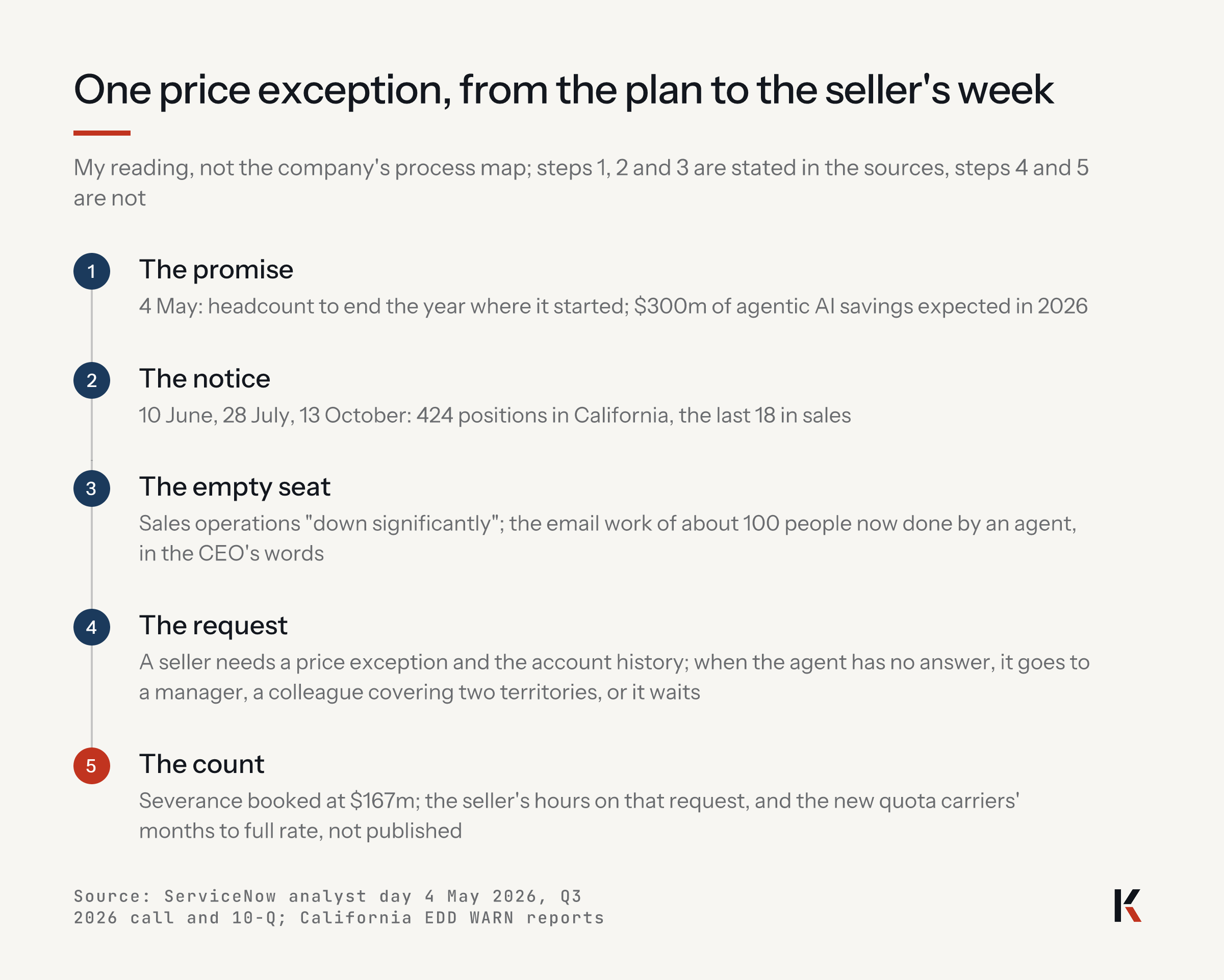
In plain words, and on my reading, the cause is how the plan was carried: a line held flat from above while roles changed hands below.
The symptoms are people leaving, some of them senior, and new sellers below full quota while they ramp. The visible bill is severance. The hidden one is the hours the people who stayed now spend on work that lost its owner, priced at the margin a customer hour should have earned.
Severance is counted, hours are not
Severance and related costs were $87 million in Q3, about €78 million, and $167 million over nine months, against $53 million (about €48 million) a year earlier. That is 3.2 times, my arithmetic.
The other side has no figure. Three units would carry it: the hours your quota carriers spend each week on what sales operations did; the months a new one needs to reach full rate; and the renewals that waited while a request had no owner.
ServiceNow counts the gain in dollars, more than $1 billion a year, and has published none of the three. That is the line to ask for first.
The objection is fair: the CFO said the quarter exceeded "the high end of our guidance across every top line and profitability metric", and the AI target was raised twice. On those numbers, the plan worked. But the numbers that would show what it cost the commercial team are not published, and an unmeasured cost is not yet a low one.
"Double digits" and "significantly" are directions, not counts. Three counts are missing: quota carriers hired and departed, their months to full rate, and hours per seller on administrative work, before and after.
That missing table is what Kihon builds for a commercial team, in its own numbers: the roles an AI target removed, the hours that moved to the people who stayed, the ramp of those who arrived, priced at margin. The Diagnosis ends in one figure your CFO can set beside the savings.
ServiceNow is an enterprise in software and technology, where a flat line can hide a change of roles for a year.
What a CFO would ask ServiceNow
How many quota carriers were hired, and how many people left?
Neither number is public. "Up double digits" and "down significantly" are the only measures given, and the only roles named in public are the 18 San Diego sales positions of October, named by the Union-Tribune.
What does a seller now do that sales operations did?
An agent now pushes insight to the seller, McDermott says; a seller's hours before and after are not published.
Did the cuts move the Q4 outlook?
No evidence says so. The CFO's reasons are about contract timing, deal mix and delivery services, and I would not connect the two.
Sources
- ServiceNow, Q3 2026 earnings call transcript (Stock Analysis), 28 October 2026
- ServiceNow, Q3 2026 results, Form 8-K exhibit 99.1 (SEC), 28 October 2026
- ServiceNow, Form 10-Q for the quarter ended 30 September 2026 (SEC), 28 October 2026
- ServiceNow, Financial Analyst Day transcript (Stock Analysis), 4 May 2026
- ServiceNow, Q2 2026 earnings call transcript (Stock Analysis), 22 July 2026
- ServiceNow at the Morgan Stanley Technology, Media and Telecom Conference, transcript (Stock Analysis), 4 March 2026
- California Employment Development Department, WARN report, 1 July 2026 to 26 October 2026
- California Employment Development Department, WARN report, 1 July 2025 to 30 June 2026
- San Diego Union-Tribune, "ServiceNow cuts San Diego sales jobs in third round of layoffs this year", 19 October 2026
- ServiceNow, Form 10-K for 2025 (SEC), 29 January 2026
Your turn: which roles does your own AI target shrink, and who does their work on the day the seat empties? Write to me at cemgorer@kihonlabs.com, or answer on LinkedIn. I read every reply.