
On 21 October Forrester published its Wave report on revenue enablement platforms. That is the software that holds a commercial team's content, courses, coaching and call scoring.
Peter Ostrow, a vice president and principal analyst at Forrester, wrote the same day what had surprised him most.
It was not the AI.
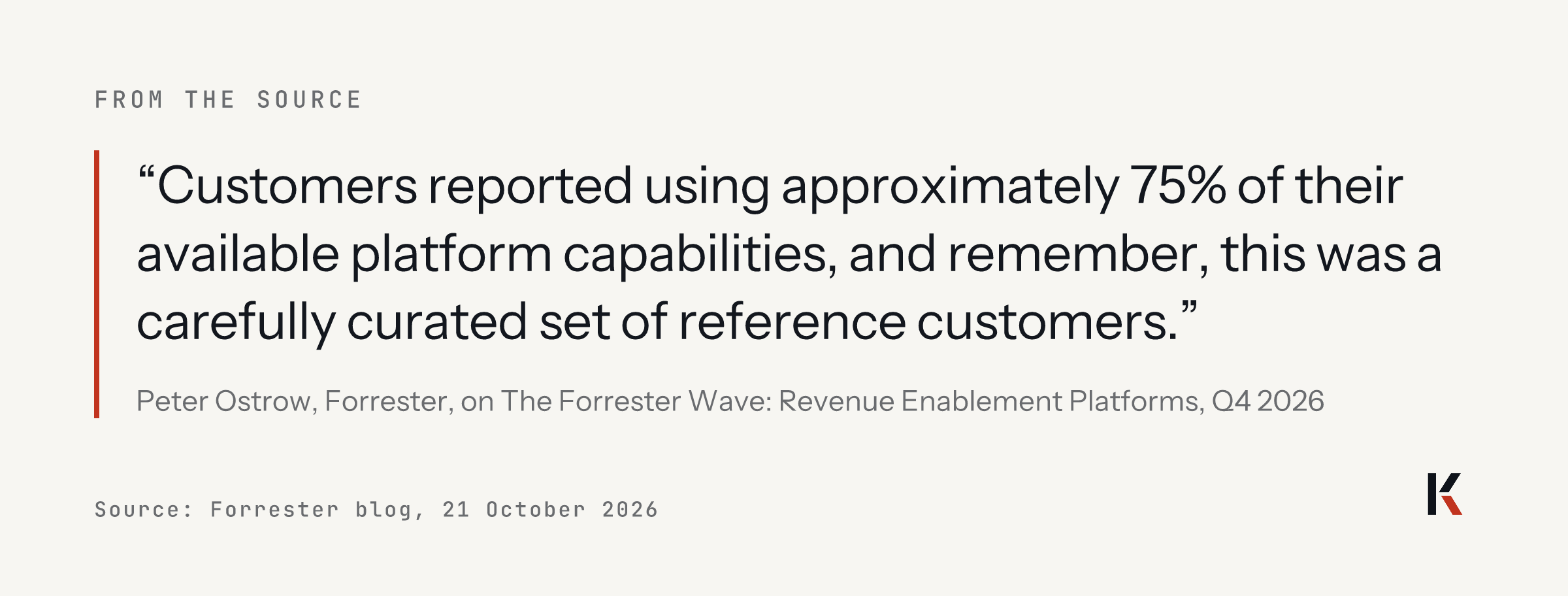
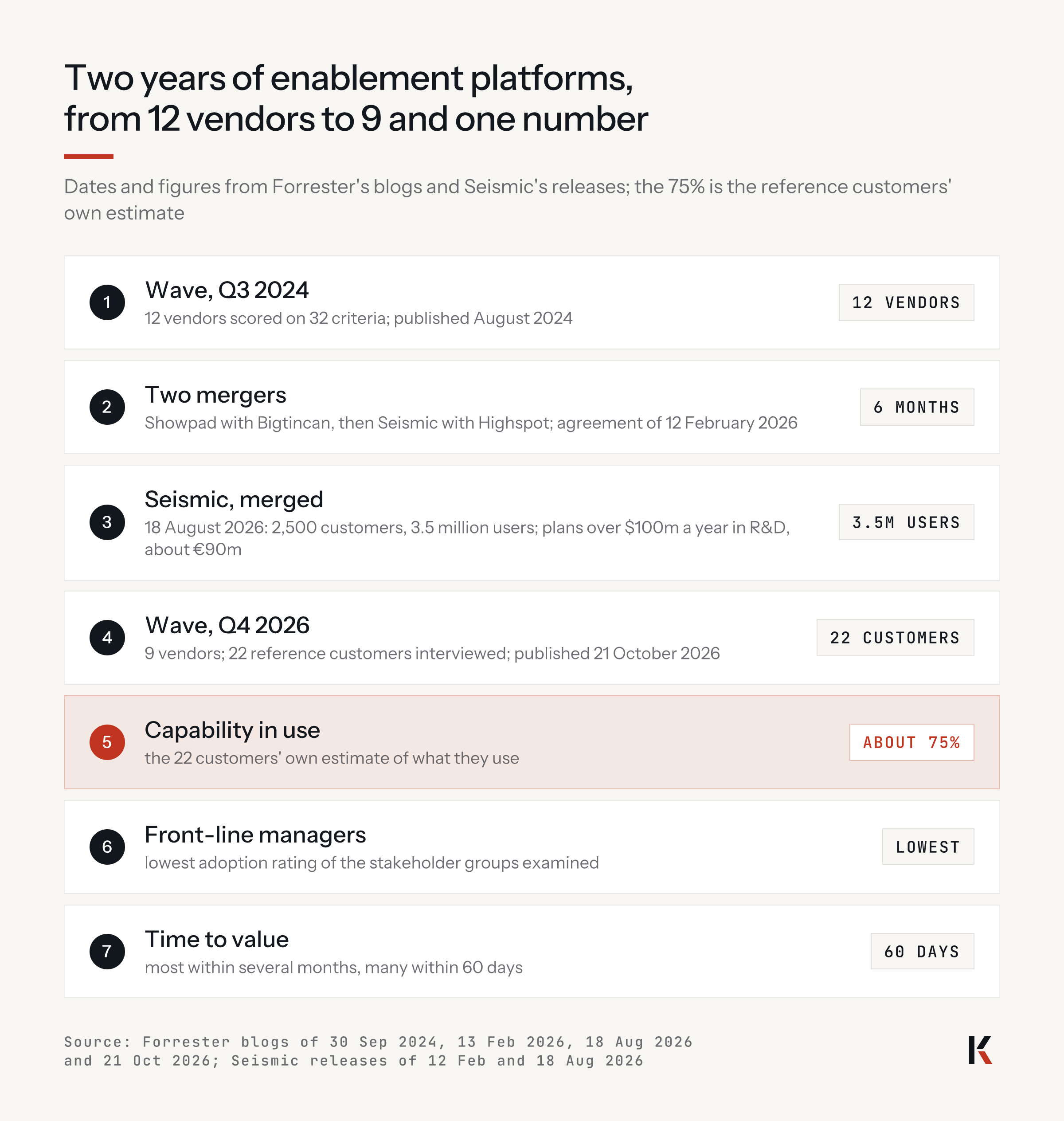
His team had scored nine vendors and interviewed 22 of their customers, a set of reference customers that he calls carefully curated. Those customers said they use about 75% of what their platform can do.
The sentence Forrester heard again and again was "we've not gotten there yet".
Among the groups Forrester examined, front-line managers had the lowest adoption rating. One customer told the analysts: "Manager behavior determines whether the platform becomes transformational or just useful."
I read the unused quarter as a training problem, not a software problem. What the platform could teach a seller stops at the manager who does not use it.
In the socio-economic approach, SEAM, developed by Henri Savall and the ISEOR team in Lyon, that is an integrated-training question. Not what you bought, but what reached the people who use it.
The short version
Forrester's 22 reference customers use about 75% of the enablement platform they pay for.
Front-line managers adopt the platform least, and they decide whether insights become coaching.
AI, in Forrester's words, scales what the organisation gives it, including its weaknesses.
Nine vendors scored, 22 customers, one number
Forrester assessed Allego, Highspot (before its merger), Letter AI, Mediafly, Mindtickle, Pitcher, SalesHood, Seismic and Showpad.
The method was questionnaires, strategy briefings, product demonstrations, comparative scoring and the 22 customer interviews.
The previous Wave, published in August 2024, had looked at 12 vendors on 32 criteria. In between, Forrester counts two mergers in six months: Showpad and Bigtincan, then Seismic and Highspot, which announced their agreement on 12 February 2026.
The platforms work, the customers said. In Forrester's summary they deliver what vendors promised and improve seller readiness and execution. Most customers saw measurable value within several months, and many within 60 days.
The barriers Forrester lists are change management, competing priorities, limited administrative resources and organisational readiness. Some customers phase their deployments on purpose. Forrester still counts the unused part as unrealised value.
The blog does not say how long the 22 customers had been live, which capabilities sit unused, or what a platform costs. The Wave itself is sold to Forrester's subscribers. I read the analyst's own account of it, not the report.
On the vendor side, Seismic completed its merger with Highspot on 18 August 2026. Its release counts 2,500 customers and 3.5 million users. It plans to invest over $100 million a year in research and development, about €90 million, with more than 700 product, engineering, data-science and AI staff.
The same day Ostrow and his colleague Kathleen Pierce wrote about the customers behind the references. For each one with advanced integration, they had spoken with two or three still struggling. They list disconnected systems, chaotic content, poor sales-marketing alignment, and platforms not even connected to the CRM.
A scored call reaches the seller and stops there
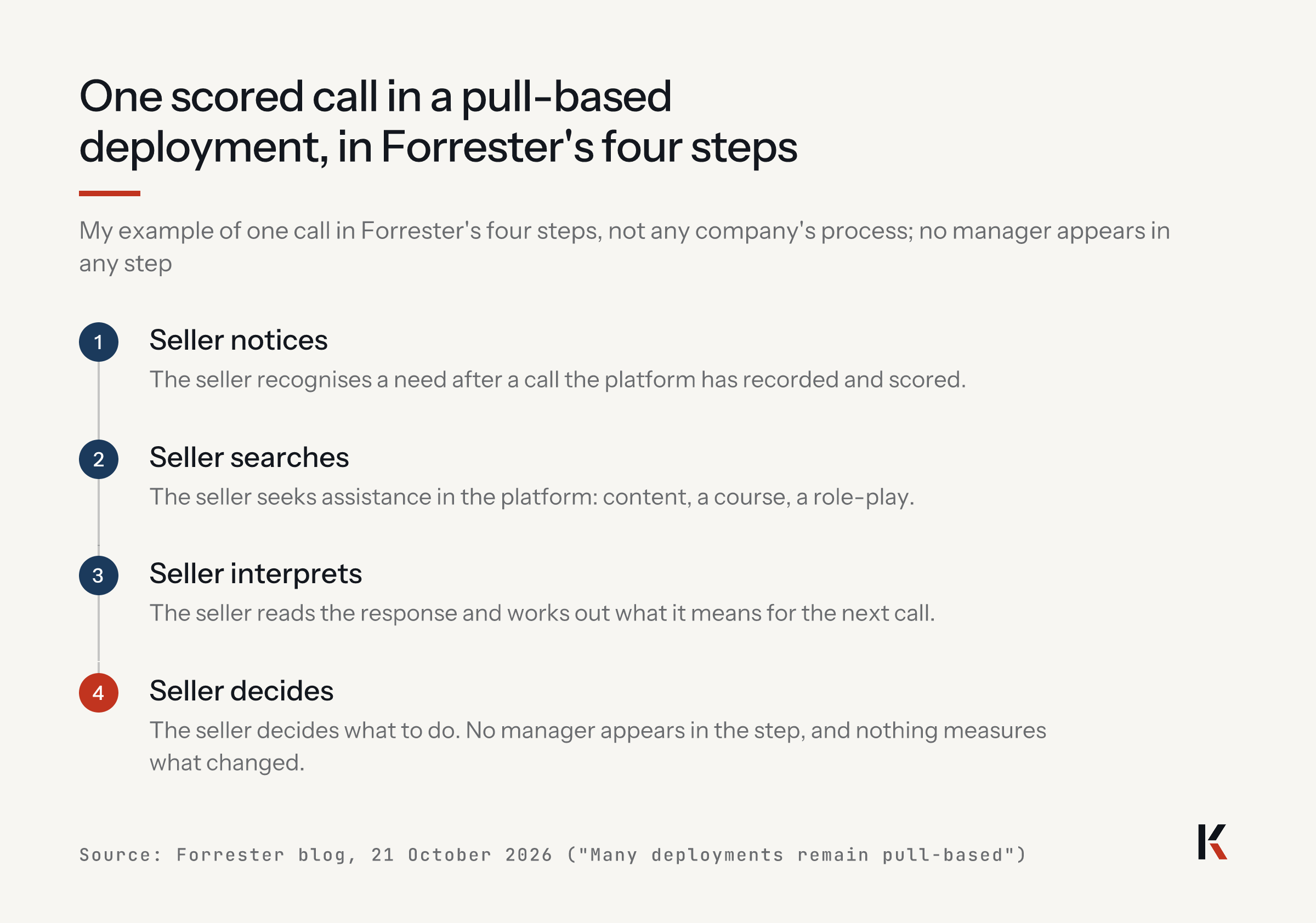
Take the smallest unit: one recorded sales call, scored by the platform. Forrester describes two ways a deployment can run.
In the pull-based way, where many customers still are, the user recognises a need, seeks assistance, interprets the response and decides what to do.
In the push-based way, the system observes signals, diagnoses the need and chooses a response. It delivers guidance in the workflow, activates human judgement and measures what changes.
In the first chain the manager is absent.
The seller reads their own score and decides alone.
How this runs inside any named customer is my reading from outside: Forrester names none and publishes no process. But the finding and the chain fit each other. The group that adopts least is the one the pull-based chain never needs.
Now multiply it across your team. Every weekly one-on-one held without the platform's scores is a coaching conversation you paid to improve and did not. Every scored call nobody acts on is a deal worked the old way.
On my reading, training here was organised as a library, not as a programme: bought, switched on and left for sellers to pull from.
The symptoms are people's work. A seller runs the next call the old way after a scored one. A manager coaches without the data. The method calls that non-quality and lack of direct productivity.
The cost to count is the deals a coached seller would have advanced, priced at the margin they should have earned, not at the licence.
The unused quarter is paid for from day one
No source prices it, so I will not.
In units you can count: the licence buys 100% of the capability from day one, and the reference customers say they use about 75% of it. Many saw value within 60 days, Forrester says; the part they have "not gotten there yet" with is paid for all the same.
Add the one-on-ones held without the data, and the calls scored and never discussed.
The licence is the only one of the three that appears on an invoice. I think the other two are the larger numbers.
Gartner's survey of 227 chief sales officers, run in August and September 2025, adds the pressure. Sales organisations completed an average of four "transformations" in the previous 12 months. Those that work on enablement content with marketing and service were 2.4 times more likely to achieve strong commercial growth.
I read four changes a year as four times a manager must learn the platform again.
A customer may answer that the rollout is phased on purpose and 75% is the plan. Forrester allows that some customers phase on purpose and still counts the unused part as unrealised value. A phase has a date and an owner; a leak has neither. Check which one yours is.
The 22 customers were a curated set of references, and 75% is their own estimate, not a usage log. Forrester does not say which capabilities are unused or what they cost. So I would not conclude that a quarter of every enablement budget is wasted.
One report settles it for your company: the platform's usage log for the last 90 days, manager logins beside seller logins.
A platform that managers do not open is a training programme with no teacher. At Kihon we treat enablement as a system with three parts: the content, the seller, and the manager who closes the loop. We price the missing part in deals, not in licences.
When your leadership team needs to see that gap together, in one session and on its own numbers, that is the Executive Workshop. A scale-up that added the platform at forty sellers and now has a hundred sits exactly where the manager layer gives way. Thirty minutes on your own numbers: start here.
What a CRO would do before the renewal
- Pull the platform's usage log for 90 days and split the logins into sellers, managers and enablement staff.
- List every capability you pay for and mark each one in use, phased with a date, or unowned.
- Put one platform score into every manager's next one-on-one and ask four weeks later what changed.
Sources
- Forrester, blog by Peter Ostrow on The Forrester Wave: Revenue Enablement Platforms, Q4 2026, 21 October 2026
- Forrester, blog "The Seismic-Highspot Merger Raises The Bar. Will GTM Teams Clear It?", 18 August 2026
- Seismic, release "Seismic Completes Merger with Highspot", 18 August 2026
- Seismic, release on the agreement to merge with Highspot, 12 February 2026
- Forrester, blog "As REP Vendors Consolidate, Buyers Face Clearer Choices, And New Risks", 13 February 2026
- Forrester, blog "Three Key Findings From The Forrester Wave: Revenue Enablement Platforms, Q3 2024", 30 September 2024
- Gartner, press release "Gartner Predicts AI-Driven Sales Enablement Will Deliver 40% Faster Sales Stage Velocity Than Traditional Enablement Methods by 2029", 1 April 2026
Your turn: which capability of your enablement platform has an owner this quarter, and which has only an invoice? Write to me at cemgorer@kihonlabs.com, or answer on LinkedIn. I read every reply.