
On 28 April Gartner published what 321 customer service and support leaders had told it between September and October 2025.
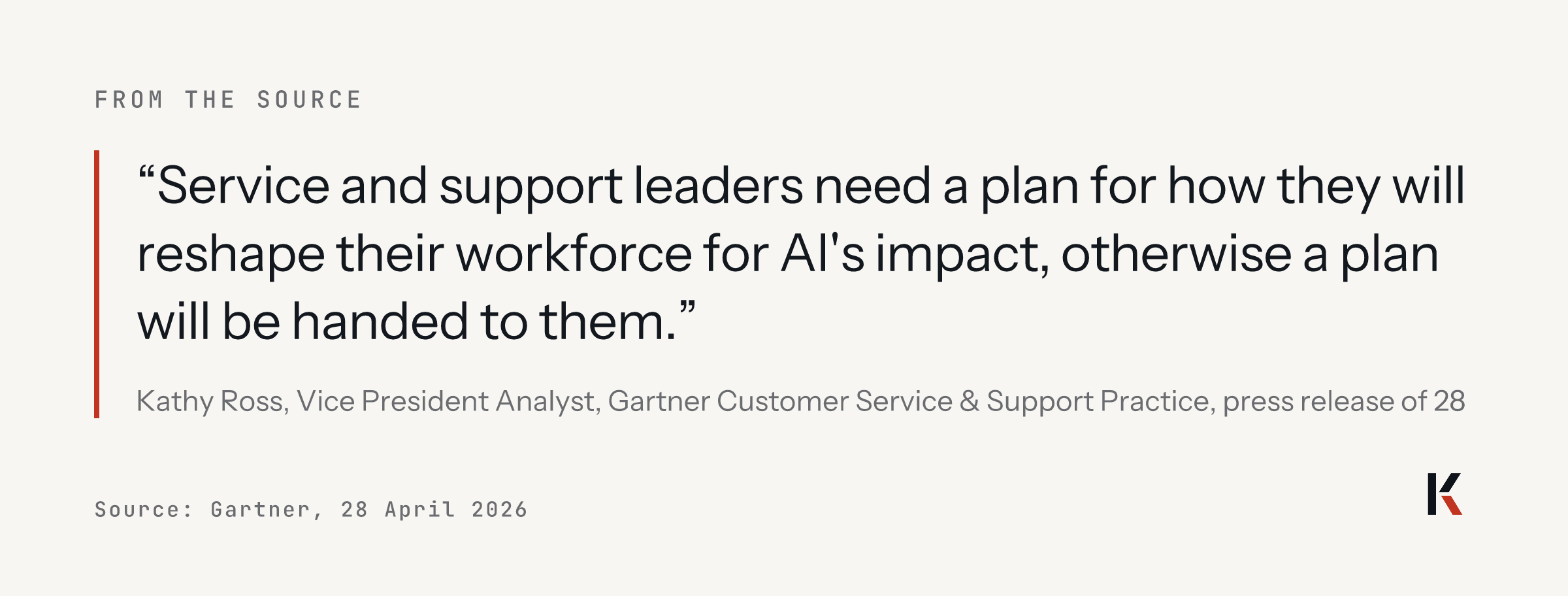
Kathy Ross, a vice president analyst there, put the finding in one sentence.
Leaders need a plan to reshape their workforce for AI, "otherwise a plan will be handed to them".
85% of the leaders are adding new tasks and responsibilities to frontline agent roles. 75% are moving agents into entirely new roles.
63% are reducing frontline headcount gradually through attrition. 31% have made, or plan, AI-driven layoffs through the first quarter of 2027.
Gartner had published the same survey three times before, on 17 December, 2 February and 18 February, each time about the agent's job.
I read the four releases as one description: a job that gets bigger while the team around it gets smaller, one leaver at a time. That is a working-conditions question: the load and the shape of the work of the people who face your customers. The socio-economic approach, SEAM, developed by Henri Savall and the ISEOR team in Lyon, starts there.
The short version
Of 321 service leaders Gartner surveyed, 63% shrink headcount by attrition and 85% add tasks to the agents who stay.
Half have paused hiring or plan to within 18 months; only 20% say AI has actually reduced their agent staffing.
Gartner expects half of the companies that cut service staff for AI to hire again by 2027, under other job titles.
One survey, four releases, a bigger job
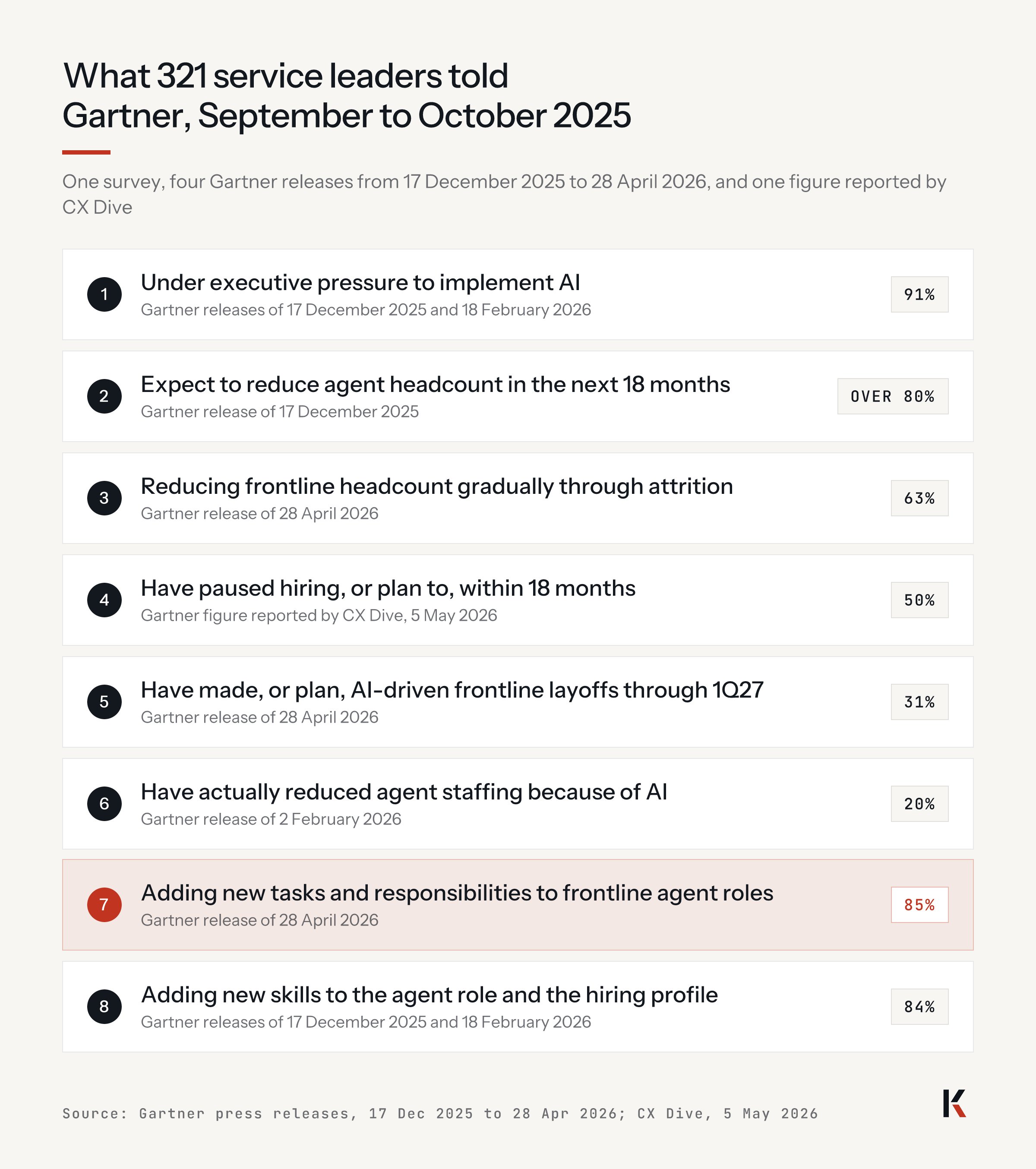
17 December 2025. Brad Fager, chief of research in Gartner's customer service and support practice, gave the first figures. 91% of the leaders were under executive pressure to implement AI.
Over 80% expected to reduce agent headcount in the next 18 months. Nearly 80% planned to move agents into new positions.
84% were adding new skills to agent profiles, and 58% planned to retrain agents as knowledge management specialists.
2 February 2026. Gartner turned the survey the other way: only 20% of the leaders had actually reduced agent staffing because of AI. The majority, the release said, report that headcount remains steady, even as they support more customers.
Ross said most recent reductions "were influenced by broader economic conditions rather than automation alone".
The same release predicted that by 2027, half of the companies that attributed headcount cuts to AI would rehire for similar functions, under different job titles.
18 February 2026. The third release repeated the 91%, the nearly 80% and the 84%. Kim Hedlin, a research director, said AI and human expertise must now "work in tandem".
28 April 2026. The fourth release gave the 85%, the 75%, the 63% and the 31%. It said 80% of the leaders felt pressure to change their workforce "as AI reduces contact volumes and improves agent efficiency".
On 5 May CX Dive reported one more Gartner figure: half of the leaders have paused hiring, or plan to, within 18 months.
What none of the five documents gives you: contacts or tasks per agent, hours, pay, sick leave, the attrition rate, or how many of the organisations serve business customers.
One empty seat, as I read it from outside
Take a service team of ten, and one resignation.
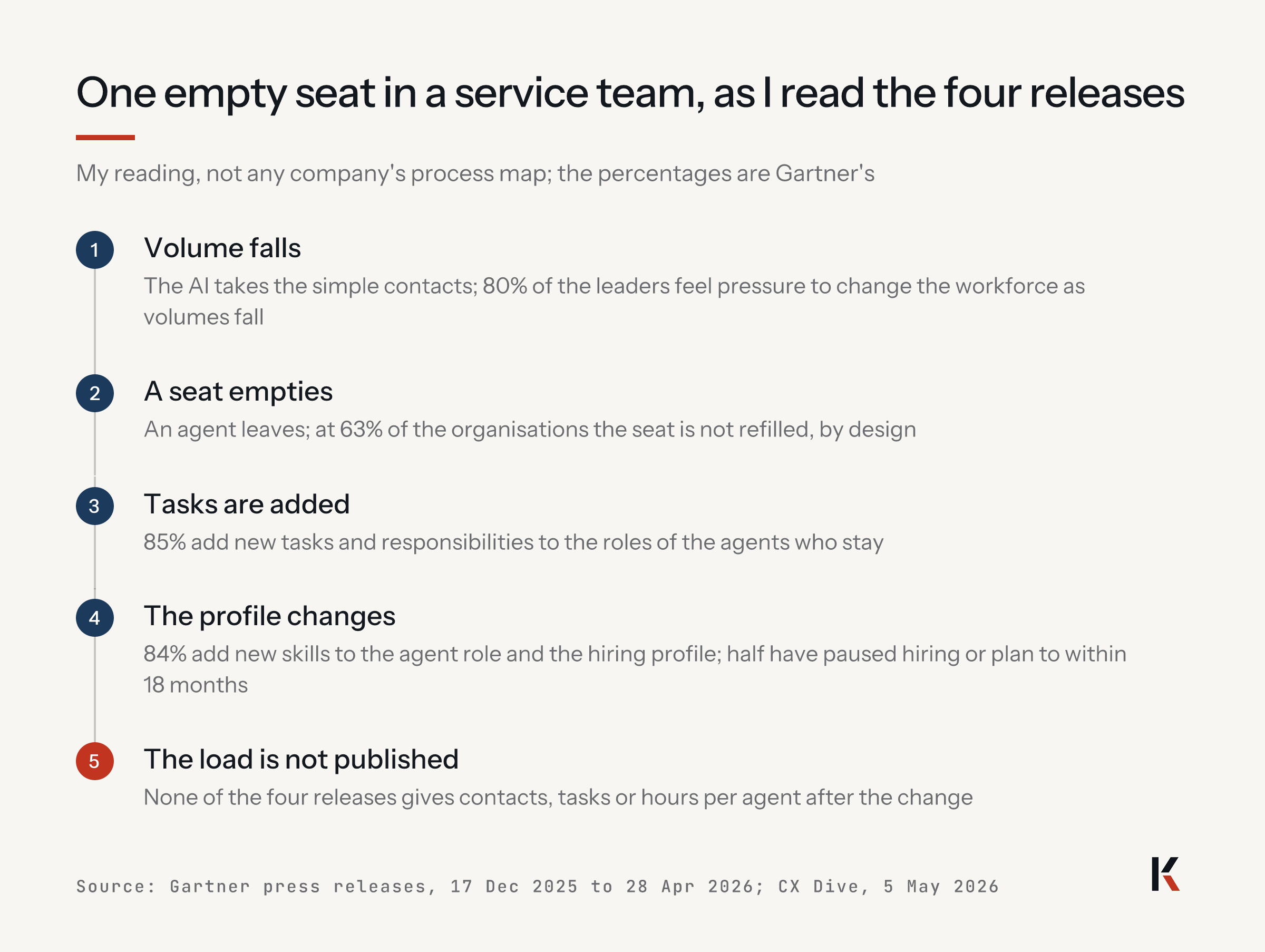
Under the route 63% of the leaders describe, the seat stays empty by design. How this travels inside any one company is my reading from outside; Gartner publishes percentages of leaders, not a process.
The AI takes the simple contacts, so the volume falls, as the 28 April release says. The complex contacts are shared by nine people instead of ten.
The leader adds new tasks to the role, as 85% are doing. 58% of the leaders plan to retrain agents as knowledge management specialists, to review and curate the content the AI produces.
The next hire, if there is one, needs skills the last one did not. Half of the leaders have paused hiring, or plan to within 18 months.
Each resignation moves a share of work to the people who stay. The hiring pause means it does not move back.
I read the root of it as the load and the shape of the job.
The first symptom is people leaving, which the plan now depends on. The next are the complex case that waits, and the knowledge role that is named but not yet taught.
The cost shows in what an agent no longer has an hour for: the renewal conversation, the customer who asked for a person and waited, the skill never built.
The method calls these non-production and non-creation of potential. It values the lost hour at what it would have added to margin, not at the agent's salary.
The cost returns as a hire in 2027
The releases give no money, so I will not invent any.
You can count these units: seats left empty since your AI went live, tasks added to each role, weeks of paused hiring.
Gartner predicts that half the companies that cut for AI will rehire by 2027, under a new title. In my reading that means a recruiter's fee and a ramp paid a second time.
An agent's hour moves from a renewal conversation to a task the leaver used to do. That hour costs you the margin of the customer kept, not the hour's pay.
For a company whose revenue repeats, that is the larger number, and it is on no invoice.
You may object: "Fewer contacts means the agents who stay have spare capacity; the new tasks fill it." Gartner's wording agrees with you: capacity is reallocated to higher-value work.
The number that would prove it, contacts and tasks per agent after the change, is in none of the releases. I read the forecast of rehires by 2027 as a sign that the capacity is often smaller than planned.
I would not conclude that AI programmes are overloading service agents. The survey measures leaders' plans, not agents' hours. A smaller team with a bigger job can be a better job; that is Gartner's reading.
What decides it is a count: contacts and tasks per agent per week, with leavers, for 12 months before and after your AI went live.
Four releases, 321 leaders, and no number for the person at the desk. Kihon works in that gap.
A plan handed to leaders, in Ross's words, lands next on the agent. We count what it weighs there: contacts, tasks, empty seats and overtime hours, priced at the margin a kept customer carries.
Running a service or success team through a redesign like this, with the load per agent counted before the hiring pause starts, is what Operation does.
If you run a scale-up that has put an AI in front of its support team and stopped refilling seats, the count starts with one month of your logs. The conversation starts with thirty minutes on your own numbers.
What a head of support would do before the next resignation
- Pull contacts and tasks per agent per week for 12 months and mark the month the AI went live.
- List every seat left empty since then and write who carries each leaver's work today.
- Set the number of empty seats at which hiring restarts, in writing, before the next resignation.
Sources
- Gartner, press release "Gartner Survey Finds 85% of Service and Support Leaders are Expanding Human Agent Responsibilities Despite Expectations of Mass AI Layoffs", 28 April 2026
- Gartner, press release "Customer Service and Support Leaders Must Prioritize Blending Human Strengths with AI Intelligence in 2026", 17 December 2025
- Gartner, press release "Gartner Predicts Half of Companies That Cut Customer Service Staff Due to AI Will Rehire by 2027", 2 February 2026
- Gartner, press release "Gartner Survey Finds 91% of Customer Service Leaders Under Pressure to Implement AI in 2026", 18 February 2026
- CX Dive, "As AI proliferates, contact centers pursue workforce redesign over mass layoffs", 5 May 2026
Your turn: since your AI went live in support, how many leavers have you replaced, and who carries the work of the ones you did not? Write to me at cemgorer@kihonlabs.com, or answer on LinkedIn. I read every reply.