
Four companies, four first numbers. The one revenue line went quiet after FY22.
From the week's six notes, built on filings, releases and one survey, I read this through the hidden-cost lens.
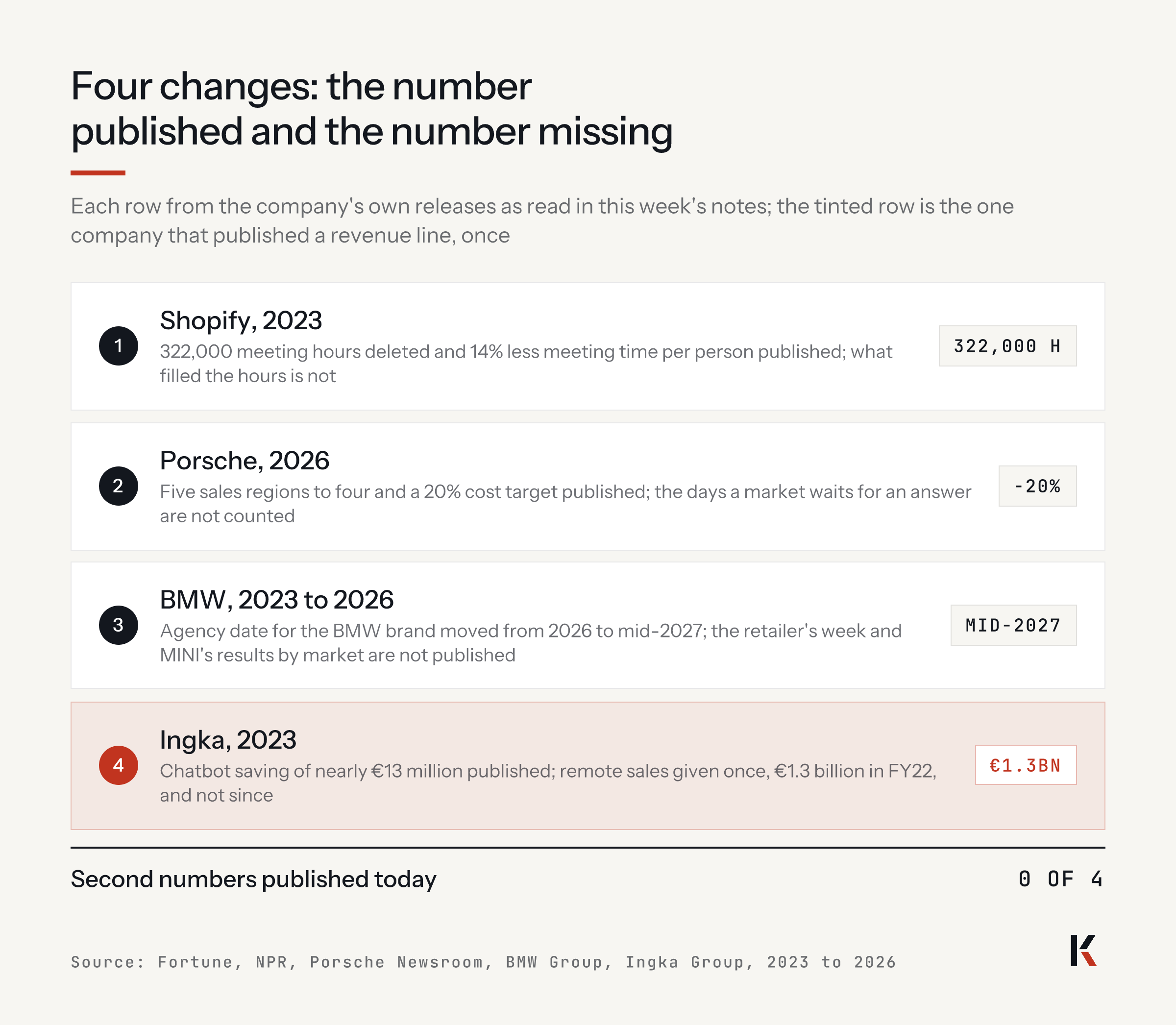
Kaz Nejatian, Shopify's operating chief, had his number six weeks after a bot deleted every recurring meeting of three or more people at the company on 3 January 2023: 322,000 hours.
Porsche set its number on 7 October: 20% off sales and distribution costs. BMW's number is a date, mid-2027. Ingka's is nearly €13 million saved by a chatbot.
Each of the four published the number its decision produced on day one; the number its customer-facing people produced afterwards is missing. Ingka is the partial exception: it published a revenue line once, for FY22, and has not since.
Through the week's six lenses, time, organisation, coordination, implementation, training and working conditions, that is what Monday, Tuesday, Thursday and Friday showed. Wednesday and Saturday do not show it, and are read on their own below.
The short version
Four companies published what a change removed or set: hours, regions, a date, a saving.
None has published what the people who meet the customer produced after it; Ingka did once, for FY22.
The first number sits in a ledger finance already keeps; nobody has published who keeps the second.
Six notes, four first numbers
Monday, time management. Three leaders cut recurring meetings; one counted the hours. Shopify measured 14% less meeting time per person; none of the three published what filled the hours. Read Monday's note
Tuesday, work organisation. Porsche cuts its sales regions from five to four. Two central departments dissolved, three leads holding a market and a region, and no count of the days a market waits. Read Tuesday's note
Wednesday, communication, coordination and cooperation. Dealers said they warned Stellantis for two years. The company said it met dealers monthly; the guidance cut came 20 days after the letter went public. Read Wednesday's note
Thursday, strategy implementation. MINI sells direct in 24 markets; BMW from mid-2027. A 2023 plan said the BMW brand would switch from 2026, and the retailer's week is still not described. Read Thursday's note
Friday, integrated training. Ingka retrained 8,500 IKEA call-centre staff as design advisers. The chatbot's €13 million saving was published; remote sales were given once, €1.3 billion in FY22. Read Friday's note
Saturday, working conditions. 81% of surveyed call-centre agents have every call recorded. Union representatives say the score can move variable pay by up to 40%, and agents cannot see the rule. Read Saturday's note
The day-one number lands in finance's ledger
Nobody set a question this week, and the six answered one anyway. When a company changes how it wins or keeps revenue, which number does it publish, and which never arrives?
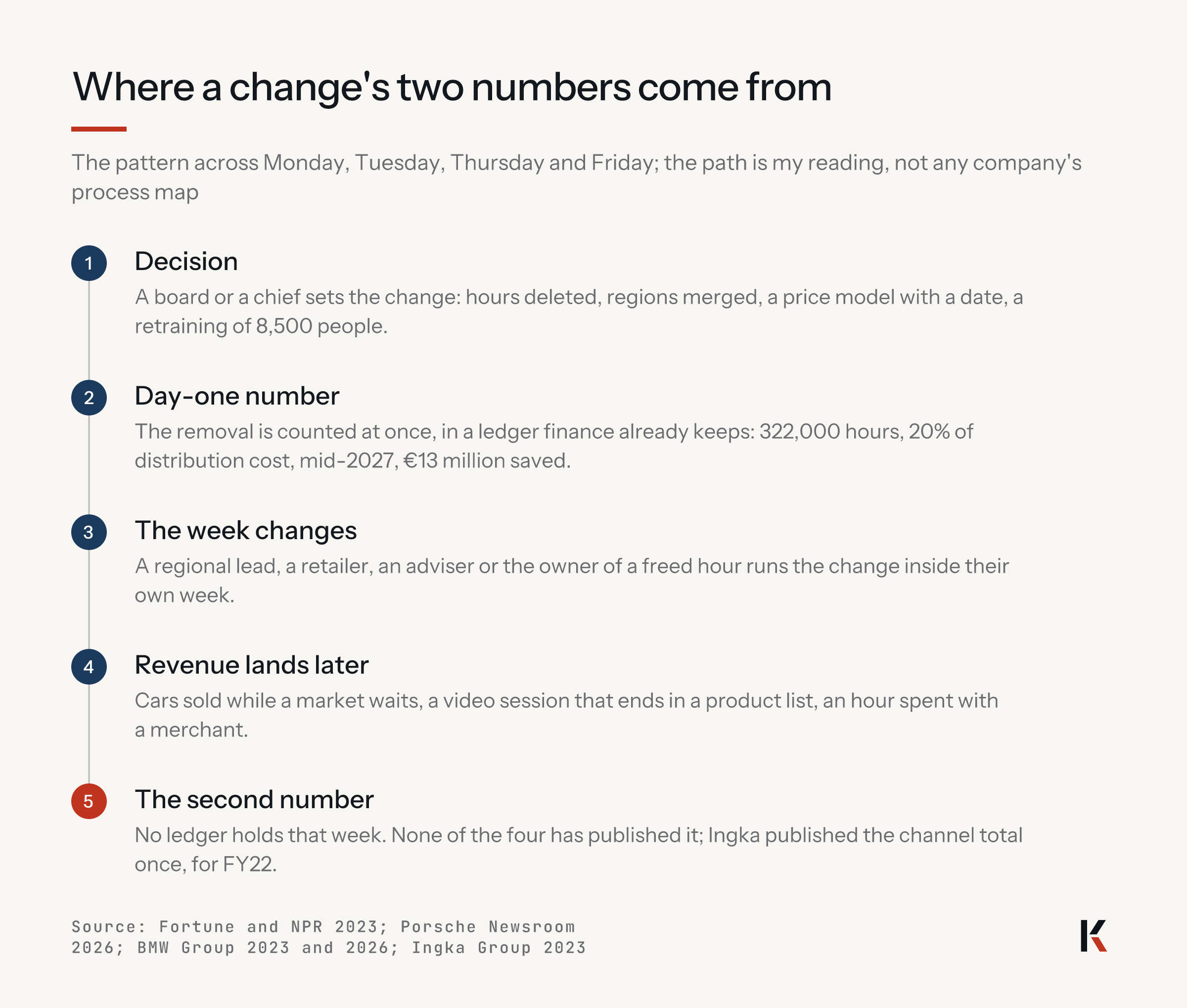
The first number arrives on the day, produced by the decision itself: hours removed from calendars, a department dissolved, a date for a price model. Finance already keeps that ledger, so it is counted at once.
The second number, as I read it, is produced later, in other people's weeks: the lead who also runs a market, the retailer whose discount conversation ends, the adviser in a 45-minute video session. No ledger holds those weeks, so the number tends to stay blank.
Monday's first number came from Shopify's finance chief in July 2023: 14% less time per person in meetings. Where the freed hours went, to merchants, to admin or to a new meeting, has never been published.
Shopify reports the hours it deleted. Nobody books what the freed hours produced.
Gartner research, reported by DestinationCRM, finds 72% of sales organisations report low reinvestment of the 4.8 hours a week AI saves sellers.
We deleted 322,000 hours of meetings. Kaz Nejatian, Shopify, as quoted by NPR, 2023
Tuesday gives the first number a euro value. Porsche's 20% target, on a 2025 distribution line of €2,796 million, is about €560 million a year, if it is the same line.
The second is the days a market CEO now waits for a car allocation or a price from a lead who also chairs Porsche Deutschland. Porsche has published no count of those days, and each day a car waits, I would argue, moves margin to a later quarter.
BMW's gap runs for years; Ingka's revenue line stopped
Thursday shows how long the gap can run: BMW's first number is a date, moved from 2026 to mid-2027. The second is what a retailer's week becomes once BMW sets the price and pays a fixed commission.
MINI reworked purchase scenarios while selling, newmobility.news reported; BMW's word for the launch is "successful", with no result by market.
Friday shows the gap best. Ingka put both numbers in one release in June 2023: nearly €13 million saved by the chatbot, and €1.3 billion sold through the remote channel in FY22, 3.3% of sales, against an aim of 10%.
The revenue line was roughly 100 times the saving, it had the target, and it is the one that stopped being published. The FY24 report dropped the reskilling target too.
"The saving is real money; the second number is speculation." At Ingka it was real money for one year, and it was the line with the target.
Of the six families, strategy implementation carried the week: in all four cases the decision reached the calendar, the chart or the training room before anyone decided what to count there. The symptom that kept returning was work done twice: MINI's reworked scenarios, a market asking two people.
The cost the week kept pointing at is hidden, because it leaves no trace: cars not sold while a question waits, sessions without a product list, hours filled with admin, priced at the margin they should have carried.
Stellantis and the call centres, read on their own
Wednesday reads from the other side. Stellantis' 2,600 US dealers said they had sounded an alarm to US executives for two years; in my words, the alarm was cars at prices customers would not pay.
The company answered with first numbers of its own, dealer stock down 42,000 units and August sales up 21%. North America's adjusted operating income fell 80% in 2024; Stellantis also names products, pricing and the market.
Saturday is a survey, where the count exists and the people cannot see it. 81.3% of more than 700 UK agents work under constant recording, and union representatives say the score can move variable pay by up to 40%. A score your customer-facing people cannot explain, I would expect, reaches the renewal they are trying to save.
It would be easy to conclude that the four changes cost revenue. The notes do not show that: Shopify measured less meeting time, MINI runs in 24 markets, Porsche's structure was scheduled to take effect on 1 October, and Ingka publishes no sales per adviser. What the four show is a blank cell, and a blank cell can hold a gain as easily as a loss. One table per company would fill it: the day-one number beside what its customer-facing people produced, by role, at 90 days and a year.
The same blank cell appeared four times this week, and filling it is Kihon's work: beside your day-one number, what your customer-facing people produced after it, by role, priced at margin, counted again at 90 days.
That second column is what the Diagnosis builds, in your own numbers. All four are large companies, where a blank like this is stable and rarely a crisis, the enterprise stage we work at. If your board saw a first number this quarter, thirty minutes on your own numbers is where we would begin.
Three laws to repeat.
- The number finance already keeps is the number that gets published.
- A revenue line with no owner is the first line to go quiet.
- A change is half reported until the field's week is counted.
To every CEO, CFO and CRO: ask who in your company would notice if the customer-side number stopped arriving next quarter.
Give the second number an owner
- Write the day-one number of your last commercial change on one line.
- Write beside it what your customer-facing people produced since, or leave it blank.
- Name the person who fills that blank in ninety days.
Which number should the board see first? Both, on one page. A day-one number alone reads as a result, and this week it was a plan.
The customer-side number belongs to the leader of the commercial organisation, with finance holding the method. It is produced in the field's week, so the field's leader has to bring it.
It can exist ninety days after the change, as a first reading; Shopify had its 14% within five months. A year gives a full reading.
Sources
- Fortune, Shopify CFO on the meeting cost calculator, 14 July 2023
- NPR via OPB, Shopify deleted 322,000 hours of meetings, 15 February 2023
- DestinationCRM, AI saves sellers 5 hours per week, Gartner research, 10 July 2026
- Porsche Newsroom, Reorganisation of Porsche sales, 2 September 2026
- Porsche Newsroom, Capital Markets Day, strategy through to 2035, 7 October 2026
- Porsche AG, Combined Management Report 2025, 22 February 2026
- BMW Group, direct sales model across Europe from 1 January 2024 with MINI, 18 October 2023
- BMW Group, Capital Market Day press release, 30 September 2026
- newmobility.news, BMW postpones agency model implementation, 14 February 2025
- Ingka Group newsroom, AI and Remote Selling bring IKEA design expertise to the many, 29 June 2023
- Ingka Group, Annual Summary and Sustainability Report FY24
- CNBC, UAW and US dealers increase criticism of Stellantis CEO, 12 September 2024
- Stellantis, full year 2024 results (SEC Form 6-K), 26 February 2025
- Social Europe, Pannini and Benassi, AI Now Scores Every Call, and Workers Cannot See the Rules, 6 October 2026
- Each note lists its own sources in full.
Your turn: which change in your commercial organisation this year has a day-one number and no second number yet? Reply to this email, or write to cemgorer@kihonlabs.com. I read every reply.