
On 10 September 2024 the Stellantis National Dealer Council wrote an open letter to the chief executive, Carlos Tavares.
The council speaks for about 2,600 dealers in the United States, CNBC reported two days later.
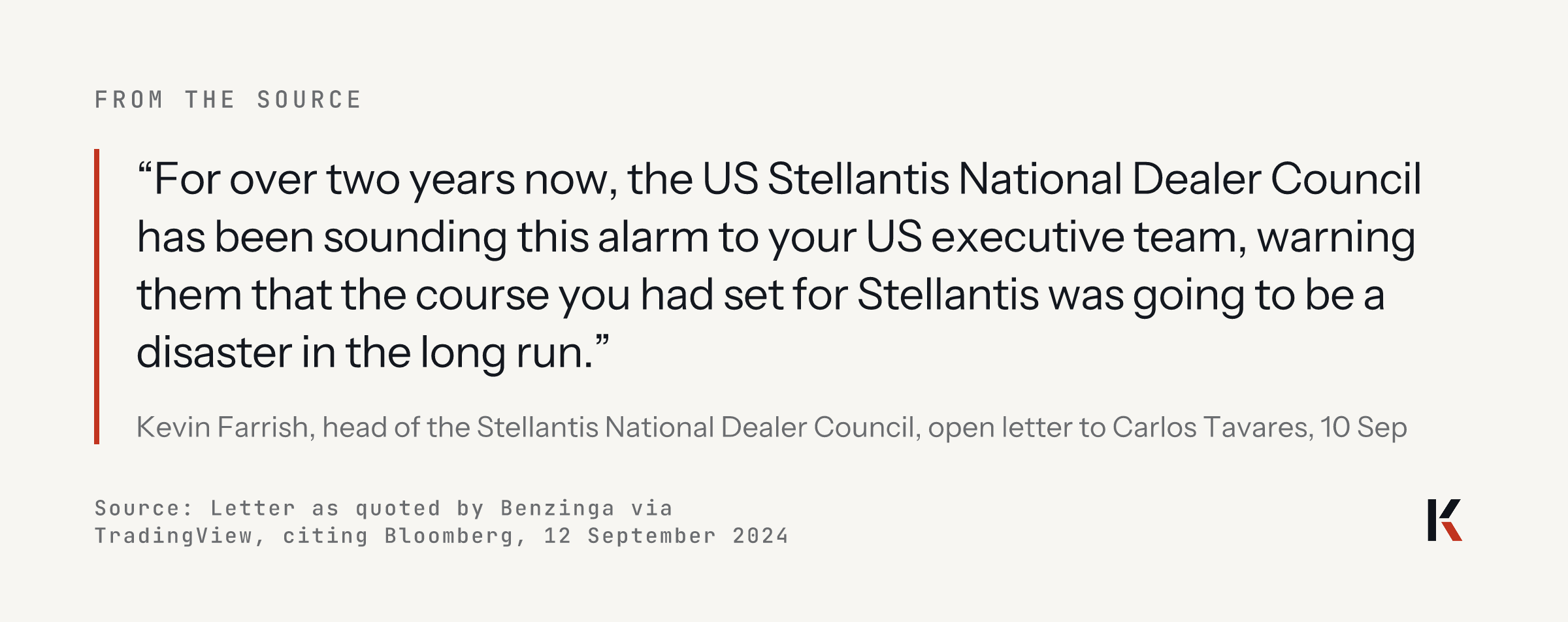
The letter said the council had been "sounding this alarm to your US executive team" for over two years. The course set for the company "was going to be a disaster in the long run", it said.
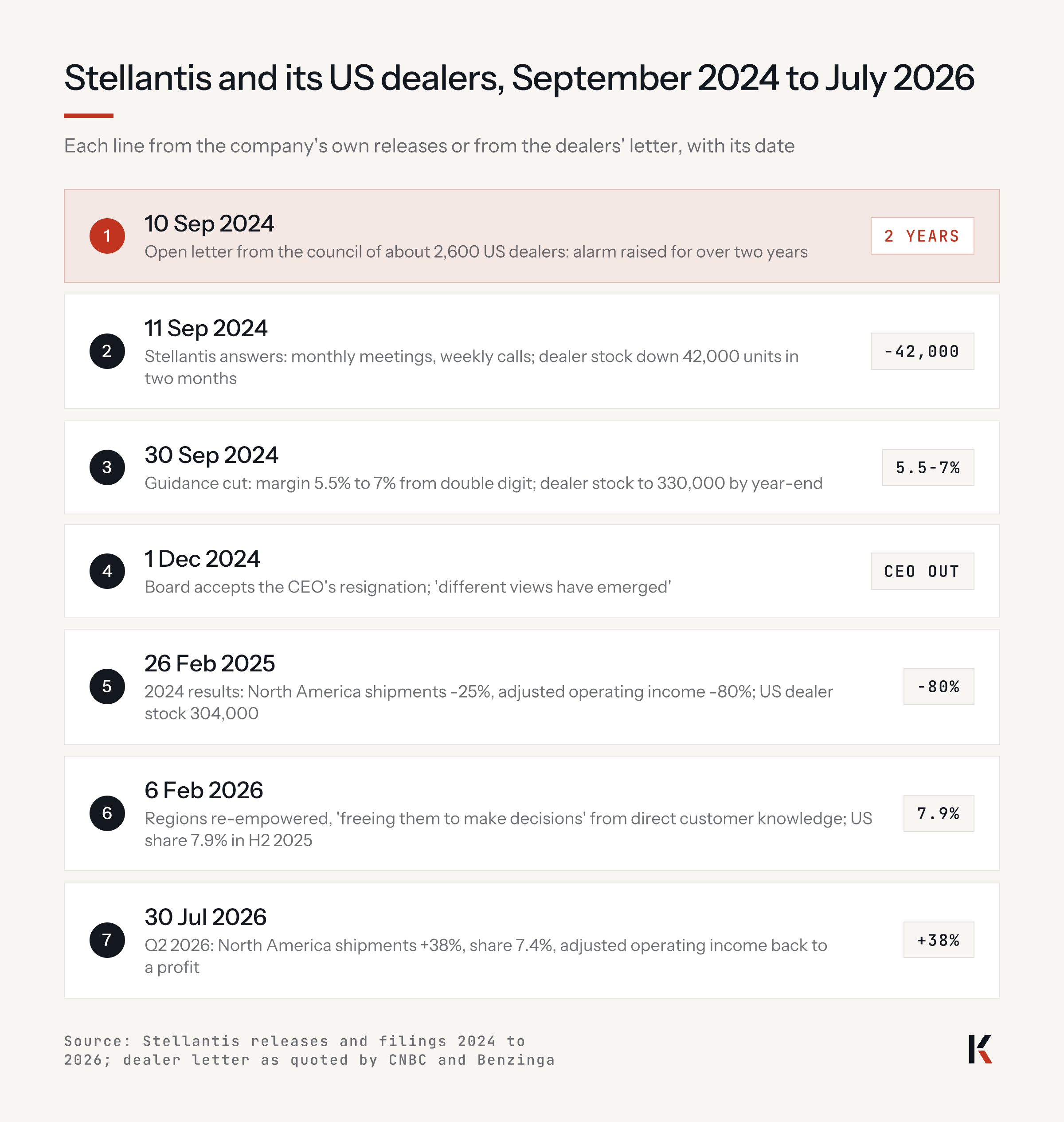
Stellantis answered on 11 September. It took "absolute exception" to the letter and said it meets dealers monthly and holds weekly calls.
An action plan developed with the dealers and introduced in August was already showing results, it said: sales up 21% on July, dealer stock down 42,000 units in two months.
The company says the channel existed. It took a public letter, a profit warning and a new chief executive before the course changed. I read this as a communication and coordination problem between head office and the people who sell. The information travelled; the decision did not.
The short version
Stellantis' US dealers said in September 2024 that they had warned the company's US executives for two years.
The company said it met them monthly and weekly; twenty days later it cut its guidance.
By February 2026 the company said its regions were free to decide from direct knowledge of their customers.
The warning travelled, the decision did not
The letter named "reckless short-term decision-making" and a "rapid degradation" of the Jeep, Dodge, Ram and Chrysler brands.
On 30 September, twenty days after the letter, Stellantis cut its guidance. The 2024 adjusted operating margin would be 5.5% to 7%; the earlier guidance said "double digit". About two-thirds of the cut came from corrective actions in North America.
The US dealer stock target of 330,000 units moved forward to the end of 2024. It had been set for the first quarter of 2025. Second-half shipments in North America would fall by more than 200,000 vehicles; the earlier plan said 100,000.
On 10 October Antonio Filosa became chief operating officer for North America. On 1 December the board accepted Tavares' resignation, citing "different views". Neither release mentions the dealers.
The 2024 results, published on 26 February 2025, gave the size of the correction. North America shipped 1,432,000 vehicles, down 25%. Adjusted operating income there was €2.7 billion, down 80%.
The same release listed "working together with our dealer bodies" and "empowering our regions to increase speed of decision-making". The company has not said what the regions could not decide before.
Filosa became chief executive on 23 June 2025; his appointment release lists "increasing dialogue with dealers, unions and suppliers" among his actions.
On 6 February 2026 the company described "the re-empowerment of regional teams, freeing them to make decisions based on their direct knowledge of the preferences of the customers they serve". US market share was 7.9% in the second half of 2025.
In the second quarter of 2026 North America shipments rose 38% and the region returned to an adjusted operating profit. Third-quarter shipments there fell 12%, the company said on 13 October 2026, on planned downtime.
Where a warning stops
Take one warning from your own field.
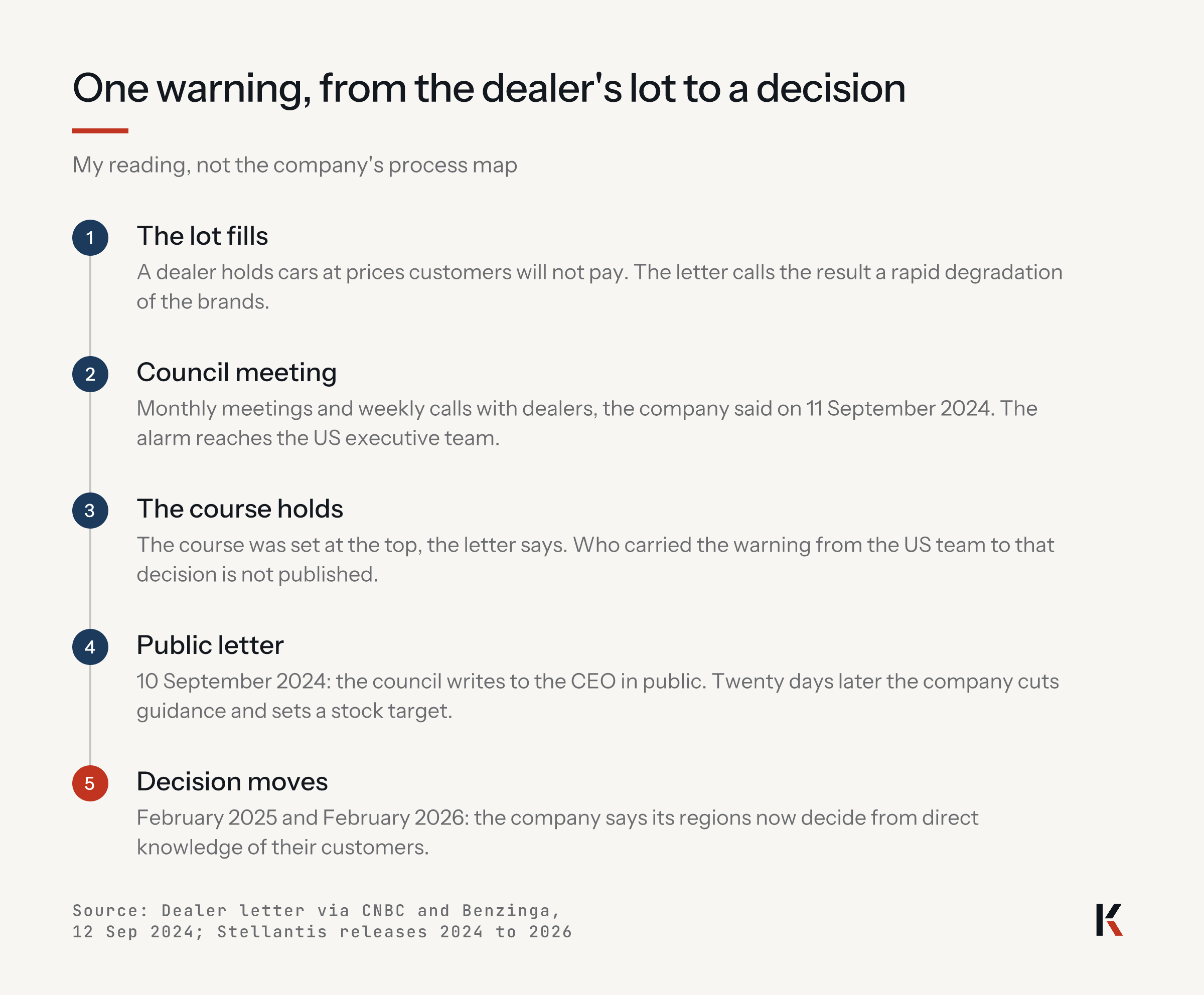
A dealer holds cars at prices customers will not pay; that is the letter's complaint, in my words.
It goes into the monthly meeting the company says it holds with its dealers.
From there, how it travels is my reading from outside; Stellantis has published no process.
The US team can carry the warning to the people who set volume and price. Or it can answer it where it stands, with incentives on the cars already built. The August 2024 plan did the second.
Each month without the first answer adds cars to the lot, and you pay for the lot later.
The 2025 annual report says so: increased dealer-owned inventories "impacted our vehicle pricing and profitability in 2024".
Multiply one dealer's month by 2,600 dealers and eight quarters.
The company's own repair says where the stop was. Decisions move "closer to our customers", the chairman said in February 2025. Product decisions sit "close to the regions", the June 2025 release said.
So the cause is coordination: a channel carried the message and no decision used it.
The symptoms are in people's work. An action plan with dealers in August 2024 was followed by a guidance cut in September; I read that as work done twice.
The second-half shipment cut doubled, from 100,000 to more than 200,000 vehicles. The North America chief and the finance chief were replaced on 10 October, and the chief executive resigned in December.
The bill is what did not happen: cars not sold at a price that held, a share point not kept. You price it at the margin it should have produced, never at anyone's salary.
The bill, in the company's own units
North America adjusted operating income fell 80% in 2024, to €2.7 billion from €13.3 billion. In the company's own table, that is a fall of €10.6 billion, or about €4.1 million per dealer.
Not all of it is communication: the company also names discontinued models, pricing and the market, and so would I.
Suppose one tenth of the fall is the price of changing course a year late. Incentives on old stock, plants stopped to clear it, a share point not recovered.
That is about €1.1 billion, or about €410,000 per dealer. In cars, roughly 24,000 vehicles at the region's 2024 revenue of about €44,000 each.
The tenth is my placeholder. The rest are Stellantis' numbers.
"Dealers always say prices are too high and stock too deep. That is bargaining." Perhaps, and Stellantis rejected the letter in September 2024. Within six months its own results release listed stock down, decisions to the regions and working together with the dealer bodies.
A channel works when a warning changes a decision.
What this does not establish
It does not show that the executives failed to hear the warning; the company says it met the dealers monthly and weekly.
It does not show that an earlier change would have saved the margin; products, pricing and the energy transition moved in the same years, and the company names them.
What would settle it is a count: the items the council raised, by date, and the decision each one changed. Stellantis has not published one, and I would not conclude without it.
Where Kihon stands
I read Stellantis' two years as the most expensive kind of communication problem: a meeting that produces no decision.
We count the distance between what your commercial team says in a review and what head office decides after it, in days and in margin.
When your leadership team has heard the same warning three times, the Executive Workshop puts it on one table in one session: the warning, the decision it should have changed, and the people who raised it. Thirty minutes on one warning of your own is where we would begin.
One thing to try this week
- List the three warnings your field has raised most often this year, with the date each was first raised.
- Write next to each the decision it changed and the date, and leave the line blank if none did.
- Price each blank line at the margin that quarter should have produced, and put it on the agenda.
Three questions to ask
Did the warning reach the person who decides?
Ask who carried it past the meeting. If nobody can name the desk, your channel ends at the minutes.
What did the channel change in the last year?
Count the decisions before you count the meetings. A channel is measured by what it changed.
Who tells the field what was decided?
Name one person who answers your field with the decision and the reason. Silence is read as a no, and the next warning arrives as a letter.
Sources
- CNBC, "UAW, U.S. dealers increase criticism of Stellantis CEO over cuts, sales declines", 12 September 2024
- Benzinga via TradingView, "Stellantis fires back at US dealer council's allegation of short-term decision-making", 12 September 2024
- Carscoops, "Stellantis dealers blast CEO for 'devastating' brand collapse, company fires back", 12 September 2024
- Stellantis, "Stellantis Updates 2024 Financial Guidance" (SEC Form 6-K), 30 September 2024
- Stellantis, leadership changes (SEC Form 6-K), 10 October 2024
- Stellantis, "Board Accepts Carlos Tavares' Resignation as Chief Executive Officer", 1 December 2024
- Stellantis, full year 2024 results (SEC Form 6-K), 26 February 2025
- Stellantis, "Antonio Filosa to be its new Chief Executive Officer" (SEC Form 6-K), 28 May 2025
- Stellantis, "Antonio Filosa announces new Stellantis Leadership Team" (SEC Form 6-K), 23 June 2025
- Stellantis, "Stellantis Resets its Business to Meet Customer Preferences" (SEC Form 6-K), 6 February 2026
- Stellantis, full year 2025 results (SEC Form 6-K), 26 February 2026
- Stellantis, Annual Report on Form 20-F for 2025, filed February 2026
- Stellantis, second quarter and first half 2026 results (SEC Form 6-K), 30 July 2026
- Stellantis, Q3 2026 estimated consolidated shipments (SEC Form 6-K), 13 October 2026
Your turn: which warning has your field raised three times this year without a decision changing? Write to me at cemgorer@kihonlabs.com, or answer on LinkedIn. I read every reply.