
322,000 hours of meetings, deleted. Nobody has said what filled them.
From the Fortune and NPR reporting and Shopify's own results, I read this through the hidden-cost lens.
Roland Busch, chief executive of Siemens, holds no recurring meetings with his direct reports. "You come to me whenever you need me," he told Business Insider, as Fortune reported on 17 August 2026. "It could be five times a week or once a month."
Adam Mosseri, the head of Instagram, went further in a memo that Business Insider obtained and published on 1 December 2025: "Every six months, we'll cancel all recurring meetings and only re-add the ones that are absolutely necessary."
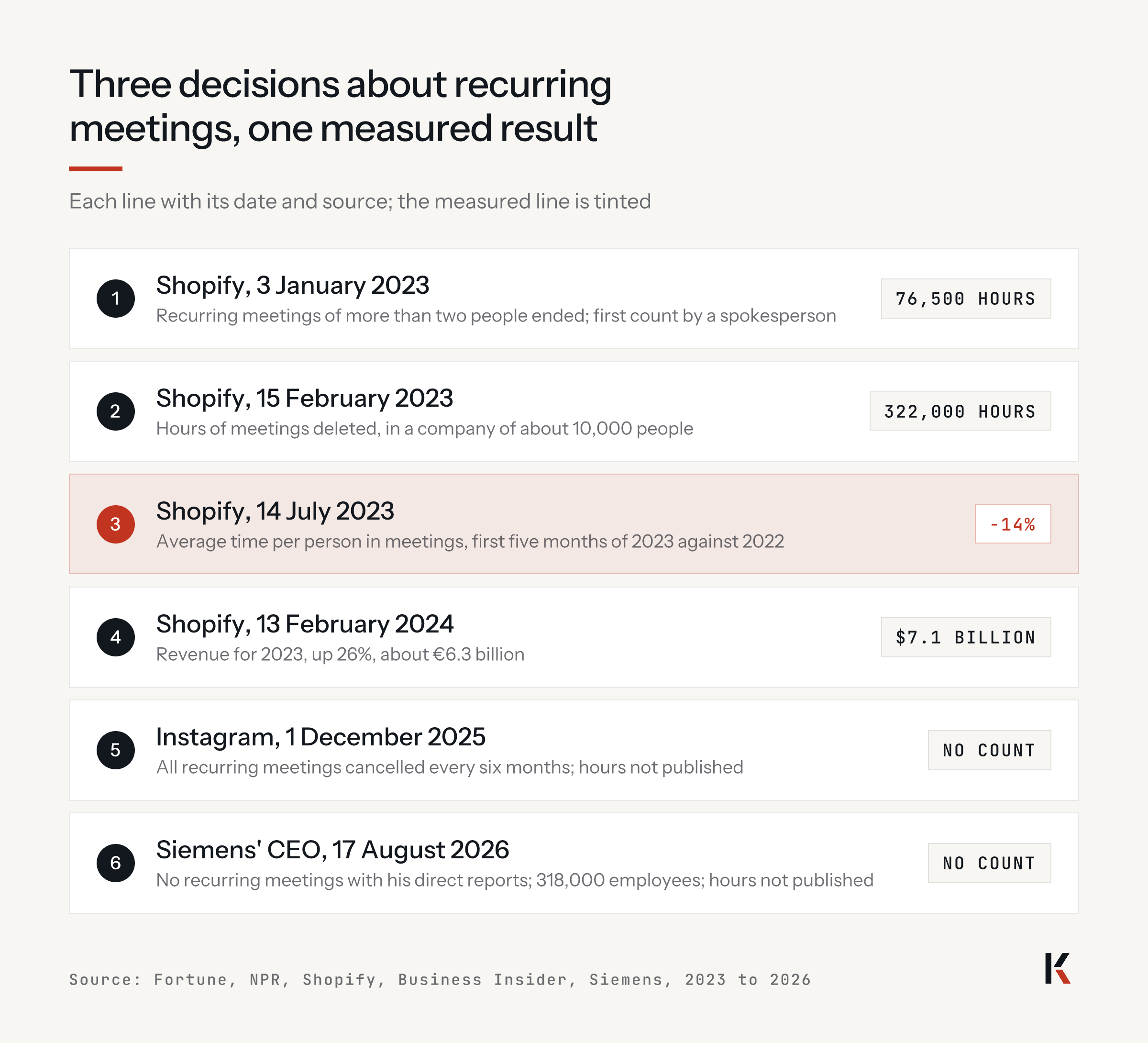
Shopify had done it first, and counted. On 3 January 2023 its operating chief, Kaz Nejatian, told employees by email that every recurring meeting with more than two people was ending, Fortune reported. A spokesperson put the first cut at 10,000 events and 76,500 hours.
Three leaders took the same decision about hours, and only one has published what the hours came to. Where a week goes, and who measures it, is a time-management question before it is anything else.
The short version
Shopify removed every recurring meeting of three or more people in January 2023 and later measured 14% less meeting time per person.
Instagram's memo of December 2025 promises the same cancellation every six months, and no hours have been published.
Siemens' CEO holds no recurring meetings with his direct reports; the habit is his own, and there is no count.
Shopify measured 14% less time in meetings
Shopify's rules were specific. Fortune's report of 3 January 2023 lists no events on Wednesdays, big meetings only on Thursdays, and a wait of at least two weeks before anything goes back. NPR reported on 15 February 2023 that a bot had purged the calendars of about 10,000 employees, all remote.
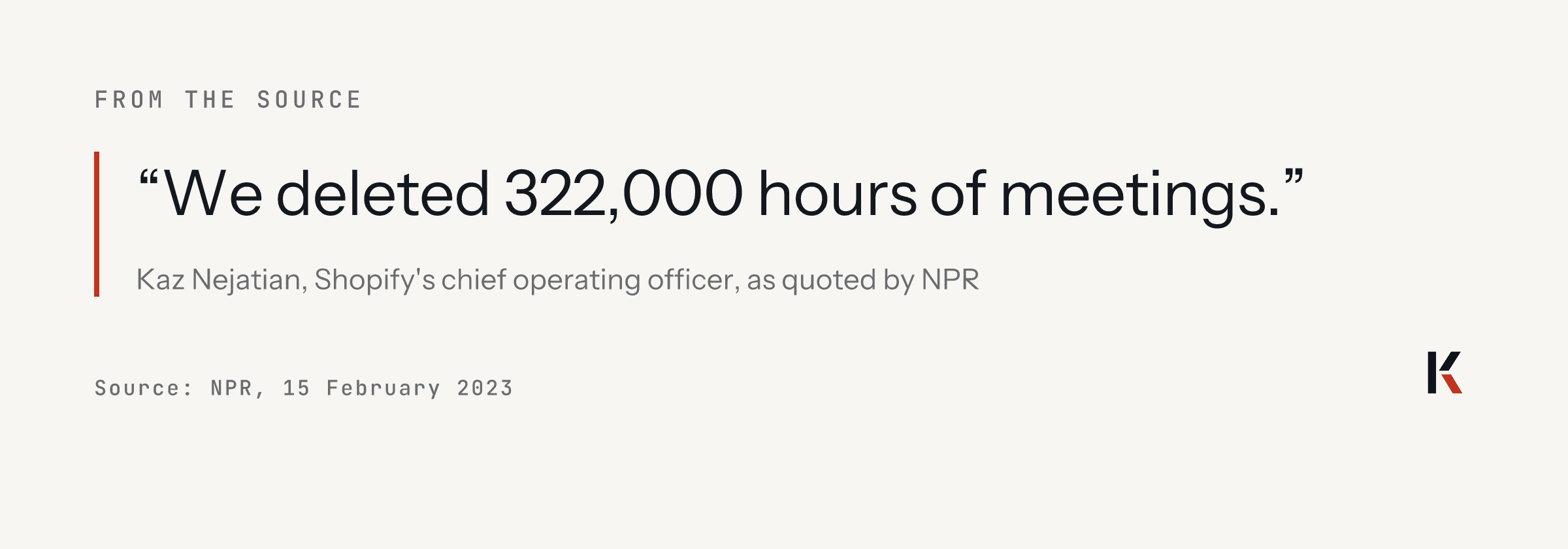
Six months later the finance chief, Jeff Hoffmeister, gave the count in a Fortune interview published on 14 July 2023: "At the start of 2023, we canceled 12,000 calendar series and events and reinstated 'no meeting Wednesdays.'"
The company projected 322,000 hours cut for the whole of 2023. Average time per person in meetings was down 14% in the first five months against 2022.
A calculator in the calendar prices a 30-minute meeting of three at $700 to $1,600, about €620 to €1,400. Shopify's 2023 revenue was $7.1 billion, about €6.3 billion, up 26%.
Since then, a letter of 4 May 2023 made the company smaller by about 20%, and Nejatian's move to run Opendoor was announced in September 2025. No later meeting count has been published.
Instagram and Siemens gave rules, not numbers
Instagram's memo, titled "Building a Winning Culture in 2026", gives rules and no numbers. Mosseri supports one-to-ones every two weeks by default, and staff may decline meetings in their focus blocks. The same memo calls US staff with assigned desks back to the office five days a week from 2 February 2026.
How many series were cancelled, and whether the first six-month reset has happened, is not published.
Busch's practice is personal. "Because I value efficiency, I don't have recurring meetings with my direct reports," he said. Siemens had 318,000 employees at 30 September 2025 and revenue of €78.9 billion in fiscal 2025, by its earnings release of 13 November 2025.
The release says nothing about meetings, and how far the habit reaches below the board is not stated.
Freed hours go somewhere, and nobody says where
Picture one weekly review in your own team: its length times the people in it, every week of the year.
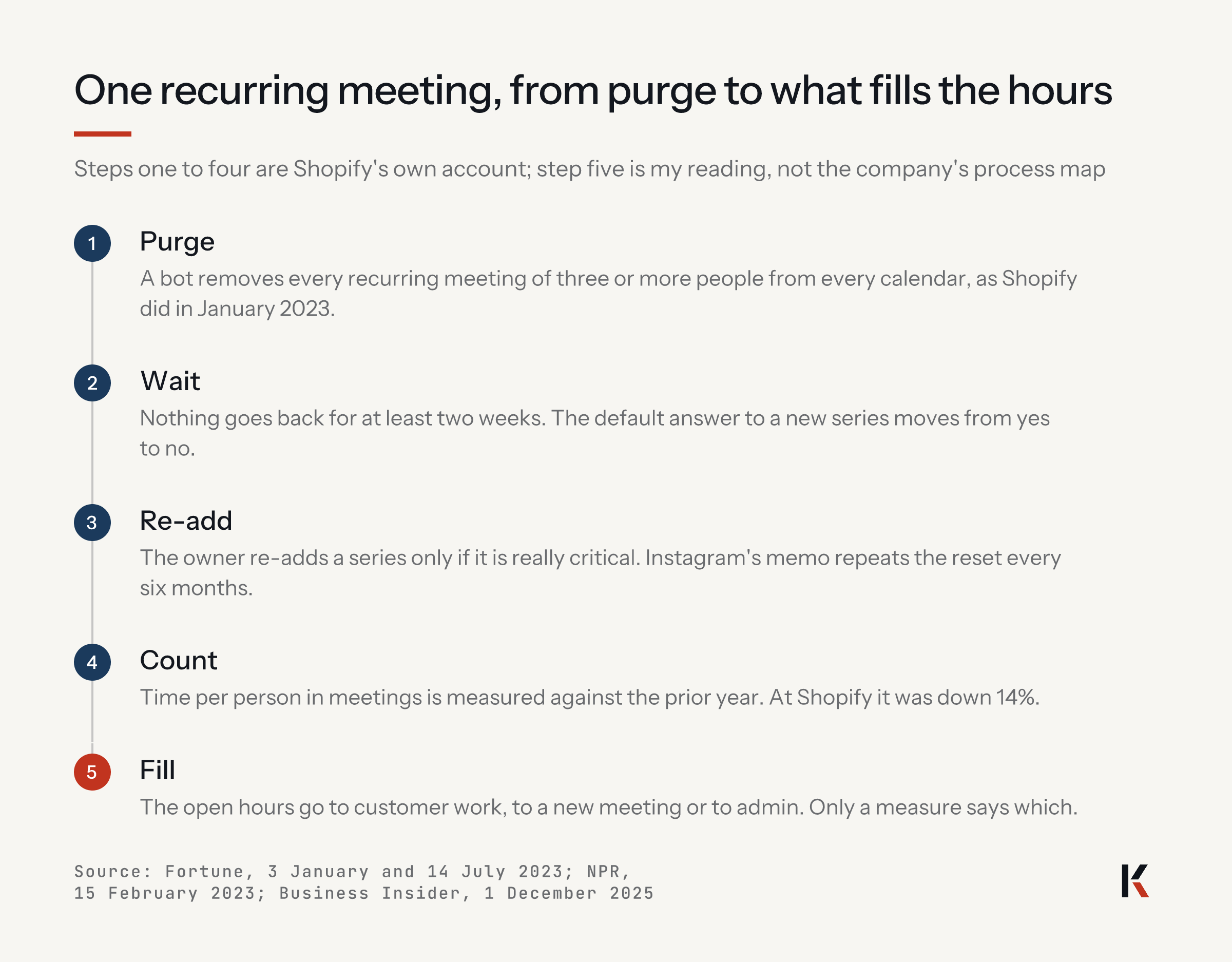
At Shopify the bot deleted it in January. The owner waited two weeks, then re-added it only if it was "really, really critical", as NPR reported employees were told. Nejatian's stated aim was to "change the default answer from yes to no".
Instagram's version repeats that reset every six months. Busch's version replaces the series with an open door.
In all three, the same thing happens next: the review's hours open up on every calendar it sat on.
From outside, I see three places those hours can go: to customer work, to a new meeting with a new name, or to mail and admin. None of the three companies has published which.
The hours taken out are on record. What filled them is in nobody's ledger.
Gartner research, reported by DestinationCRM on 10 July 2026, finds AI tools save sellers 4.8 hours a week, and 72% of sales organisations report low reinvestment of that time in high-value work. A freed hour and a saved hour behave the same way.
What decides the result is how your week is allotted, and who decides what a standing hour must produce. When nobody decides, two symptoms follow: hours in meetings that decide nothing, and work prepared twice for a deck.
The hidden cost sits in those hours: a renewal not called, a quote not sent. I price it at the margin the hour should have carried.
32 hours a person, and no word on where they went
Shopify's 322,000 hours across about 10,000 people is 32 hours per person a year.
Its 2023 gross profit was $3.5 billion, about €3.1 billion. Those 32 hours each came out of time that carries that margin. Every one that fills with a new meeting or mail is an hour freed and spent on nothing a customer pays for, and the Gartner pattern says many of them do.
You may object: "Those meetings did work; cancelling them costs more than it saves." Shopify measured: time per person fell 14%, and its finance chief said his own calendar shrank. The measurement answers the objection, and the purge alone would not have.
I would still not conclude that fewer recurring meetings raised output at any of the three. Nejatian projected 18% more finished projects for 2023, and Shopify has not reported whether that arrived; Instagram and Siemens have published no number at all. Meeting hours by role before and after a cut, and what filled the freed hours, read 90 days later, would answer it.
Of the three numbers, Shopify's 14% is the only one a CFO can use, and it leaves the more useful question open: what filled the hours? That is the question Kihon puts to a commercial team, pricing its hours at the margin they should carry and asking of each freed hour where it went.
The count, hours in recurring meetings by role and what fills the calendar after a cut, is what the Diagnosis does in your own numbers. The same count fits a commercial team of any size, and in a small one a single weekly review is a bigger share of the week.
If a calendar purge is on your list, thirty minutes on your own numbers is where we would begin.
Three laws to repeat.
- A freed hour is spent by default.
- A deleted hour is only half the change.
- Measure the fill, not only the cut.
To every CEO, CFO and CRO: ask which recurring meeting in your commercial team would come back first after a purge, and what it decides.
Measure before you cancel
- Count the hours each role in your commercial team spends in recurring internal meetings this week.
- Price those hours at the margin an hour of that role should carry, never at salary.
- Mark, ninety days after any cut, what filled the freed hours: customers, admin or new meetings.
What a CFO would ask before a calendar purge
Why cancel every series instead of trimming the list?
Because trimming leaves the default at yes. Shopify moved it to no with a two-week wait and let owners bring a series back only if it was critical.
What did Shopify's count show?
14% less time per person in meetings in the first five months of 2023, and about 26% less on Wednesdays. The 322,000 hours was a projection for the year, and I found no later result.
Should you copy Busch and drop your one-to-ones?
Only with a count. His practice covers his own direct reports and comes with an open door. Below the board, I would expect a cancelled one-to-one with no open door to become a lost handoff, and nothing in the sources prices that.
Sources
- Business Insider via AOL, Instagram chief Adam Mosseri orders staff back to the office five days a week in 2026, 1 December 2025
- Fortune, Siemens CEO Roland Busch on efficiency and no one-on-one meetings, 17 August 2026
- Fortune, Shopify CFO on the meeting cost calculator, 14 July 2023
- Fortune, Shopify is cutting meetings, 3 January 2023
- NPR via OPB, Shopify deleted 322,000 hours of meetings, 15 February 2023
- Fortune with Bloomberg, Shopify adopts meeting cost calculator, 12 July 2023
- Shopify, fourth-quarter and full-year 2023 financial results, 13 February 2024
- BetaKit, Shopify cuts 20 percent of staff, 4 May 2023
- The Globe and Mail, Shopify COO Kaz Nejatian's departure, 10 September 2025
- Fortune, Instagram CEO calls staff back to the office five days a week, 2 December 2025
- Entrepreneur, Siemens CEO Roland Busch responds to emails with two letters, 18 August 2026
- Siemens, earnings release Q4 and fiscal 2025, 13 November 2025
- DestinationCRM, AI saves sellers 5 hours per week, Gartner research, 10 July 2026
Your turn: when your commercial team last freed hours from its calendar, who measured what filled them? Write to me at cemgorer@kihonlabs.com, or answer on LinkedIn. I read every reply.