
Five regions, now four. Three leads, each with a second job.
From Porsche's press releases and its 2025 management report, I read this through the hidden-cost lens.
Robert Ader chairs Porsche Deutschland. Under a structure Porsche scheduled for 1 October, he also leads its Europe sales region, which now takes in Germany, the home market.
Porsche announced the change on 2 September. Five sales regions become four. Germany joins the Europe region. North, Central and South America become one region, the Americas.
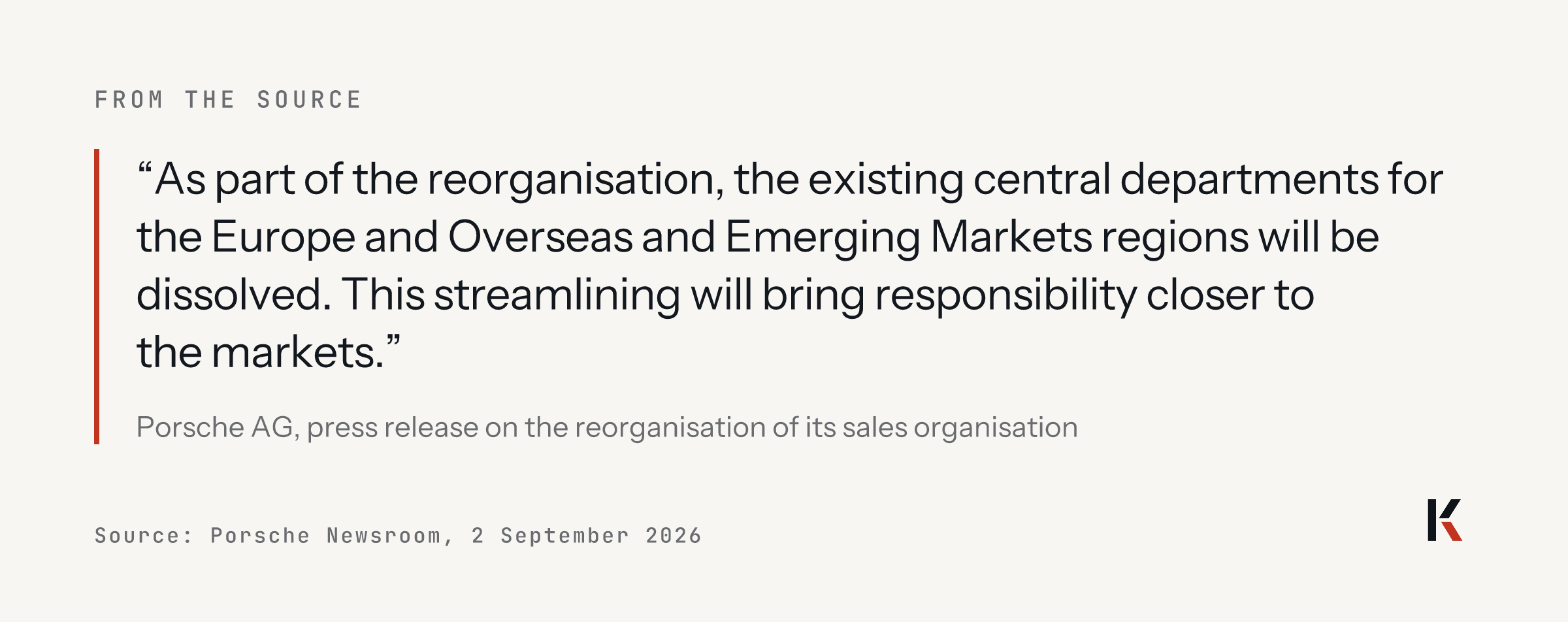
Two central departments, one for the Europe region and one for Overseas and Emerging Markets, are dissolved. Porsche says this brings responsibility closer to the markets.
Ader is one of three. Timo Resch runs Porsche Cars North America and leads the Americas. Mathias Busse runs Porsche Korea and leads Overseas. Three of the four regional leads also run one of Porsche's sales companies.
Porsche changed who leads each sales region, and it has not said which decisions moved with the change.
Who owns what, and where a market's question goes next, are the two questions of work organisation, and this reorganisation reopens both.
The short version
Porsche cuts five sales regions to four from 1 October and dissolves two central departments.
Three regional leads also run a sales company, and Porsche has not said how their weeks split.
The target, set on 7 October, is 20% off sales and distribution costs in the medium term.
Germany joins Europe; China stays alone
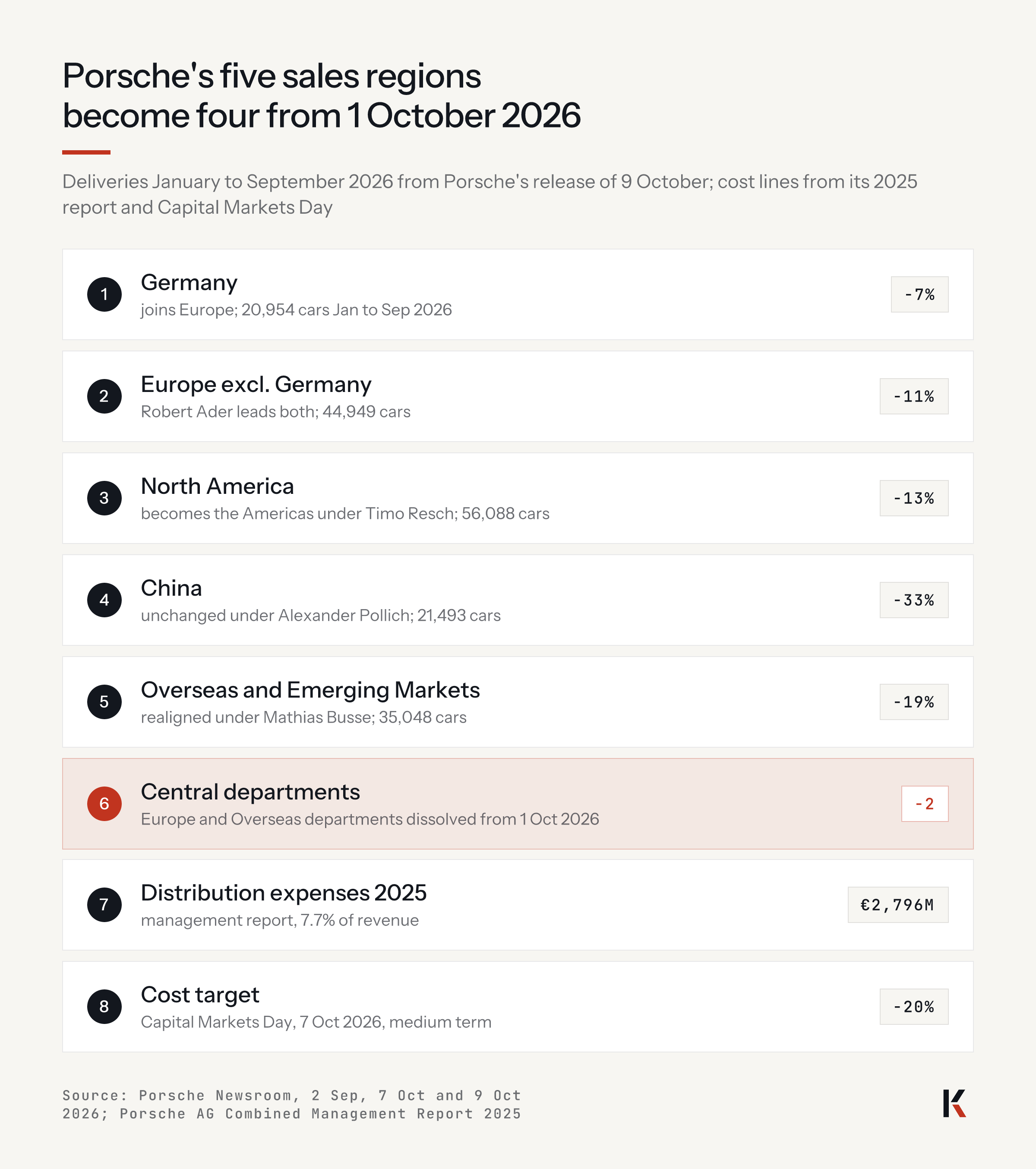
The before-state is in Porsche's 2025 management report, signed on 22 February 2026. It lists five regions: Germany, Europe without Germany, North America excluding Mexico, China including Hong Kong, and Overseas and Emerging Markets, "which includes the remaining countries and regions".
Germany joins Europe under Ader. North America becomes the Americas under Resch, with Central and South America added.
China stays as it is under Alexander Pollich. Overseas and Emerging Markets is realigned under Busse, with a focus on the Middle East and Asia.
Two vice presidents move. Christiane Zorn, Vice President of the Overseas and Emerging Markets region, goes to Volkswagen Group Africa on 1 October. Iryna Kauk, Vice President of the Europe region, becomes CEO of Porsche Schweiz on 1 January 2027.
Porsche does not say how many people worked in the two dissolved departments, or where their work goes. The release says the new structure is scheduled to take effect from 1 October; Porsche has published nothing since to say that it did.
Every region fell, China by a third
Porsche delivered 178,532 cars in the first nine months of 2026, down 16%, with China down 33%. Porsche puts the overall fall on a persistently challenging market and its value-oriented sales strategy, names the end of the 718 line among the reasons in North America and Overseas, and calls market conditions in China challenging.
On 7 October, at its Capital Markets Day, Porsche set a target of 20% lower sales and distribution costs in the medium term. It named "reducing the sales regions from five to four" as one lever.
A market's question now waits on a second job
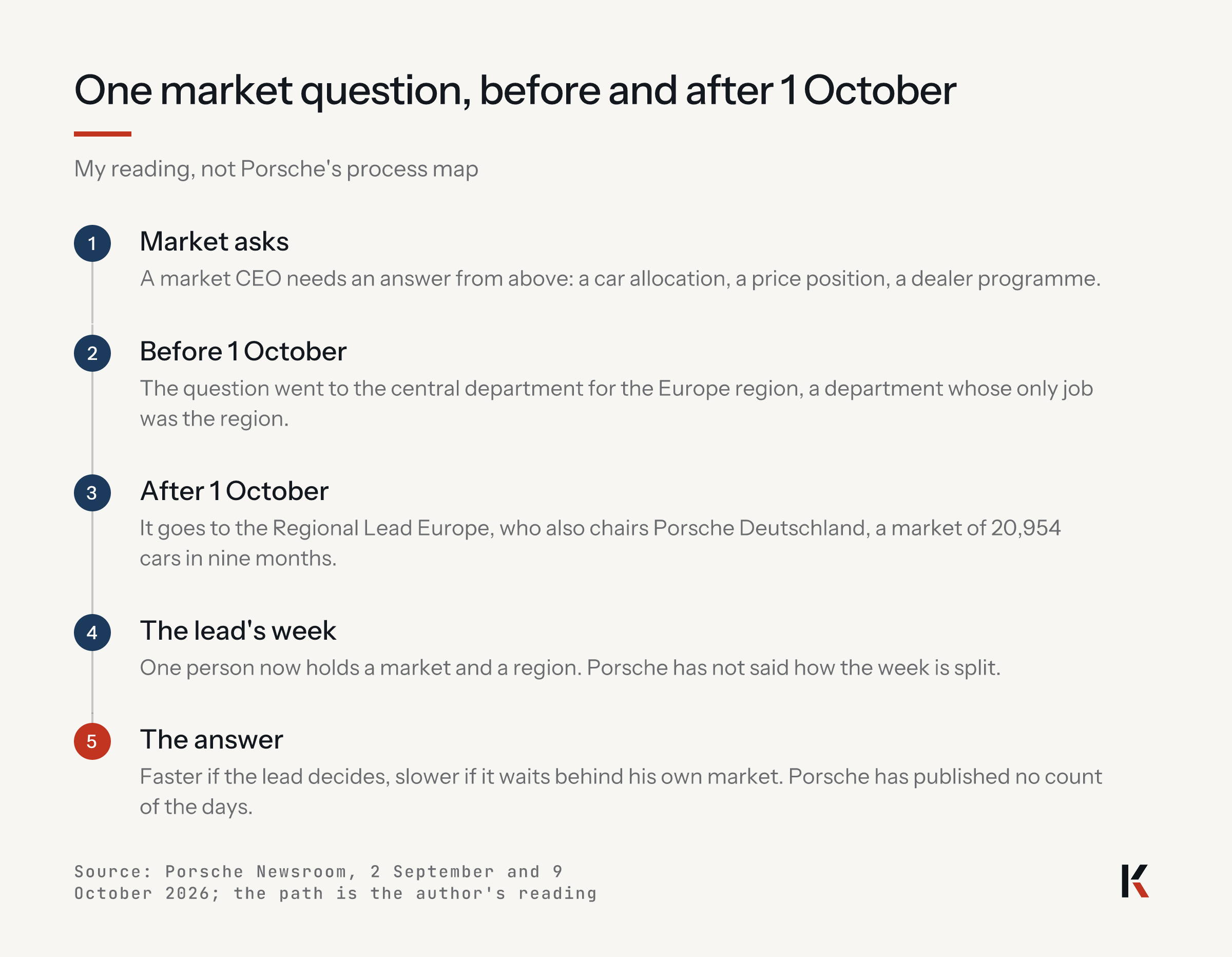
Picture a market CEO who needs an answer from above: a car allocation, a price position, a dealer programme.
Porsche has published no process, so the path that follows is my outside reading.
Before 1 October, a question from Porsche Schweiz went to the central department for the Europe region. That department had one job: the region.
After 1 October the question goes to Ader, who also chairs Porsche Deutschland, a market of 20,954 cars in nine months.
That is why the outcome can change. If the lead decides, the answer is one step shorter. If it waits behind his own market's week, it is slower.
Now multiply by every market in Europe, every market in the Americas, and Busse's region across the Middle East and Asia.
Two departments dissolved and three people given a second role on one date: that is a change in how the work is organised. You would see its symptoms as work done twice when a market asks two people, and as targets missed when an answer comes late.
The hidden cost is the cars not sold while your question waits, priced at the margin each should have carried. Add the growth a lead cannot plan because the second job took the hours.
A €560 million target, and the side nobody priced
Start with the saving Porsche names itself. Distribution expenses were €2,796 million in 2025, 7.7% of revenue.
Twenty per cent of that line is about €560 million a year, in the medium term.
Porsche sets a figure for the saving. Nobody books the car that waits for an answer.
Per car delivered in 2025, that is about €10,000 of distribution cost, so the target is about €2,000 per car. Porsche's 20% covers "sales and distribution costs"; whether that is the same line as the report's, Porsche does not say.
Now the side nobody has priced. Automotive revenue of €32,185 million over 279,449 cars is about €115,000 per car. Porsche delivered 178,532 cars in nine months.
Every order the new path wins or loses moves that side a car at a time, each one worth far more than the €2,000 of distribution cost the target takes out of it, and nobody has published a count of those cars.
Read from outside, this is a cost cut with an organisation chart attached. The chart came first, on 2 September, and the target five weeks later. Porsche's 20% rests on the levers it names: four regions instead of five, more cost-efficient sales processes, and efficiency gains in the distributor and sales organisation. Whether four leads answer faster than two departments did, nobody has published.
Two things are not shown. Porsche has published no measure of decision time, so "speeding up decision making" is a stated aim, and I would not read it as a result. Nor is there evidence yet that three people can hold a market and a region at once. Your own version of the test is a count: days from a market request to an answer, same decision types, the quarter before 1 October against the quarter after.
Every question that used to go to a central department now goes to a person who also runs a sales company, and Porsche has not published what that does to the days each answer takes. The handoff moved; the count of it is the work Kihon does: the decisions your markets wait on, the days each waits, and the hours the lead loses, priced at margin.
When a structure like this takes effect on a date, it is Kihon's Operation work: running your commercial system through the change with an owner and a day count for each decision type. The same question fits an industrial company of any size whose regional leads also run a market. Thirty minutes on your own decisions is where we would begin.
Three laws to repeat.
- A dissolved department leaves its decisions behind.
- A second job is paid in the first job's days.
- One lost car outweighs the saving on many.
To every CEO, CFO and CRO: ask each leader who holds two jobs which of them gets Monday morning.
Write the decisions down before the chart
- List the ten decisions your markets wait on most, and write the desk that answers each today.
- Count the days from request to answer for the last ten of each, before you redraw the chart.
- Write the weekly split for every leader who holds two jobs, and check it after ninety days.
After a change like this, the release names the lead, not the decisions. Ask for the list of decision types with a name next to each, and treat your chart as the cover page.
Porsche does not say what the two central departments actually decided, and most companies never write it down. Ask your markets which answers they used to get from that department, and where they get them now.
You will know decisions got faster only by counting days: ten requests before the change and ten after, same types, and the median of each. A stated aim gives you no measure.
Sources
- Porsche Newsroom, Reorganisation of Porsche sales for closer integration between regions and head office, 2 September 2026
- Porsche AG, Combined Management Report 2025 (Annual and Sustainability Report), 22 February 2026
- Porsche Newsroom, Porsche presents new strategy through to 2035 (Capital Markets Day), 7 October 2026
- Porsche Newsroom, Porsche delivers 178,532 cars worldwide in the first nine months of 2026, 9 October 2026
- Porsche Newsroom, Porsche delivers 279,449 sports cars to customers in 2025, 16 January 2026
- RTTNews, Porsche announces changes to organisation as part of restructuring of Sales and Marketing division, 3 September 2026
Your turn: when a market in your organisation needs an answer from head office, how many days does it wait, and who counts them? Write to me at cemgorer@kihonlabs.com, or answer on LinkedIn. I read every reply.