
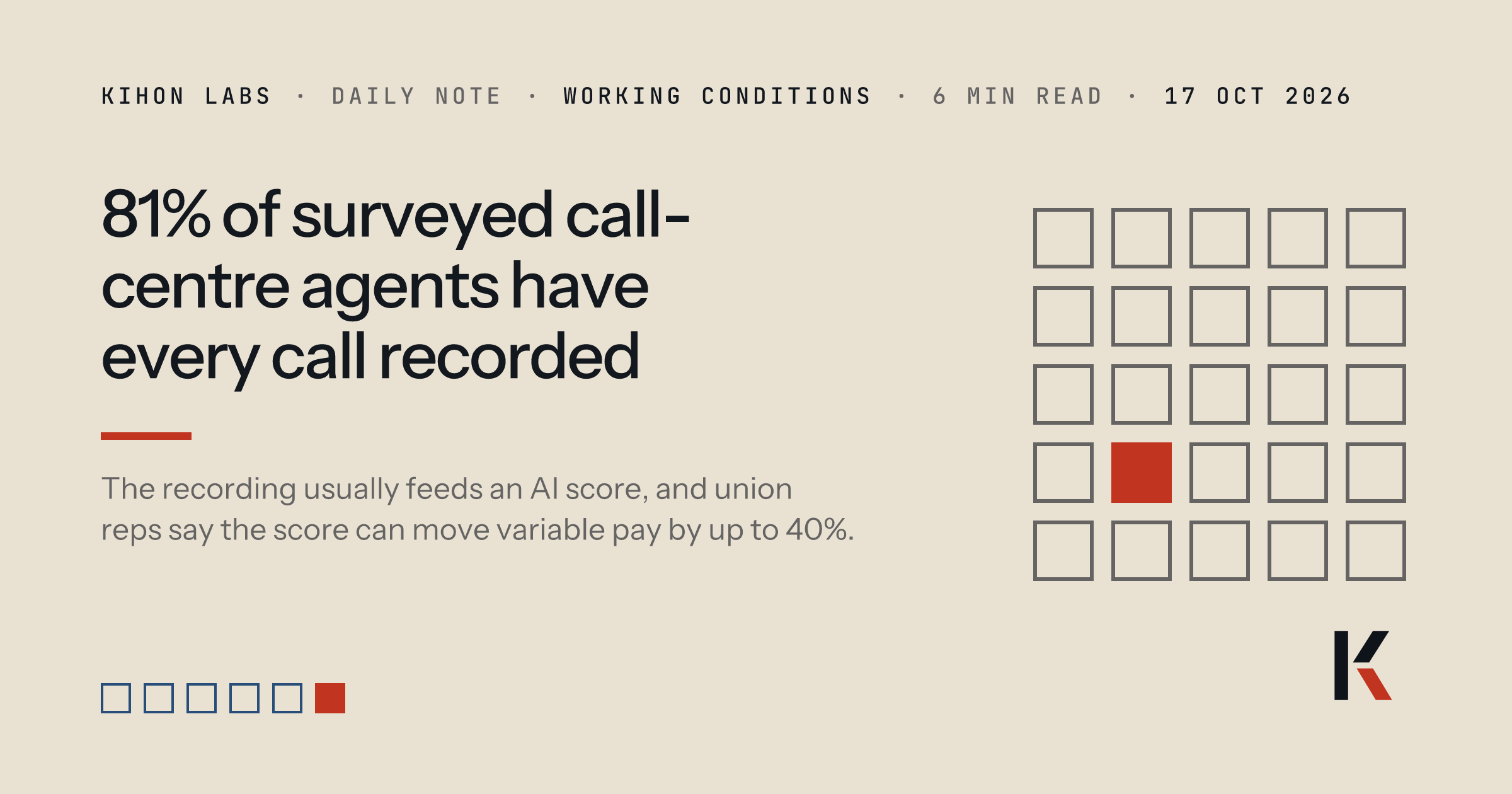
81.3% recorded. Up to 40% of variable pay on a rule the agent cannot see.
From an academic survey of UK call-centre agents, I read this through the hidden-cost lens.
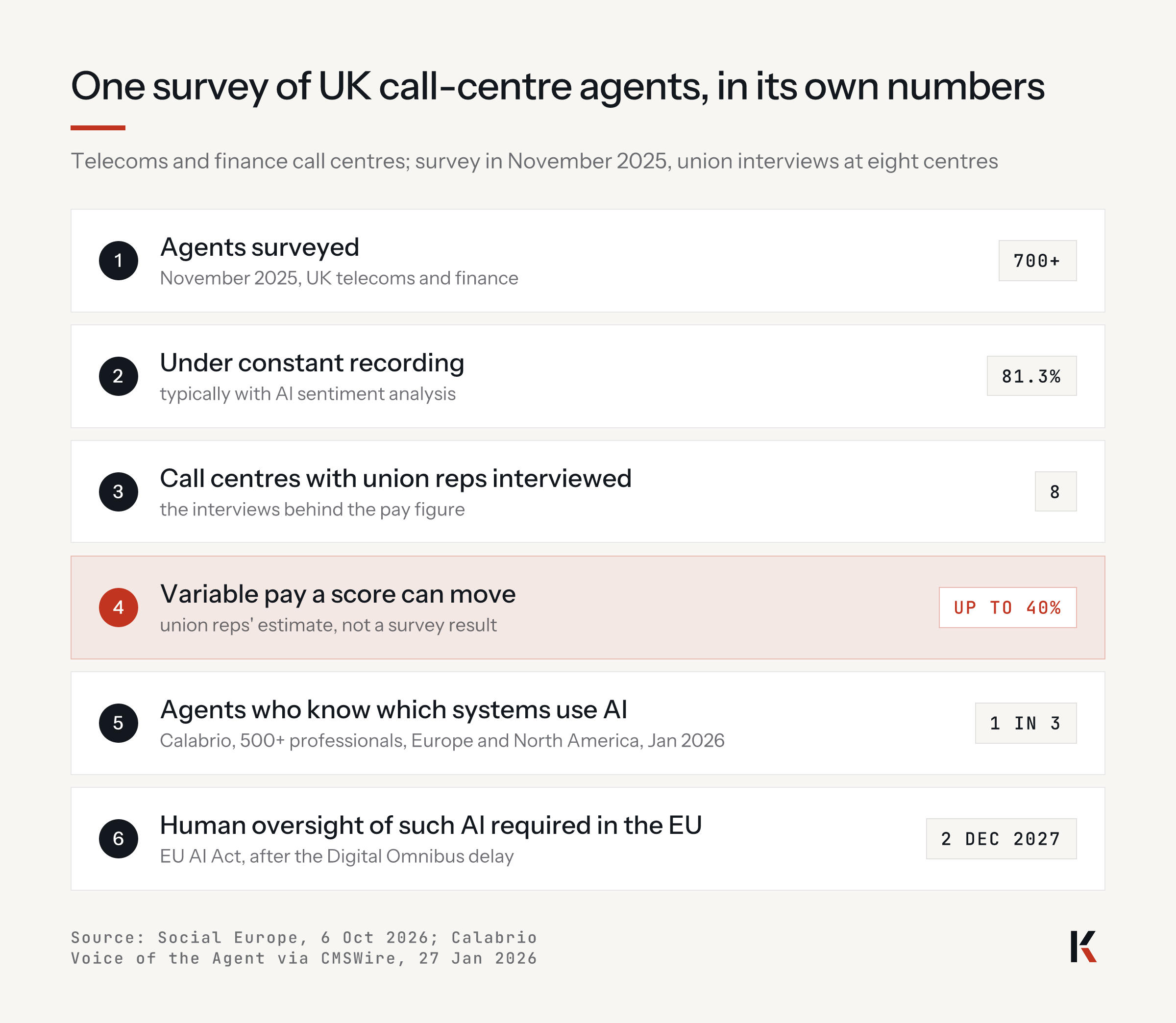
In November 2025 two researchers, Elisa Pannini of the University of Greenwich and Chiara Benassi of the University of Bologna, put a survey to more than 700 agents in UK call centres in the telecoms and finance sectors.
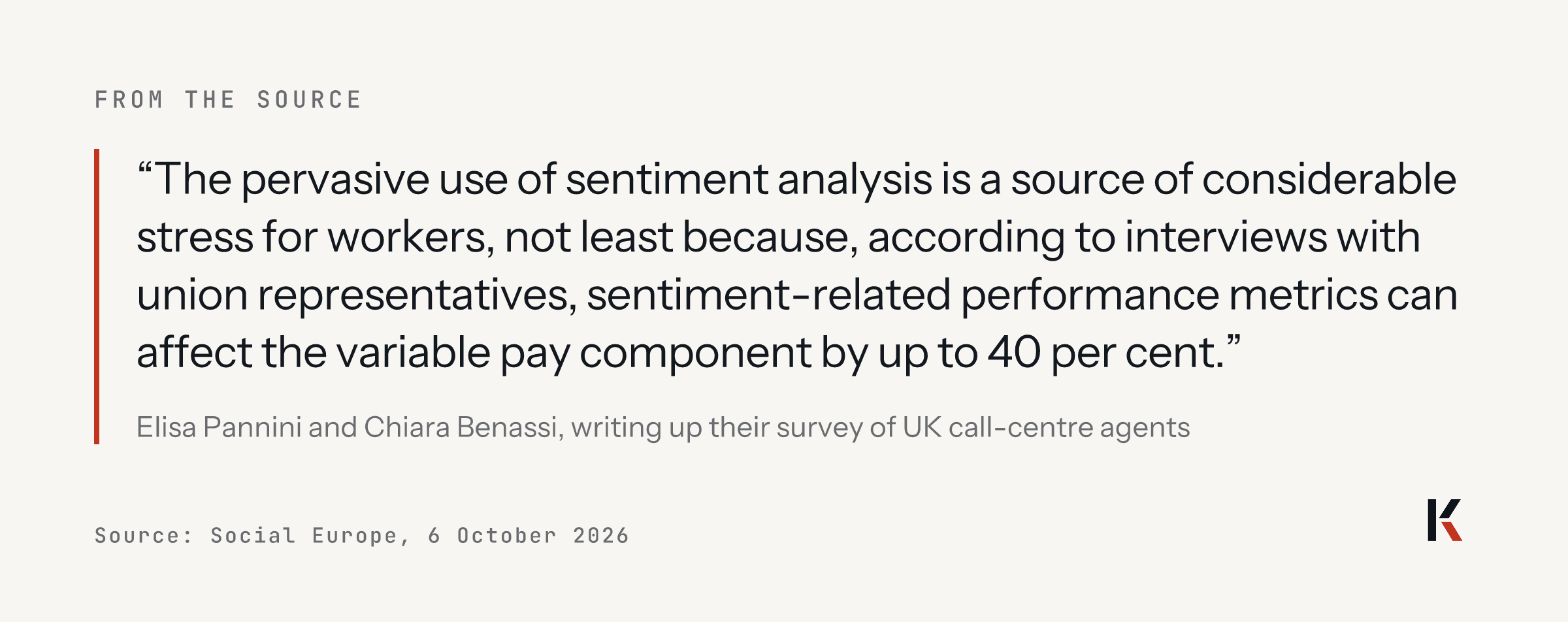
They published the findings in Social Europe on 6 October 2026.
81.3% of the agents work under constant voice recording.
The recording typically feeds sentiment analysis, which is software that gives each call a sentiment score.
Union representatives interviewed at eight call centres told the researchers that the score can move an agent's variable pay by up to 40%.
Some agents reported unexplained drops in their scores. The criteria are not visible to them.
The score decides part of the pay, and the people it scores cannot see the rule. The tool and the setting of the work changed, so this is a story about working conditions, and the study gives no number for what the change costs.
The short version
More than 700 UK call-centre agents were surveyed, and 81.3% work under constant recording, usually with AI sentiment scoring.
In interviews at eight centres, union representatives said the score can move variable pay by up to 40%, and agents cannot see the criteria.
The study gives no count of what an unexplained score costs in hours, in people who leave or in calls that end badly.
One number measured, one number told
The survey's one hard number is the 81.3% under constant recording, from more than 700 agents in two sectors.
The pay figure comes from interviews with union representatives at eight centres, and the researchers say so.
They add that the EU AI Act will require human oversight of such systems from 2 December 2027, a date the Digital Omnibus delayed.
The article names no company, no union and no call centre. It gives no count of leavers, no absence rate and no revenue or retention figure.
The study reports who is recorded. Nobody books the hours spent asking why a score fell.
The researchers report why the tools were introduced: to assess every call instead of a supervisor's sample, and to find training needs more easily.
One other count sits beside it. Calabrio, a contact-centre software vendor, surveyed more than 500 contact-centre professionals in Europe and North America. On 27 January 2026 it reported that only one in three agents knows which of their systems use AI, and 40% have had no related training.
A falling score with no reason attached
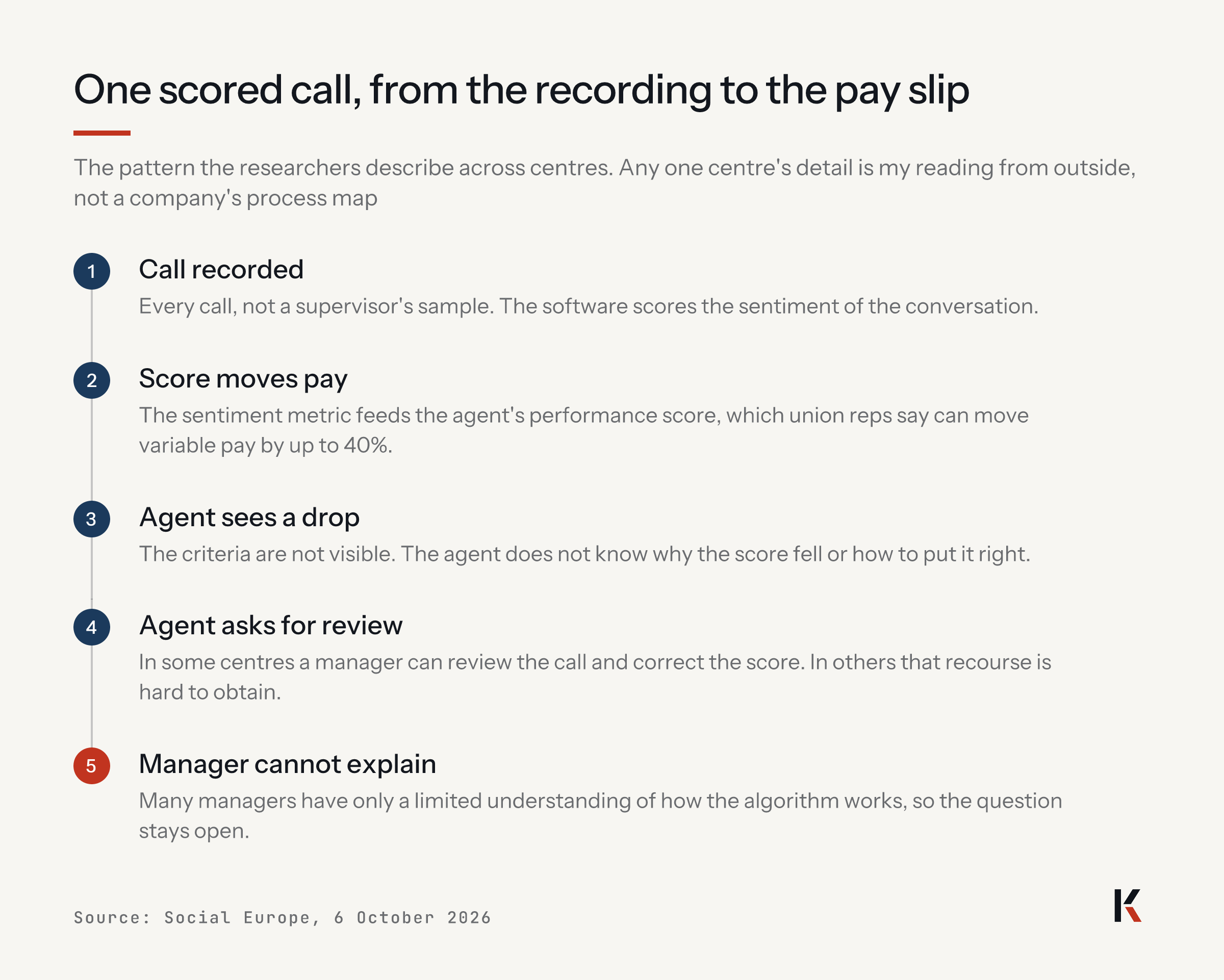
Follow one call. Before the software, a supervisor listened to a sample of an agent's calls and judged the agent's performance on them.
Now every call is recorded, and the software usually scores it.
The score feeds a performance metric, and union representatives say the metric feeds the variable pay.
When the score drops, the agent cannot see why it fell or how to put it right. In some centres a manager can review the call and correct the machine. In others that is hard to obtain.
Many managers, the researchers found, appear to have only a limited understanding of how the algorithm works.
The researchers describe a pattern, not one company's process, so how it fills a week in any one centre is my outside reading. The agent asks a team leader. The team leader reviews the call, or passes the question up.
The usual answer, the researchers write, is that only the technical content is analysed. Many of the union representatives they interviewed expressed doubts.
Now multiply by every agent whose score fell this month.
A tool that hears everything, with no visible rule, changes the conditions of the work itself.
The symptoms land in people's work: hours spent asking why, calls reviewed again by a manager, people who stay home on a bad week, people who leave.
Behind them sits a hidden cost: the cancellation an anxious agent did not fight to save, the renewal a tired team leader did not chase. I price those hours at the margin they should have produced.
The cost comes in pay, hours and leavers
The survey gives shares, not pounds. In a centre of your own, the cost comes in three units you can count.
The first is pay: the share of each agent's variable pay that hangs on a rule nobody can explain. The second is hours: the time agents spend asking about a score and team leaders spend reviewing calls again, every week. The third is people: the agents who leave over it.
The larger line has no number yet: the cancellation not saved by an agent watching their own tone instead of the customer.
You may say: "Scoring every call is fairer than a supervisor hearing three of them." That is the reason the researchers report: a more consistent and objective assessment. They found that a manager's ability to correct the machine was a key factor in how fair agents felt it was.
It is tempting to conclude that the scores are wrong, or that they drive people out. The study shows neither. It records stress, unexplained drops and hidden criteria in two UK sectors, and the 40% is an estimate from union representatives. One centre's own count would go further: score disputes a month, hours spent on them, absences and leavers in the year before the tool and the year after.
A score that moves pay and cannot be explained reaches your P&L through the hours and the people it costs. Kihon counts exactly that: the tools that score your customer-facing people, the share of pay each moves, the hours spent on disputes, and the leavers, priced at margin.
The Diagnosis does that count in your own numbers, for a large contact centre or a small customer success team. The centres in this study are in telecoms and financial services, where the customer's call is the revenue. If a scoring tool is on your roadmap, thirty minutes on your own numbers is where we would begin.
Three laws to repeat.
- A score that moves pay owes the scored person its rule.
- Every unexplained drop is paid for in team leaders' hours.
- An agent watching their own tone has stopped watching the customer.
To every CEO, CFO and CRO: ask how many of your managers could explain one agent's falling score today.
Ask the scored people to explain their score
- List every tool that scores a customer-facing person, with the metric and the share of pay it moves.
- Ask ten scored people to explain how their score is calculated, and count how many can.
- Count the hours agents and managers spent on score disputes last month, and price them at margin.
Is scoring every call fairer than sampling? Only if the person scored can see the rule and challenge the result. Where a manager could correct the machine, agents felt less negative about the tool.
To find what an unexplained score costs you, count the hours first: disputes, calls reviewed again, reassurance meetings. Then compare leavers in your scored teams with the others, and price both at margin.
Before a scoring tool goes in, ask the people it will score, and do it before you sign the contract. In the centres studied, consultation often came after the decision was made.
Sources
- Social Europe, Elisa Pannini and Chiara Benassi, "AI Now Scores Every Call, and Workers Cannot See the Rules", 6 October 2026
- CMSWire, Calabrio press release, "Voice of the Agent" report, 27 January 2026
- IT Brief UK, "Contact centres report rising morale but AI doubts grow", 30 January 2026
- European Central Bank, euro foreign exchange reference rates, 16 October 2026
Your turn: which score moves pay in your customer-facing teams, and can the people it scores explain it? Write to me at cemgorer@kihonlabs.com, or answer on LinkedIn. I read every reply.