
Barcelona, 25 October.
On 1 February 2022, Okta joined two sales teams into one. The sentence that told a rep which product to lead with came in August, six months later.
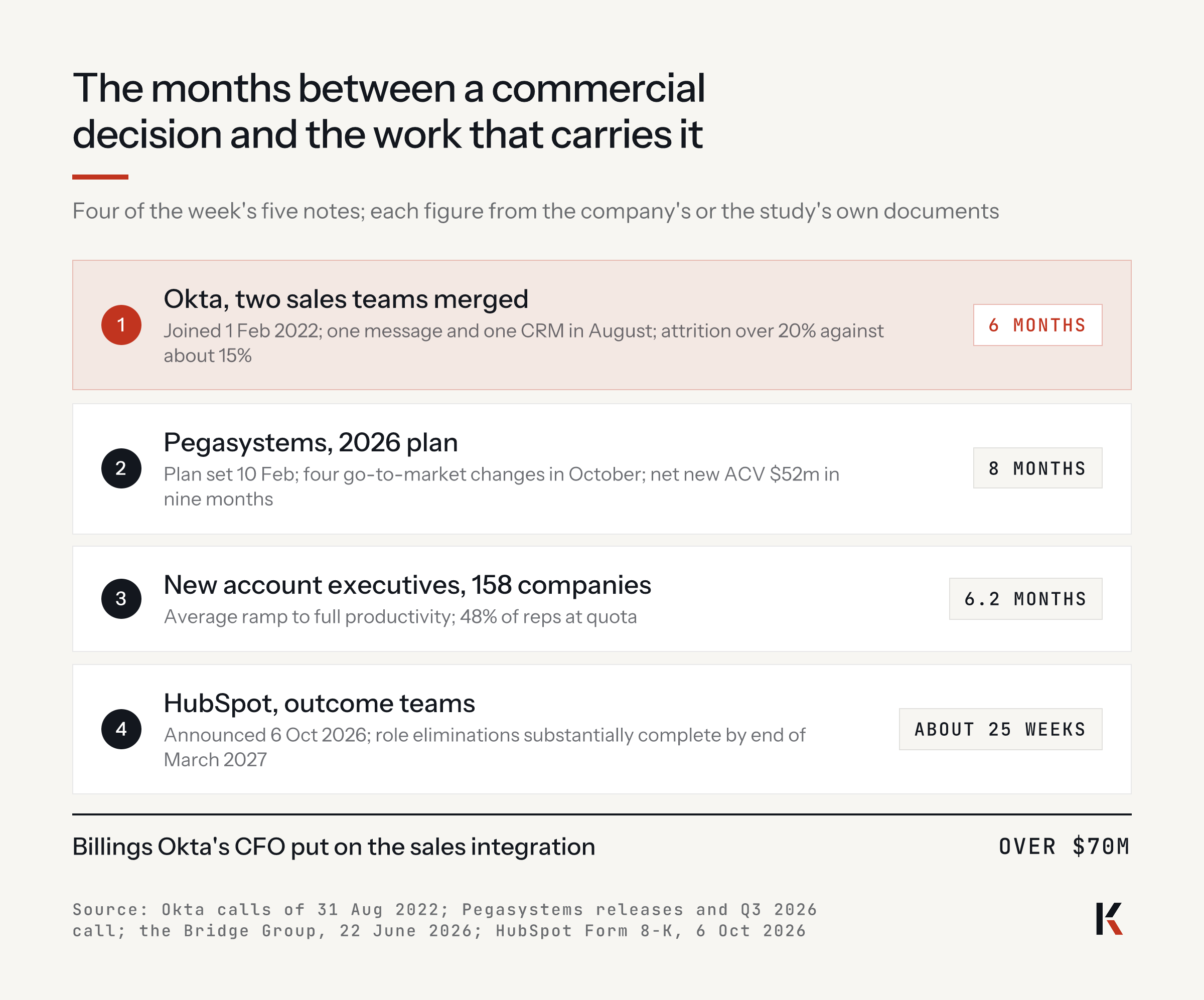
This week the same gap appeared four times. Pegasystems set its growth plan on 10 February and changed the model meant to carry it in October. Across 158 B2B companies, a new account executive needs 6.2 months to reach full productivity.
In four of the week's five notes, a commercial decision has one date, and the work of carrying it to the customer runs about six months or more.
I read the week through the socio-economic approach, SEAM, developed by Henri Savall and the ISEOR team in Lyon: five of its six lenses, from time to training. Saturday had no note.
The short version
Okta needed six months to give its merged teams one message; Pegasystems changed its operating model eight months after its plan.
A new account executive takes 6.2 months on average to reach full productivity, while companies ask a year more experience at hire.
Okta's CFO put over half of a $140 million cut to the billings outlook, about €120 million, on the sales integration.
The week in five
Monday, time management: "Anthropic's median employee spends 20% more time in meetings". After AI agents took over drafting, the company counted more reading, more instructing of agents, and more meetings. Read Monday's note
Tuesday, work organisation: "HubSpot cuts 660 roles; product teams will own outcomes". Product teams move from six Hubs to four customer outcomes; role eliminations are substantially complete by the end of March 2027. Read Tuesday's note
Wednesday, communication, coordination and cooperation: "Okta merged two sales teams; confusion lasted six months". Teams joined in February 2022; one message and one CRM came in August; attrition passed 20%. Read Wednesday's note
Thursday, strategy implementation: "Pega planned 15% growth; it expects 10% at most". The plan dates from February; in October the company named its own go-to-market execution. Read Thursday's note
Friday, integrated training: "Account executives ramp in 6.2 months; companies buy experience". Companies ask 3.7 years of experience at hire, and ramp is still the longest the study has measured since 2006. Read Friday's note
The week's teardown
Thursday's Pegasystems note was the teardown. Everyone reports growth in annual contract value (ACV): 15% planned, at most 10% expected.
Nobody books the ACV the plan counted and 2026 will not add: $80 million to $128 million, about €71 million to €110 million, my arithmetic on Pega's numbers. Read the teardown
What the five show together
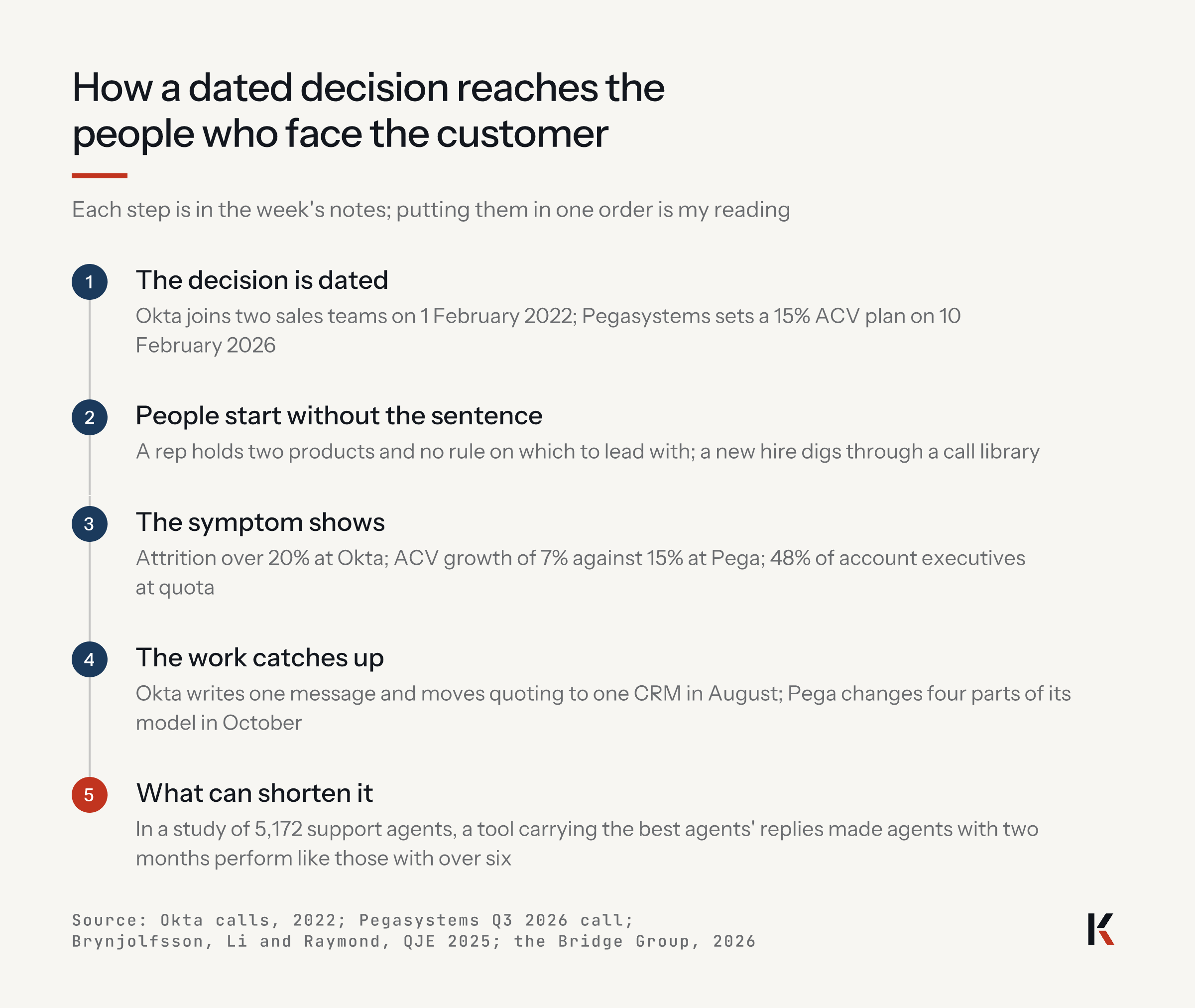
One question ran through the week: how long until a decision reaches the customer?
About six months, in four notes from four companies or studies.
Okta is the clearest case. The teams were joined on 1 February 2022.
Pricing and quoting moved into one CRM in August, with the rule on which product a rep leads with. By August, attrition was a little over 20% against a usual 15%, and higher in the former Auth0 team.
We put sales reps in a tough spot before we clarified the positioning around customer identity. Todd McKinnon, Okta, as reported by BankInfoSecurity, 2022
That reached revenue directly. The CFO lowered the billings outlook by about $140 million and put over half of it on the sales integration.
Pegasystems took longer. The plan of 10 February asked for 15% ACV growth.
Eight months later the CEO said "our execution this year has not kept up", and the company moved commercial authority closer to the market.
Pega says win rates held; it names longer sales cycles and customer deployment challenges. The CFO expects "a quarter or two of change management" more.
The new account executive is the same gap in one person. The hire is decided on one day; full productivity comes 6.2 months later on average.
Companies asked for 3.7 years of experience, up from 2.7 in 2022, and ramp is still the longest the Bridge Group has measured.
On a $960,000 median quota, that is $496,000 of quota below full rate per hire, my arithmetic.
HubSpot's months are still ahead. The memo of 6 October redraws product teams around four outcomes, one of them "win deals". Role eliminations are to be substantially complete by the end of March 2027, about 25 weeks away, and the filing names customer relationships as a risk.
Monday stands apart. Anthropic's report shows where hours went after a tool arrived, not how long a change took. For a chief commercial officer, I read one lesson in it: freed hours are not capacity until someone counts where they went.
I read coordination as the lens that carried the week: in three of the four cases, what came late was something written down and shared.
Okta lacked one sentence for the rep. Pega put all marketing under one leader for "one clear and differentiated Pega story". On Friday's reading, the new hire lacks the best rep's answers.
The symptoms kept returning as work that does not produce: a target missed, 48% of reps at quota, people leaving. The bill pointed one way: revenue not won while people learned the new way, in billings at Okta, in ACV at Pega, in quota for each new hire.
"Every change has a dip; six months is normal." Normal is not free: at Okta, it was over half of a $140 million cut to the billings outlook.
Three laws from this week:
A merger date without a message date is half a plan.
Experience hired is not knowledge shared.
Six months of ramp is half a year of quota.
To every CEO, CFO and CRO: ask how many months your last decision took to reach the person who talks to your customer.
You may conclude that a change fails without a message on day one. The notes do not go that far.
Okta also names a hiring plan it calls a mistake and a weaker economy. Pega names clients who check large spending more closely. HubSpot's months have not happened yet.
A count of months to full rate by team, before and after a change, beside the day each team got its sentence, would settle it.
I read this week as one gap seen four times: the distance between the day a decision is made and the day the people facing the customer can act on it.
This is the distance we count at Kihon, in months by team, priced at the margin those months should have carried.
The Executive Workshop puts a leadership team's next decision on one table, with the date each team gets its sentence, before the decision is announced.
If a change is planned for your first quarter, thirty minutes on your own numbers is a fair place to start.
Give the sentence a date too
- Write your last commercial decision's date beside the date each team acted on it.
- Write the sentence each customer-facing role needs before announcing the next change.
- Count months to full rate by hiring cohort, and report them with the plan.
What a CFO should ask the CRO
How many months did our last change take?
Nobody knows unless someone dated both ends. Take the decision date and the first full quarter at plan for the team that carried it.
Who wrote the sentence our people now repeat?
It should be a named person, on a named day. At Okta that sentence came six months after the teams were joined.
What did the months in between cost?
Count the revenue those months should have carried, at margin, not the salaries paid through them. A new hire on the median quota is $80,000 of quota a month.
Sources
- The Motley Fool, Okta Q2 fiscal 2023 earnings call transcript, 31 August 2022
- BankInfoSecurity, Okta clears up customer identity confusion as SMB sales dip, 30 November 2022
- Pegasystems, Q4 2025 release with 2026 guidance, 10 February 2026
- Pegasystems, Q3 2026 release with financial schedules, 20 October 2026
- The Motley Fool, Pegasystems Q3 2026 earnings call transcript, 21 October 2026
- The Bridge Group, AE Models, Motions & Metrics: 2026 Research Report, 22 June 2026
- Brynjolfsson, Li and Raymond, Generative AI at Work, The Quarterly Journal of Economics, 2025
- HubSpot, Form 8-K, 6 October 2026
- HubSpot, Exhibit 99.1, update to employees from Yamini Rangan, 6 October 2026
- Anthropic, How employment is changing at Anthropic, 16 October 2026
- Each note lists its own sources in full.
Your turn: on what date was your last commercial decision made, and on what date did the person facing your customer first act on it? Reply to this email, or write to cemgorer@kihonlabs.com. I read every reply. If your CFO or CRO should see this, forward it.