
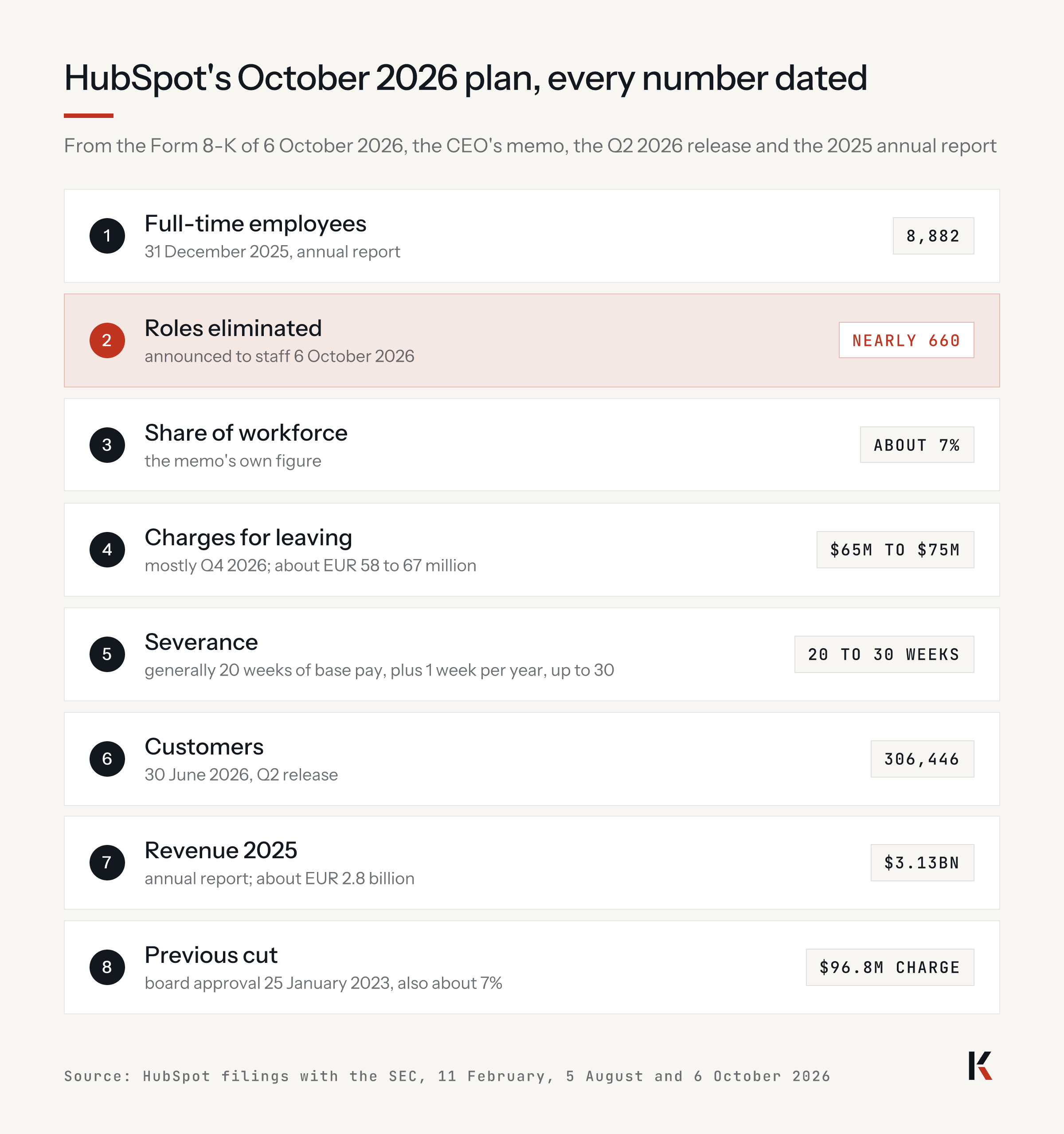
On Tuesday 6 October 2026, HubSpot's chief executive, Yamini Rangan, wrote to the company's staff. Nearly 660 people, about 7% of the workforce, would leave.
The board had approved the plan on 1 October.
The memo opens with the cut and then lists three changes to how the company operates. Product teams will no longer be built around Hubs, the six product lines in the annual report.
Each team will own the full customer journey for its outcome, and there will be fewer management layers.
HubSpot is replacing product teams built around Hubs with teams built around customer outcomes, and it says the 660 roles were the result of that design, not its starting point.
I read it as the clearest public example this autumn of a work-organisation problem: who owns what, in a company of 8,882 people at the end of 2025.
The short version
HubSpot said on 6 October that nearly 660 roles go, about 7% of staff, and that product teams will be organised around four customer outcomes instead of Hubs.
The filing puts the cost of the departures at $65 million to $75 million and gives no number for the reorganisation itself.
Which teams lose people, and whether sales and customer success are organised the same way, is not stated.
Six Hubs become four outcomes
The annual report of 11 February 2026 gives the company before the change. HubSpot had 8,882 full-time employees on 31 December 2025: 5,724 in the Americas, 2,480 in Europe and 678 in Asia Pacific.
Revenue in 2025 was $3.13 billion, about €2.8 billion, from 288,706 customers.
The report names six Hubs as products: Marketing, Sales, Service, Content, Operations and Commerce. It does not say how the teams behind them were organised. The memo supplies that in two words: "instead of hubs".
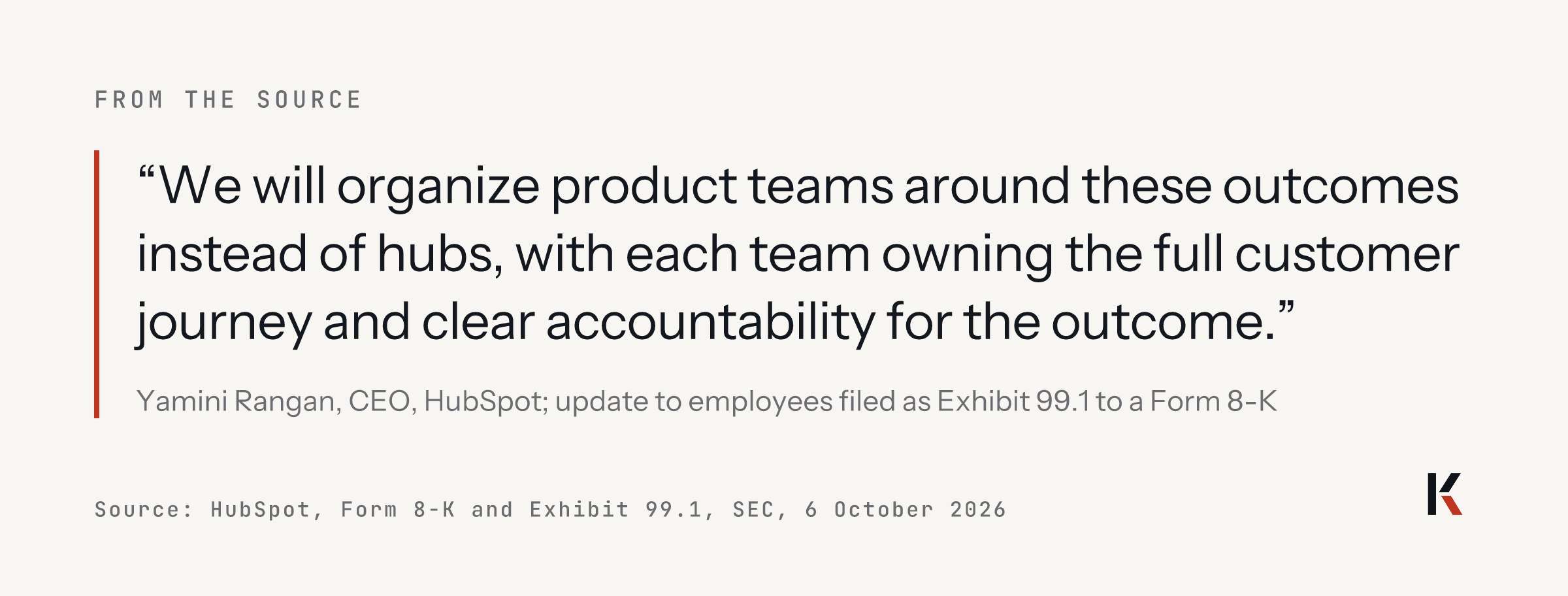
The four outcomes are generate demand, win deals, delight customers and scale growth. Every role was then assessed against six criteria. One reads: "Drive revenue: Are we protecting our capacity to generate demand and drive revenue?"
The Form 8-K gives the money: charges of $65 million to $75 million, about €58 million to €67 million, mostly in the fourth quarter of 2026.
Role eliminations are to be substantially complete by the end of March 2027.
The revenue guidance of 5 August stands: $3.678 billion to $3.686 billion for the year, about €3.3 billion.
It is HubSpot's second cut of about 7%. On 25 January 2023 its board approved a plan that also removed about 7% of the workforce. The restructuring charge that year was $96.8 million, about €86 million.
Headcount still grew from 8,246 at the end of 2024 to 8,882 at the end of 2025.
Neither filing says which functions or regions the 660 come from, or how many layers go.
One customer, two Hubs, one owner
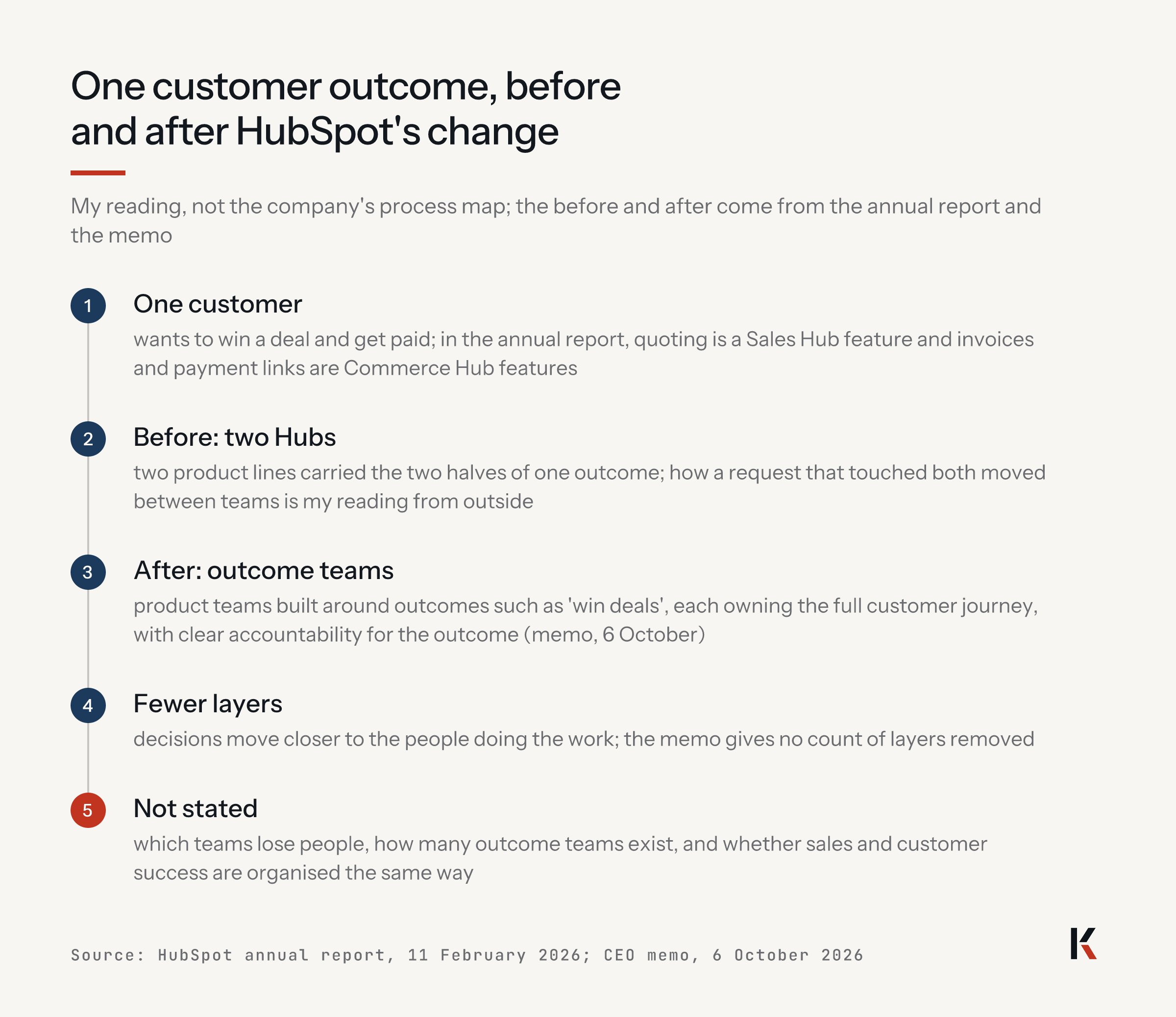
Take one customer who wants to win a deal and get paid. In the annual report, quoting is a feature of Sales Hub. Quotes, invoices and payment links are features of Commerce Hub. One outcome, two product lines.
How a request that touched both moved between two teams before 6 October is my reading from outside; HubSpot has not described that path. What the memo states is the after: product teams built around outcomes such as "win deals", each owning the full customer journey, with decisions moved closer to the people doing the work.
Two other B2B companies have made the same kind of change since late August.
Eos Energy announced on 25 August that sales, business development, government affairs, marketing and communications now report to one chief commercial officer, who "owns the path from first customer engagement through order intake and revenue conversion". Her predecessor leaves today, 20 October.
Commvault named a chief customer officer on 7 October over sales engineering, customer success, professional services and support, "from technical evaluation through adoption, renewal, and expansion". He reports to a president of customer and field operations.
When two teams each hold half of one outcome, the symptoms show up as work: a request answered twice, a decision waiting for the layer above, a feature finished on one side only.
You never see those hours on an invoice. You see them as the deal a customer did not close while waiting, priced at the margin that deal should have carried, not at the salary of the people who waited.
The leaving is priced; the redrawing is not
Divide the filing's charge by the memo's headcount and each departing role costs $98,000 to $114,000, about €88,000 to €100,000. The severance alone, the memo says, is generally 20 to 30 weeks of base pay per person.
The other cost has no figure in any document. From 6 October to the end of March 2027 is about 25 weeks in which roles are removed and teams redrawn. My reading from outside: every decision taken in those weeks by a team that does not yet know its owner is work at risk of being done twice.
HubSpot's own 2025 numbers put the revenue behind one employee at about $352,000 a year, about €310,000, or roughly $6,800 a week.
You may answer: "This is a product reorganisation; my commercial team is organised by territory and works."
The four outcomes are the commercial funnel in a leader's words, and one of HubSpot's six criteria asked whether a role protects the capacity to generate demand and drive revenue. The test for you is simpler: does one customer with one outcome meet one owner or three?
What this does not establish
It does not establish that outcome teams produce more than Hub teams. No number for that exists yet; the first numbers to watch are the customer count and net revenue retention, 103.5% in 2025, in the reports for late 2026 and mid-2027.
Nor does it establish why the roles went. The memo says the cut was not driven by AI-related efficiencies and was not simply a cost-cutting exercise, and nothing public can test that.
Where Kihon stands
Six Hubs becoming four outcomes is the question we put to a commercial team before any box on the chart moves: which outcome has one owner, and which is split between a marketing team, a sales team and a success team that each hold a third.
I read HubSpot's memo as that question answered for product and left open for the teams that face the customer. In one session, the Executive Workshop puts your four outcomes on the table with the handoffs each one crosses and the days a customer waits at each.
It is the same exercise for a software company of 200 as for one of 8,882. If one of your outcomes has two names beside it, thirty minutes on your own four outcomes is where we would start.
What a commercial leader would do first
- Write the four outcomes your revenue comes through and put one owner's name beside each.
- Follow one customer with one outcome through marketing, sales and customer success, counting every handoff and its days.
- Count the layers between a customer's request and the person who can decide it, and remove one.
What a CRO would ask HubSpot
Which of the 660 roles faced customers?
The filings do not say. The memo speaks of product teams, and the 8-K names customer relationships as a risk.
Are sales and customer success organised by outcome too?
Not stated. The memo's first change is about product teams. The annual report still describes sales representatives, partner development managers and customer success managers by function and by customer spend.
What will an outcome team report in March 2027?
Nothing is promised in the documents. The number worth asking for is each team's outcome in its own unit: demand generated, deals won, customers kept, accounts grown.
Sources
- HubSpot, Form 8-K (restructuring plan and reaffirmed guidance), SEC, 6 October 2026
- HubSpot, Exhibit 99.1, update to employees from Yamini Rangan, 6 October 2026
- HubSpot, Annual Report on Form 10-K for 2025, SEC, 11 February 2026
- HubSpot, Q2 2026 results, Exhibit 99.1 to Form 8-K, 5 August 2026
- Eos Energy Enterprises, press release on the chief commercial officer transition, Exhibit 99.1 to Form 8-K, 25 August 2026
- Eos Energy Enterprises, Form 8-K (chief commercial officer transition), SEC, 25 August 2026
- Commvault, Commvault appoints Matthew Stauble as chief customer officer, press release, 7 October 2026
- SalesTechStar, Commvault appoints Matthew Stauble as chief customer officer (release text), 8 October 2026
- CMSWire, HubSpot cuts 660 jobs, reorganizes product teams around customer outcomes, 6 October 2026
Your turn: which customer outcome in your company has two owners' names beside it today? Write to me at cemgorer@kihonlabs.com, or answer on LinkedIn. I read every reply.