
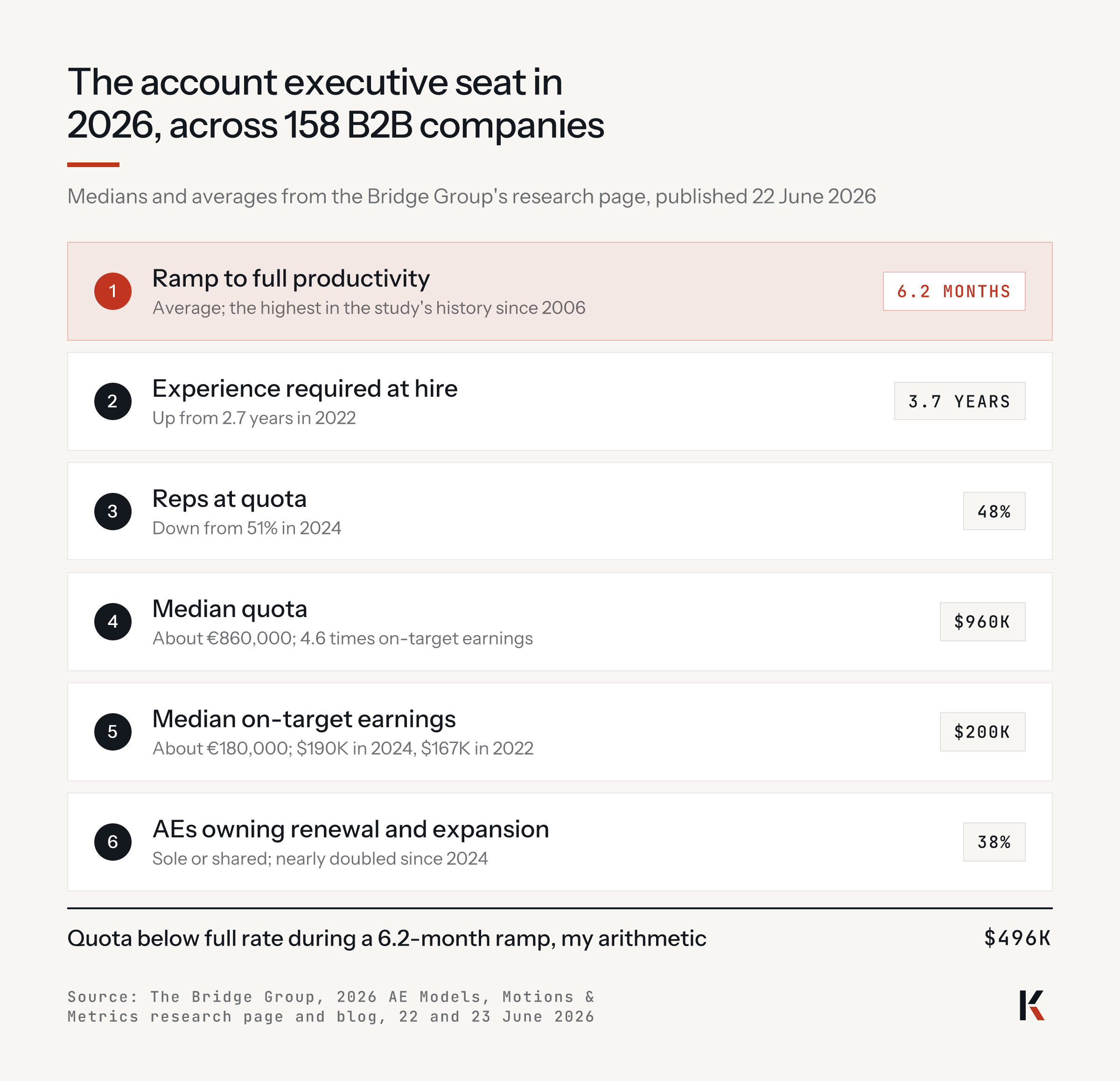
On 22 June 2026 the Bridge Group published the tenth edition of its account-executive study. 158 B2B companies answered. A new account executive now needs 6.2 months on average to reach full productivity, the longest the study has measured since 2006.
The same companies ask for 3.7 years of experience at hire, up from 2.7 in 2022. 48% of reps reached quota, down from 51% in 2024.
Companies answered rising ramp costs by buying experience, and the ramp is the longest in the study's history anyway. I read that as an integrated-training problem: what a new hire is taught in six months, and what she is left to find alone.
A second account came on 22 October, in a Fortune commentary by Anis Bennaceur, chief executive of Attention.com, which makes AI software for sales teams. His customer EliseAI plans to double its sales team in 12 months, after growing it 74% in a year.
He quotes Ben Rey, EliseAI's vice president of enterprise sales: "We've tripled the productivity of our AEs, and many of them now close $5 million to $15 million per quarter each." That is about €4.5 million to €13 million, in EliseAI's own figures, reported by its vendor.
The short version
A new account executive takes 6.2 months on average to reach full productivity, the longest the Bridge Group has measured.
Companies ask a year more experience at hire than in 2022, and 48% of reps reach quota.
In a study of 5,172 support agents, an AI tool trained on past chats, above all the best agents', made an agent with two months on the job perform like one with more than six.
Companies asked for a year more experience
The Bridge Group's page gives medians. On-target earnings: $200,000, about €180,000, up from $190,000 in 2024 and $167,000 in 2022. Quota: $960,000, about €860,000, 4.6 times earnings.
The role widened too: 38% of account executives now own renewal and expansion, alone or shared, nearly double the 2024 share.
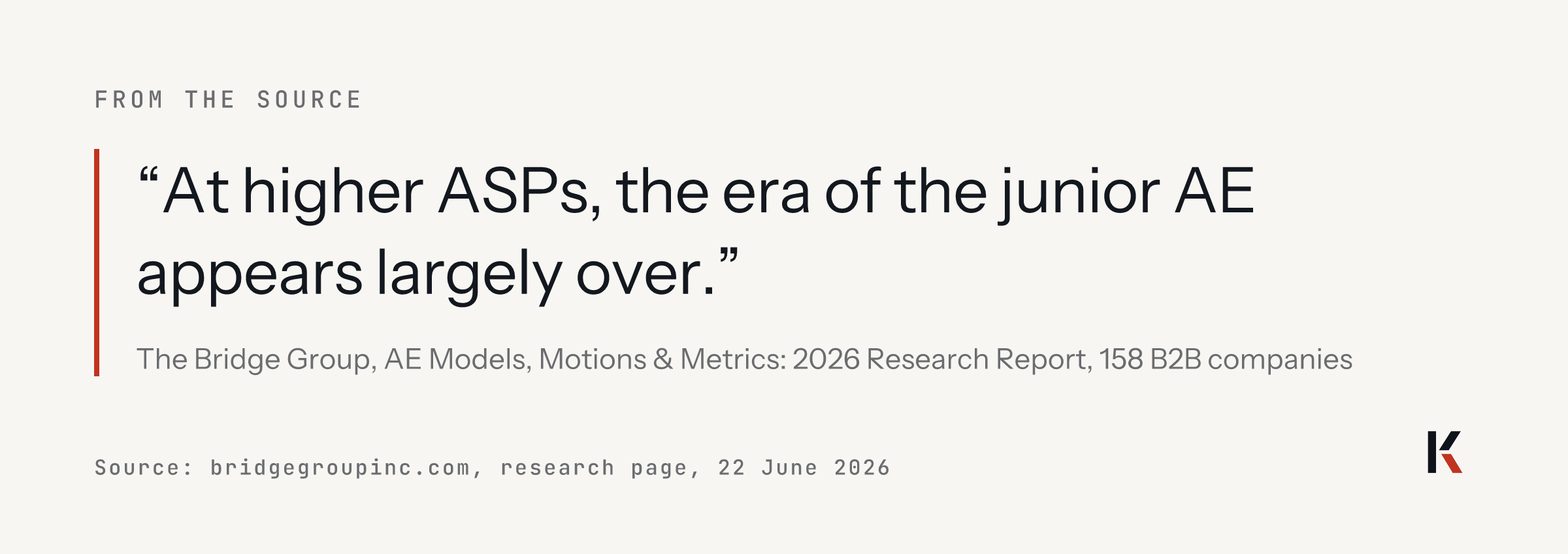
On ramp, the page gives one reason: "increasing deal complexity and buying committee size, particularly at higher ASPs", that is, higher average selling prices. It adds that "companies are demanding more prior experience as ramp costs rise".
It does not say how ramp is measured or what onboarding the companies run, and the 2024 ramp figure is not on the page I read.
The third document is an economists' paper. Erik Brynjolfsson, Danielle Li and Lindsey Raymond studied 5,172 support agents at a Fortune 500 software company and the Quarterly Journal of Economics published it online in February 2025.
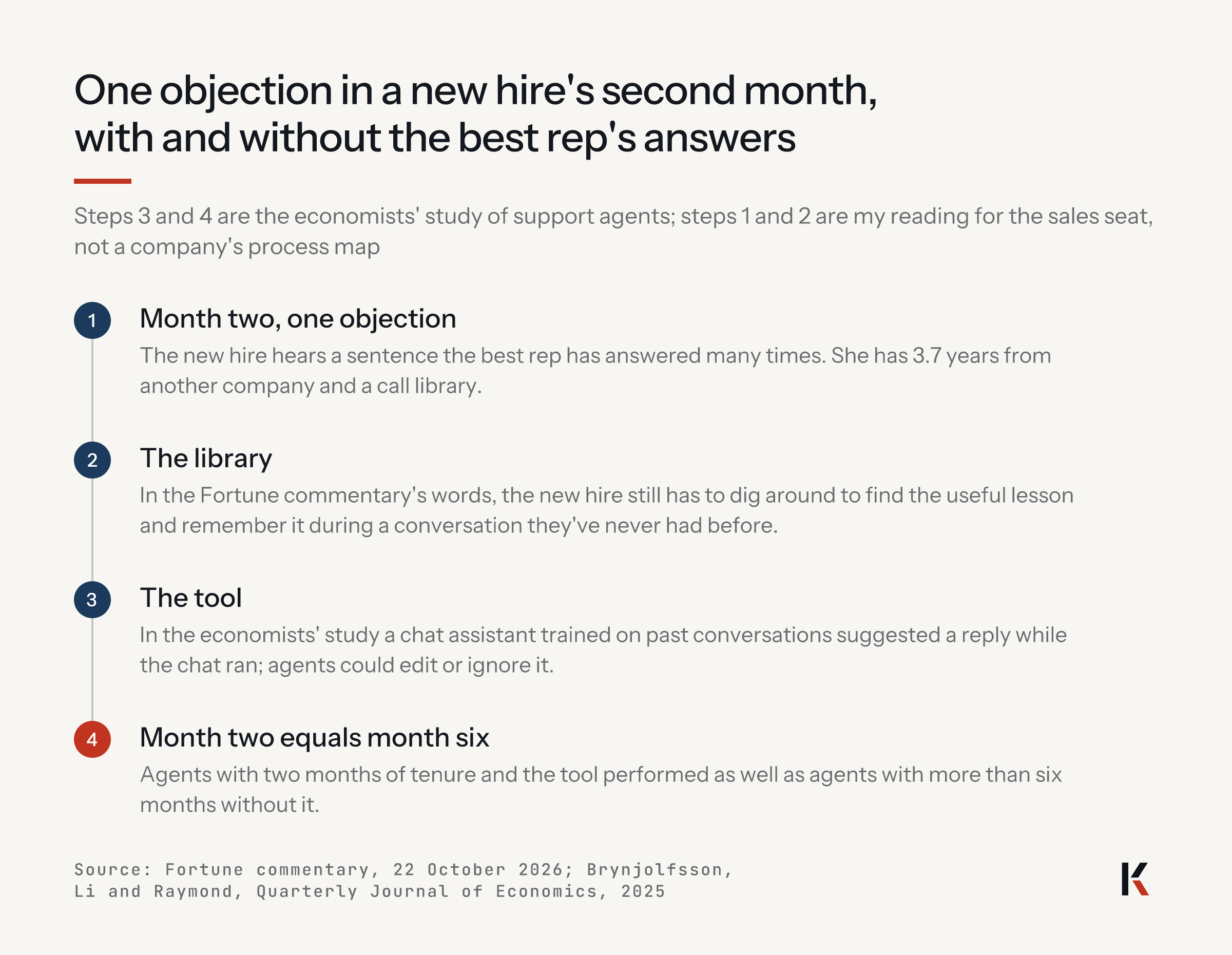
A chat assistant trained on past conversations raised issues resolved per hour by 15%, and by 30% for the less skilled, less experienced agents. The best agents gained little. Agents with two months of tenure and the tool matched agents with more than six months without it.
Among agents under six months, leaving fell by about 10 points, 40% of a 25% baseline, a result the authors say should be read with more caution than their main findings.
The knowledge sits in calls nobody replays
Take one objection, in a new hire's second month. The buyer says the price is fine and the timing is wrong.
Your best rep has answered that sentence many times; the new hire has heard it once, now.
She brings 3.7 years from another company and a call library. In Bennaceur's words, she "still has to dig around to find the useful lesson and remember it during a conversation they've never had before".
In the economists' setting the tool did the digging. Trained on past chats, it suggested a reply while the conversation ran, which agents could edit or ignore. The authors write that the gains for newer workers indicate the system "may be capable of capturing and disseminating the behaviors of the most productive agents".
Agents started at 1.8 resolutions an hour. With the tool they reached 2.5 after two months; without it, 8 to 10 months later.
How that travels into an enterprise sales seat is my reading from outside; none of these documents publishes a company's ramp path.
Multiply one objection by six months of calls and you have the ramp: your best rep's answers stay in her calls while you pay a new hire to relearn them on live buyers.
I read the cause as how skills are built for the seat, or not built. The symptom is work that does not produce: more than half the reps below quota, every new hire half a year from full rate on average.
The cost is the margin those months should have produced; I would count it there, never at the salary paid through them.
Half a year of quota on every hire
The study gives no cost of ramp, so this arithmetic is mine, on its medians. A $960,000 quota is $80,000 a month, about €71,000.
At 6.2 months, one new seat sits below full rate for $496,000 of quota, about €440,000: half a year of one seller's number.
If the ramp is a straight line from nothing to full, about $248,000 of it, about €220,000, is not won before month seven.
You pay through it as well: 6.2 months of a $200,000 on-target package comes to about $103,000, about €92,000, before a recruiter's fee the study does not price.
The economists give the sentence a CFO should keep: AI assistance "alters the relationship between on-the-job productivity and time, with potential implications for how firms might value prior experience, or approach training and worker development".
"Our deals got harder; that is why ramp is longer," you may say. The Bridge Group says the same, naming buying committees and higher prices. Harder deals are a reason to move your best rep's answers to the new hire faster, and the companies that bought experience still report the longest ramp in the study's history.
You may conclude that AI closes the ramp; I would not go that far. The Bridge Group's figures are a survey of leaders at 158 companies, observational by its own account, and the economists studied chat support, where a reply can be suggested live.
A company could settle it by measuring ramp by hiring cohort, in months to the first full quarter at quota, beside the hours of structured teaching each cohort received.
I read a ramp of 6.2 months as a revenue system with a step nobody designed: the path by which a new seller gets the best seller's answers. We design that step with the commercial team and count it, hire by hire, in months to full rate and in margin not won while the seat waits.
That is the work of Build, most often in the scale-up that hires its tenth to fiftieth account executive and still seats each one next to somebody good. If your next offer letter asks for four years of experience, thirty minutes on your own ramp is a fair place to begin.
What a CFO would ask before the next hire
How many months did our last three hires take?
The number is in your CRM, from start date to the first full quarter at quota. If nobody has pulled it, the Bridge Group's 6.2 months is as good a guess as yours.
What does one month of ramp cost at margin?
One twelfth of the seat's quota, times the margin that revenue carries, times the share of the month below full rate; on the study's median, $80,000 of quota a month.
Where would a month-two hire find our best answers?
If the answer is "in the call library" or "by asking her", the knowledge lives in one person, and the test is one hiring cohort with that person's answers in a tool.
Sources
- The Bridge Group, AE Models, Motions & Metrics: 2026 Research Report, research page, 22 June 2026
- The Bridge Group, State of Sales: 2026 AE Models, Motions, & Metrics Research, blog, 23 June 2026
- The Quarterly Journal of Economics, Generative AI at Work, Brynjolfsson, Li and Raymond, author copy, 4 February 2025
- Fortune, My industry wants you to fire your sales team. One of my customers plans to double theirs, commentary by Anis Bennaceur, 22 October 2026
Your turn: how many months did your last account-executive hire take to reach a full quarter at quota, and who wrote that number down? Write to me at cemgorer@kihonlabs.com, or answer on LinkedIn. I read every reply.