
Six agent hours for every human hour. The humans got 20% more meetings.
From Anthropic's own report on its workforce, I read this through the hidden-cost lens.
One of Anthropic's account executives told the company's researchers that automations for email drafts and CRM integrations had replaced around 20% of their prior tasks. The interview is one of 17 in a report on Anthropic's own workforce, published on 16 October. The researchers also used employment records, output metrics, surveys, calendar data and hiring records.
The calendar data shows where the time went.
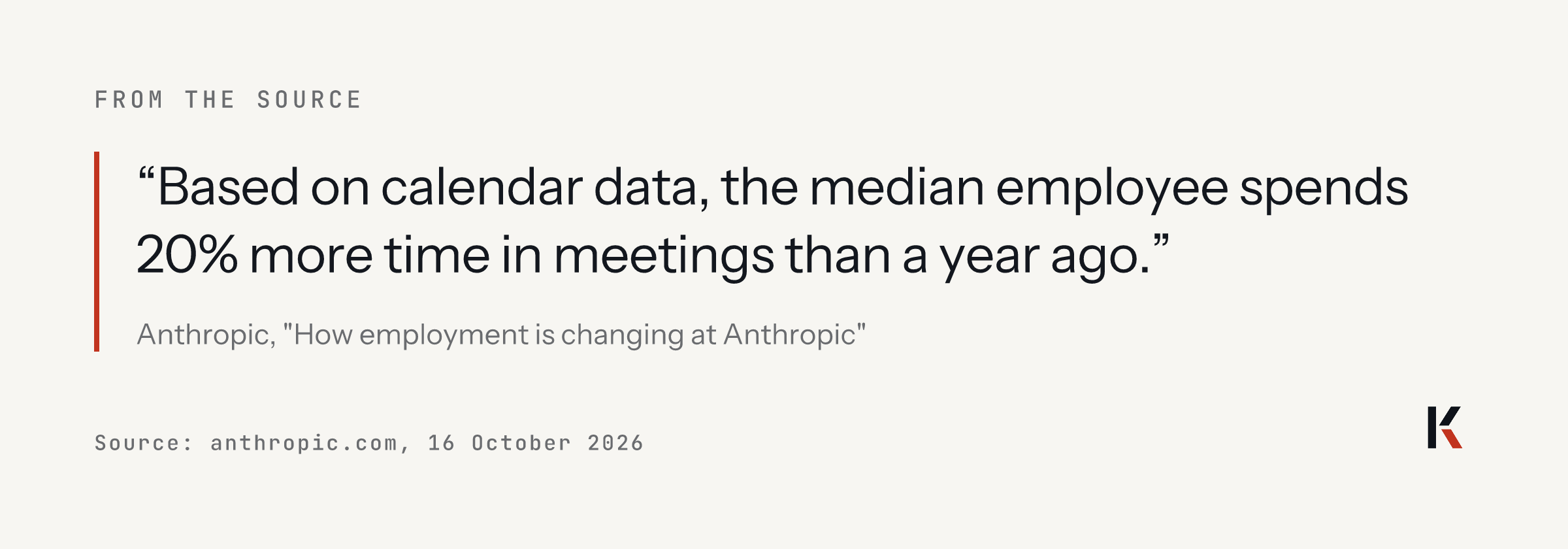
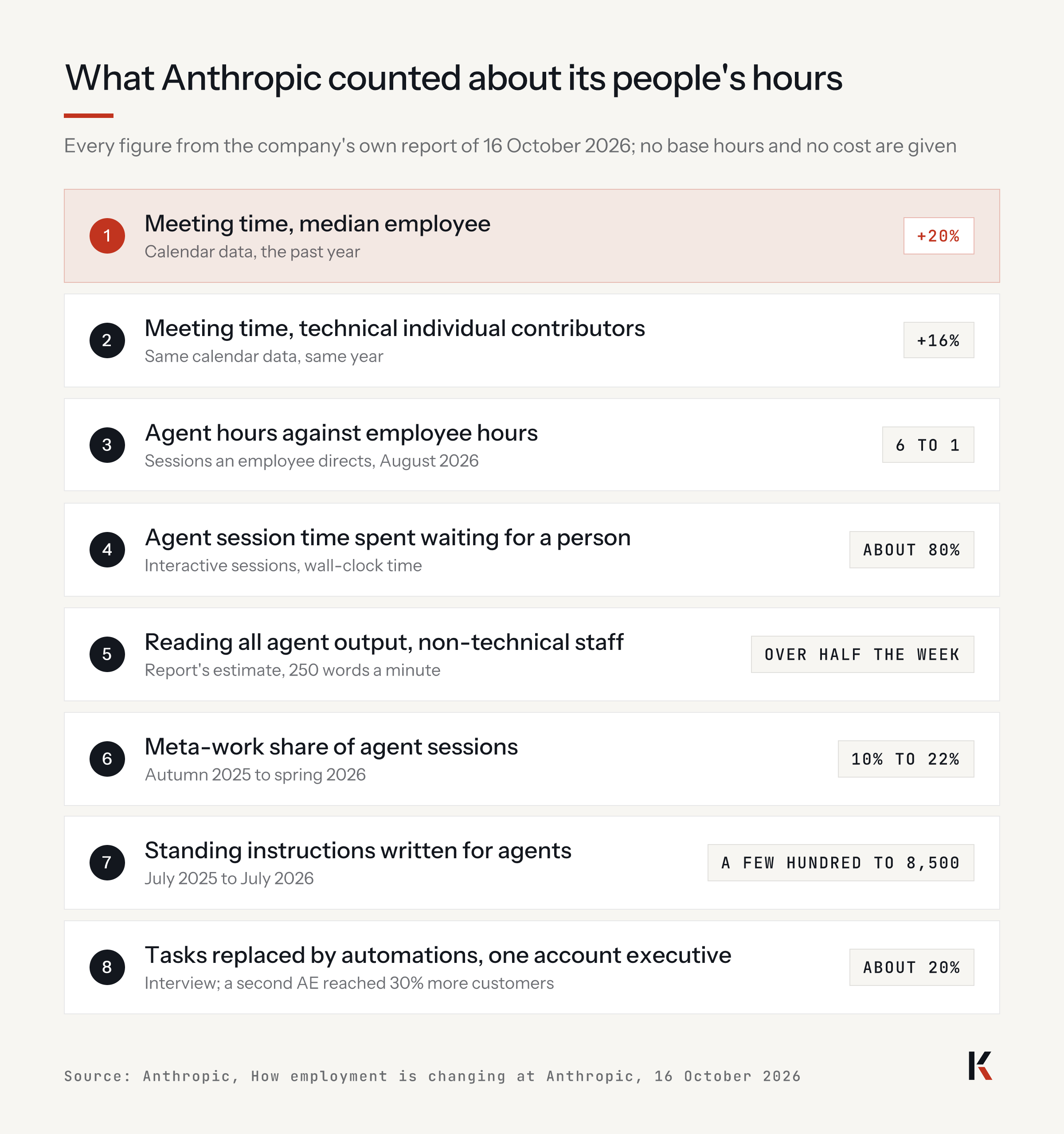
The median employee spends 20% more time in meetings than a year ago. For technical staff in individual contributor roles, meeting time is up 16%.
By August 2026 its AI agents worked six hours for every hour its employees worked, in sessions an employee directs. Those six hours count only the agents' active time: about 80% of the total time of an interactive session is spent waiting for a person to answer.
Anthropic's agents took over the drafting, and the company counted what grew in its people's week: reading the agents' output, managing them, and meetings.
The counts are the company's; the link between them, that the freed hours went there, is my reading. Where a week goes when a tool takes over the doing is time management in its plainest form.
You rarely get the count. Here you have one.
The short version
Anthropic's calendar data shows its median employee spending 20% more time in meetings than a year earlier, and 16% more for technical individual contributors.
Reading everything its agents write in a week would take a non-technical employee more than half the week, by the report's own estimate.
The company explains part of the rise with growth and a shift to meeting-heavy roles, and it gives no base hours and no cost.
Six agent hours for every human hour
The agents' hours came first. In March 2026 the hours worked by AI agents passed the hours worked by employees. By August the agents one employee directs worked six times the hours of their human handlers.
Human hours are counted as headcount times a 40-hour week.
Then the reading load, counted at 250 words a minute. For non-technical groups, interactive sessions "are outputting enough content to take up over half of the work week".
On the 40-hour week the report assumes for its people, that is more than 20 hours.
Then the new work. Meta-work, the report's word for writing instructions for agents and monitoring their pipelines, rose from 10% of sessions in autumn 2025 to 22% in spring 2026. Standing instructions for agents grew from a few hundred in July 2025 to 8,500 a year later.
In an April 2026 survey, 27% of employees described productivity gains from the tools. 20% described their role shifting from doing the work to managing Claudes, the company's agents.
Reps closed deals with more clients, with two cautions
Sales representatives adopted agents from September 2025 and afterwards closed deals with more clients, the report says. Beside the account executive whose automations took a fifth of their tasks, another said they could now talk to 30% more customers.
The report adds two cautions: reps with more opportunities may have chosen automation first, and a strong product makes deals easier to close. It gives no base of meeting hours, no headcount beyond "tripled in size in the last year", and no cost.
Anthropic reports the rise in meeting time. Nobody books what one of those hours cost.
Freed tasks, then reading, instructing and meeting
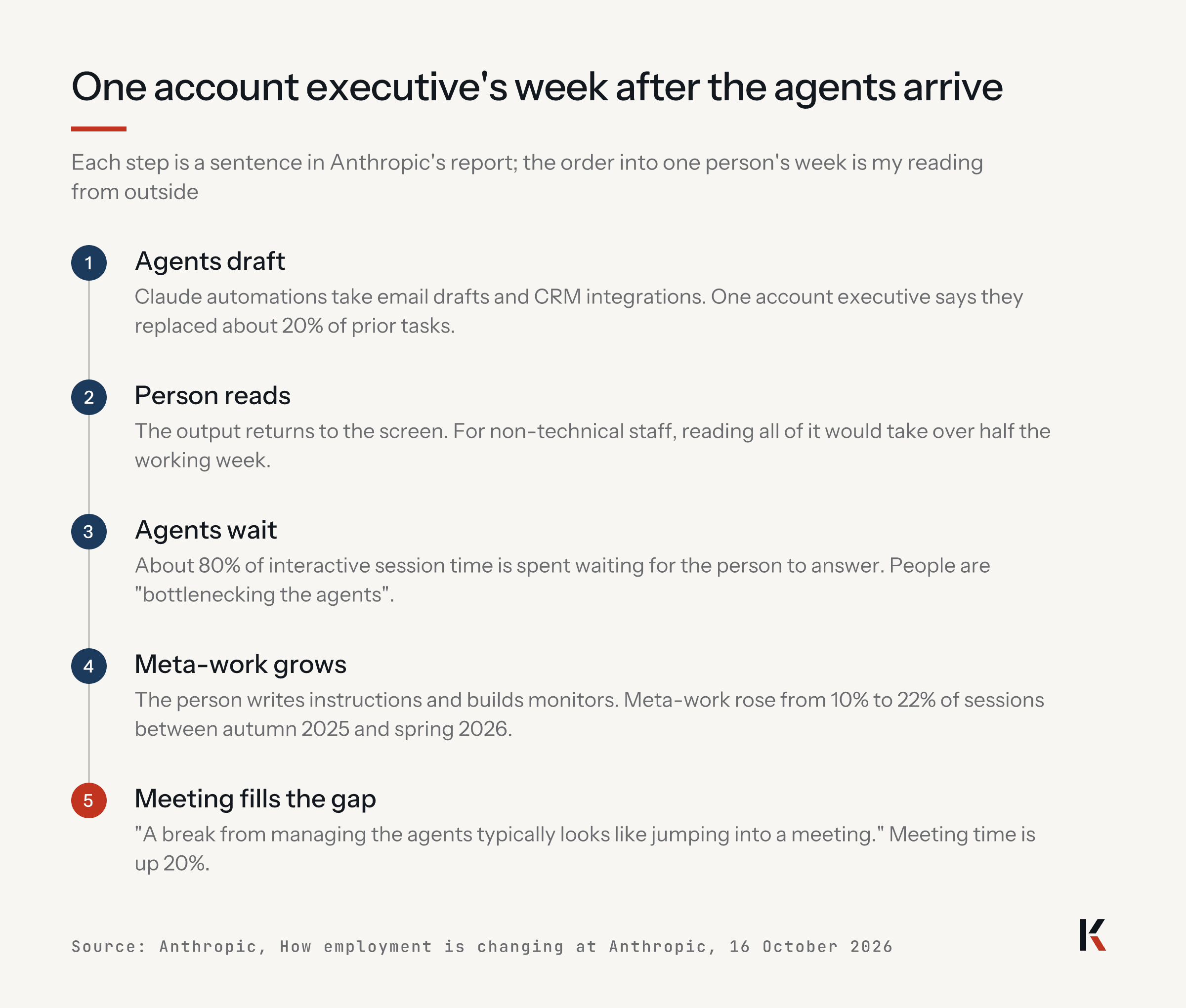
Follow that account executive's week.
Before the agents, email drafts and logging were done by hand; the report counts them as implementation work.
After, by their own count, automations took about a fifth of their prior tasks.
The output of every agent returns to the person who started it. One engineer compared them to children, each demanding attention with equal urgency. For non-technical roles, reading all of it would take more than half the week.
So the person writes instructions and builds monitors, the meta-work that more than doubled as a share of sessions. The questions left after the drafting is automated need other people. The report puts it in one sentence: "A break from managing the agents typically looks like jumping into a meeting."
Each step is a sentence in the report; putting them in this order inside one person's week is my reading from outside.
Multiply it by a team and the agents' hours grow six to one while the people's attention does not.
The report does not say anyone planned where the freed time would go, and the calendar shows meeting time up 20% while the agents' output grew. That is a time-management question left open. The symptom I would expect is work done twice, once by the agent and once by the person who checks it.
The hidden cost is what the freed hours did not produce. Priced at the margin a customer hour should carry, the 20% is the largest unpriced line in the report.
Over 20 hours of reading against a fifth of the tasks
The report gives no money, so the cost stays in hours. On its own 40-hour week, over half a week of reading is more than 20 hours per non-technical employee. For one account executive, automations took about 20% of prior tasks; the report does not say how many hours that freed.
Against those tasks stand 20% more meeting time, 80% of agent session time spent waiting, and meta-work that went from 10% to 22% of sessions. Which of those hours produced a customer conversation, the report does not say.
"Anthropic is an AI company; my commercial team does not work like that." Its account executives used automations for email drafts and CRM integrations, two tasks every commercial team has. Output that outruns the attention to read it does not depend on the sector.
Two conclusions would go too far. The extra meeting time is not shown to be waste: Anthropic credits part of the rise to growth and to roles that meet more, and its employees call face-to-face coordination indispensable. Nor is it shown that the agents made the reps close more deals; the report names selection and a strong product as other causes. A calendar count by role, before and after a rollout, with the hours of reading agent output logged beside it, would answer both.
It is rare for a company to publish what grew in its people's week after an AI tool took over the doing. Kihon counts exactly that gap for commercial teams: the hours a rollout promised against the hours the calendar and the logs show.
The Diagnosis does it in a company's own numbers, priced at the margin a customer hour carries; it is the door for a team that has agents and no count. A software company growing this fast needs the count more each quarter. Thirty minutes on your own numbers: start here.
Three laws to repeat.
- Every agent hour lands as reading on someone's desk.
- Freed hours go somewhere; only the calendar says where.
- A meeting is the break nobody planned.
To every CEO, CFO and CRO: ask what one meeting hour of your commercial team costs at margin.
Count the reading before the rollout
- Pull your commercial team's calendar data for the last twelve months and count meeting hours per person by quarter.
- Ask five people who use AI agents to log one week of hours spent reading and correcting their output.
- Set both counts beside the hours the rollout promised to free, and tell the team the gap.
What a CRO would ask before adding agents
Where did the hours your AI tools freed actually go?
Nobody knows until a calendar or a log says so. At Anthropic, the counts that rose were reading, managing the agents and meetings. Yours may differ, and you cannot know without a count.
Should you cap meeting time while agents expand?
Not before you know what each meeting carries. Anthropic's employees call face-to-face coordination indispensable. Cap the hours blind and you may cut the meeting that decides a renewal.
Who reads what the agents write for your customers?
A named person, with hours set aside for it. If reading the output takes more than half a week, that person either skips it or does nothing else.
Sources
- Anthropic, How employment is changing at Anthropic, 16 October 2026
- TechCrunch, Anthropic says its workforce has become less junior and is spending more time in meetings, 17 October 2026
Your turn: when your commercial team last got hours back from a tool, who counted where they went? Write to me at cemgorer@kihonlabs.com, or answer on LinkedIn. I read every reply.