
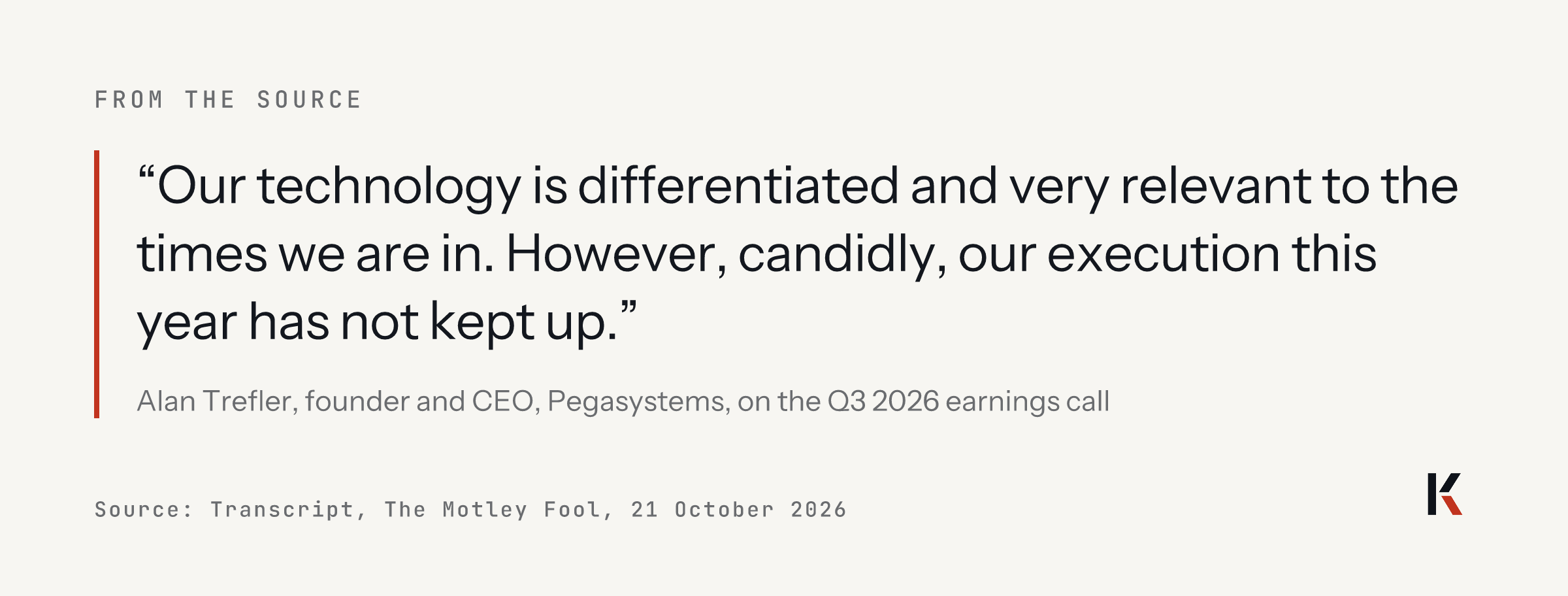
On 21 October, Alan Trefler opened his remarks on Pegasystems' third-quarter call with a sentence founders rarely say in public. "Our technology is differentiated and very relevant to the times we are in," he said. "However, candidly, our execution this year has not kept up."
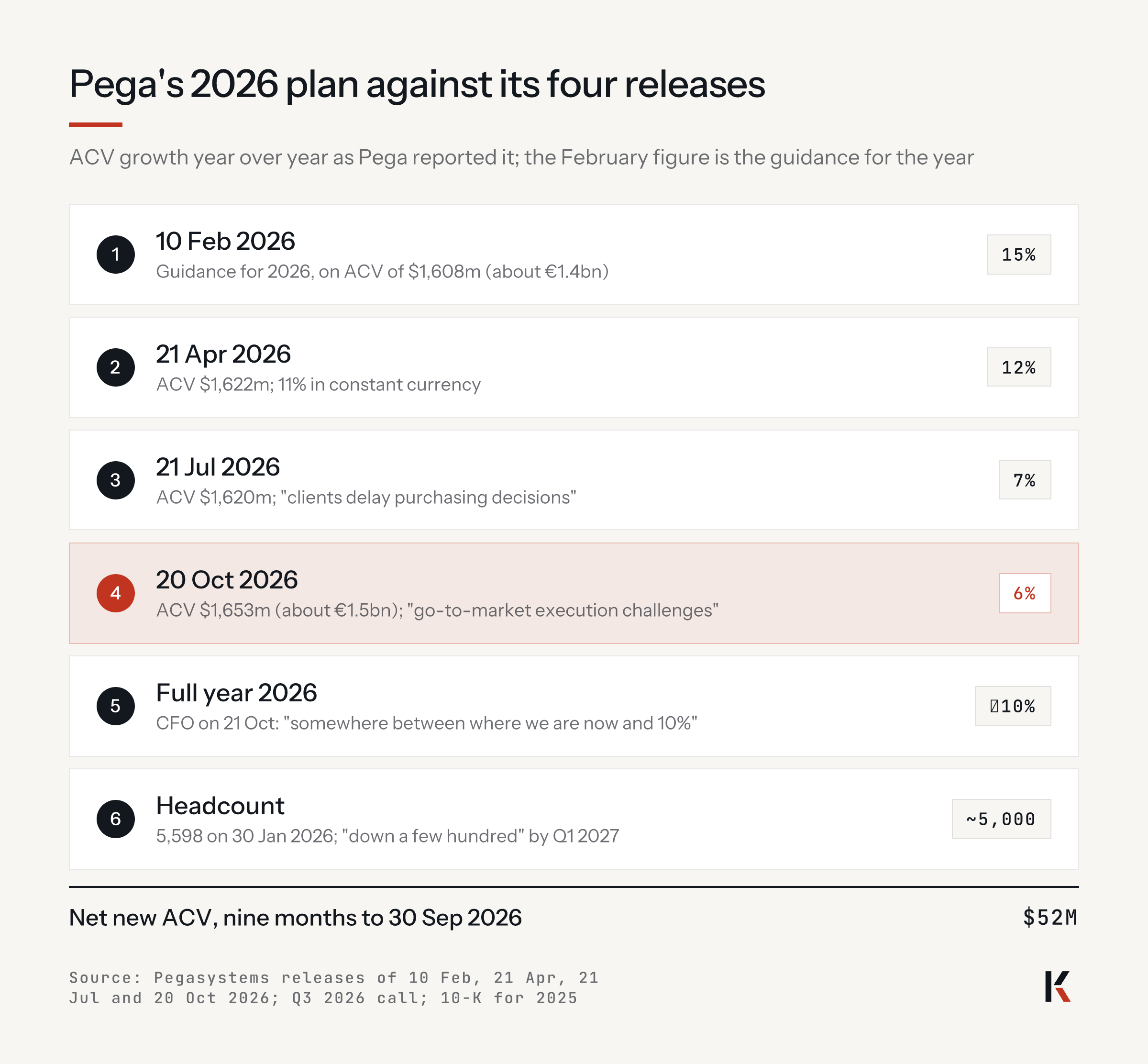
Eight months earlier, on 10 February, the company had guided to 15% growth in annual contract value (ACV) for 2026. ACV then stood at $1,608 million, about €1.4 billion. By 20 October it was $1,653 million, about €1.5 billion, up 7% in constant currency.
Ken Stillwell, chief operating officer and chief financial officer, said he saw no path above 10% for the year.
The release of 20 October names the cause in one clause of Stillwell's quote: "largely due to go-to-market execution challenges". In July the release had put the slowdown on the market: "Unprecedented changes in the AI market caused clients to delay their purchasing decisions." The October release keeps a sentence on clients applying "greater scrutiny" to large technology investments "as AI disrupts the industry"; the execution clause is new.
A plan can be right and still not reach the people who carry it out; Pega's 2026 is that gap, counted in its own four releases. I read it as a strategy-implementation problem. The strategy stayed; the operating model meant to carry it changed in October.
The symptom is a target missed, what the socio-economic approach (SEAM, developed by Henri Savall and the ISEOR team in Lyon) calls a lack of direct productivity.
The short version
Pega set a 15% ACV growth plan in February. In October its CFO put the year between the current 7% and 10%.
The company says demand and win rates held; the constraint was how long a client takes to decide, and how deployments go.
The fix is four operating changes and a headcount of about 5,000 by the first quarter of 2027, from 5,598 in January.
Four releases, one plan, two explanations
10 February 2026. Pega reported 2025 ACV of $1,608 million, up 17%, and guided 2026 to 15% ACV growth and $575 million of free cash flow (about €510 million). The release carried no sentence about go-to-market.
21 April. ACV was $1,622 million, up 12%.
21 July. ACV was $1,620 million, up 7%, and lower than in March. The release put the slowdown on clients delaying decisions as the AI market changed.
20 October. ACV was $1,653 million. Net new ACV for nine months was $52 million in constant currency, about €46 million; the third quarter alone brought $32 million, the strongest of the year. Quarterly revenue was $393.4 million, up 3%; consulting revenue fell 18%.
What the documents do not give: ACV by region, the number of people in sales, marketing or consulting, and the size of the "few hundred" roles that go. The 10-K for 2025 says Pega sells through a direct sales force and partners, and no more about how sales is organised.
What a 15% plan asks of one seller's week
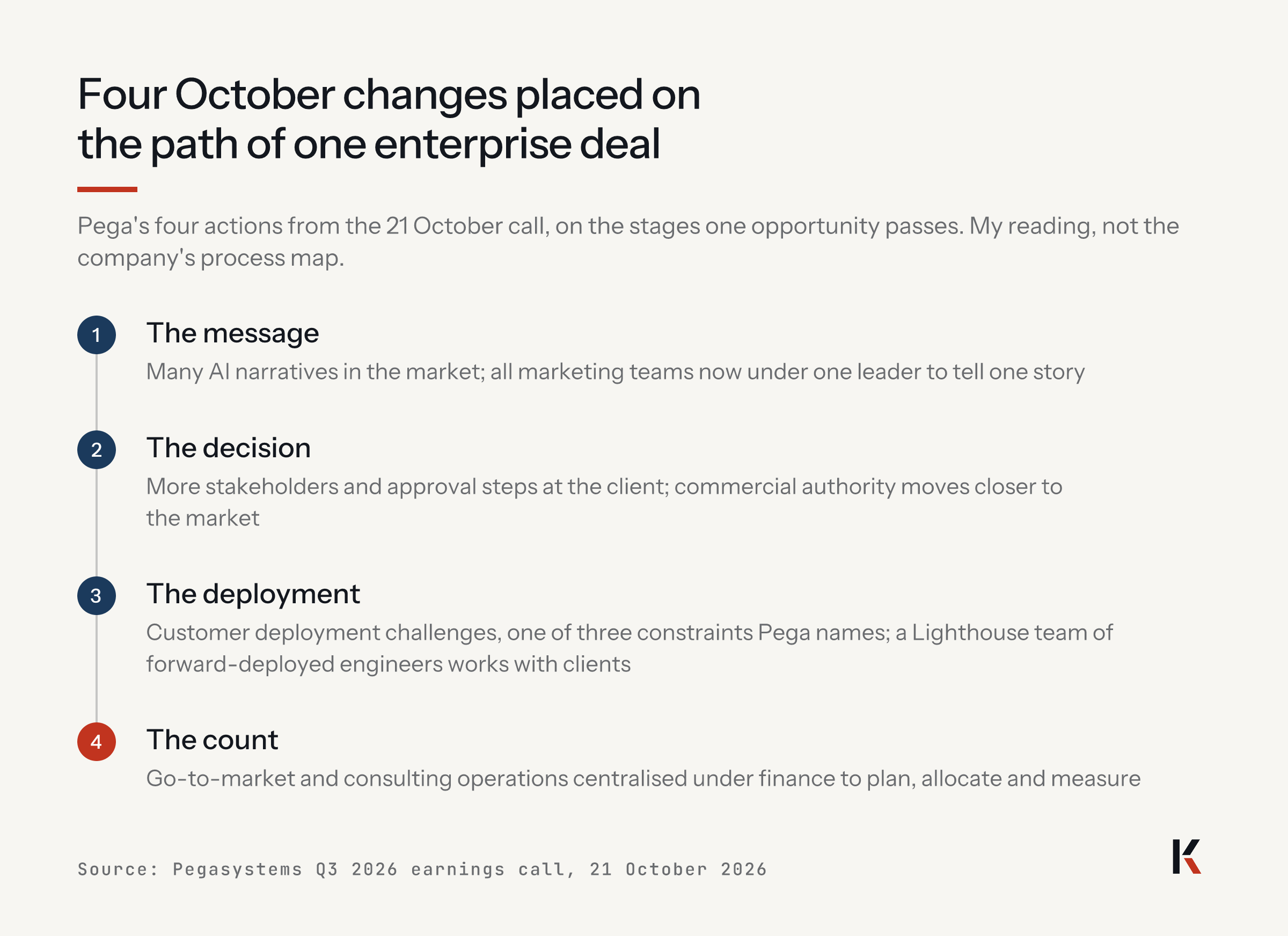
Take one enterprise opportunity at a large bank. How it travels inside is my reading from outside; Pega has published no process map.
Before October, on that reading, a seller carries an AI message into what Trefler calls "the most chaotic and confused technology market" of his career. At the client, Stillwell says, decisions "now involve more stakeholders and additional approval steps". Where the authority to decide that deal sat, Pega has not said. The call says the change "returns us to an operating model where the senior leaders have more commercial-driven authority"; I read that as authority that had moved away from the leaders closest to the client.
After signature comes deployment, and Stillwell names "customer deployment challenges" as one of three constraints.
After the four changes, in Pega's own words: "commercial leadership and day-to-day execution authority sit closer to the market", within company-wide pricing, contracting and financial controls. All marketing teams sit under one leader to tell "one clear and differentiated Pega story". A "Lighthouse" team of forward-deployed engineers works directly with clients, and one operations team under finance plans and measures the whole.
Multiply that opportunity by what Stillwell calls the strongest fourth-quarter pipeline the company may ever have had. By Pega's own assessment the demand was there; what it lacked each quarter was decisions reached and deployments finished.
I read this as the family at work: the plan came first, the way of working followed eight months later. The symptom shows as targets missed and deployments that stall, what the method calls lack of direct productivity and non-quality.
Up to $128 million of ACV the plan counted and 2026 will not add
Pega's numbers allow one piece of arithmetic, and I mark it as mine. A 15% plan on $1,608 million is about $241 million of net new ACV for 2026, about €210 million. Stillwell's October range, from the current 7% to 10%, is $113 million to $161 million. The gap is $80 million to $128 million of ACV, about €71 million to €110 million.
ACV is annual and it recurs: what you do not add in one year is missing again the next. Stillwell said the 2028 target of $700 million of free cash flow (about €620 million) "will require stronger ACV growth".
Stillwell expects "a quarter or two of change management" and improvements "in the early to mid part of 2027". For about 5,000 people, I read that as one or two quarters of learning new lines of authority.
Restructuring took $15.4 million in cash in nine months, about €14 million; more charges will be "firmed up" by the first quarter of 2027.
The objection is that the market moved and every vendor saw longer cycles. Pega says the same, then goes further: win rates held, the pipeline grew, and the primary constraint was its own execution, in the release and on the call.
The conclusion you may jump to is that a regional model fixes this. I would not conclude that from one call; Pega says it has run this model before and does not say why it left it. The measurement that answers it is net new ACV per quarter in 2027 against this quarter's $32 million, and the days from first meeting to decision, which Pega does not publish.
Pega's four actions are an operating model catching up with a plan set eight months earlier. Kihon works on that distance before a third release has to name it: the stage where a plan stalls, who holds the decision there, and what a quarter of waiting costs at margin. When a leadership team wants to see that path on one table, the Executive Workshop does it in one session.
Pega is a company of 5,598 people, the enterprise stage, where a gap like this can stay unnamed for three quarters. If your February plan reads differently in October, thirty minutes on your own plan is a fair place to start.
What a CEO would do before the next plan
- Write beside the growth target the three stages a deal must pass and who holds each one.
- Count the days from first meeting to decision for the last ten enterprise deals, by region.
- Date the quarter when each team will work under the new model, and publish it with the target.
Sources
- Pegasystems, press release "Pega Cloud ACV Grows 20% in Q3 2026", 20 October 2026
- Pegasystems, Q3 2026 release with financial schedules (Exhibit 99.1), 20 October 2026
- The Motley Fool, Pegasystems Q3 2026 earnings call transcript, 21 October 2026
- Pegasystems, Q2 2026 release with financial schedules, 21 July 2026
- Pegasystems, Q1 2026 release with financial schedules, 21 April 2026
- Pegasystems, Q4 2025 release with 2026 guidance (Form 8-K Exhibit 99.1), 10 February 2026
- Pegasystems, Form 10-K for the year ended 31 December 2025, 10 February 2026
- Pegasystems, Form 8-K Item 2.05 on the consulting reorganisation, 12 January 2026
- European Central Bank, euro reference rates, 21 October 2026
Your turn: at which stage of one deal does your own 2026 plan stall, and who holds the decision there? Write to me at cemgorer@kihonlabs.com, or answer on LinkedIn. I read every reply.