
On 1 October Microsoft told its partners that a billing date had moved. Usage billing switched on by default for new Copilot Business licences would start on 1 December, and the notice says the date had been 2 November.
On 30 September the press reported that Barclays had moved its third office day, due on 5 October, to 2027. In August Airbus had said it would bring in its own office rule "more gradually".
The same week Accenture reported 46 million hours of training and nearly 110,000 AI and data professionals against a goal of 80,000. Its goal held.
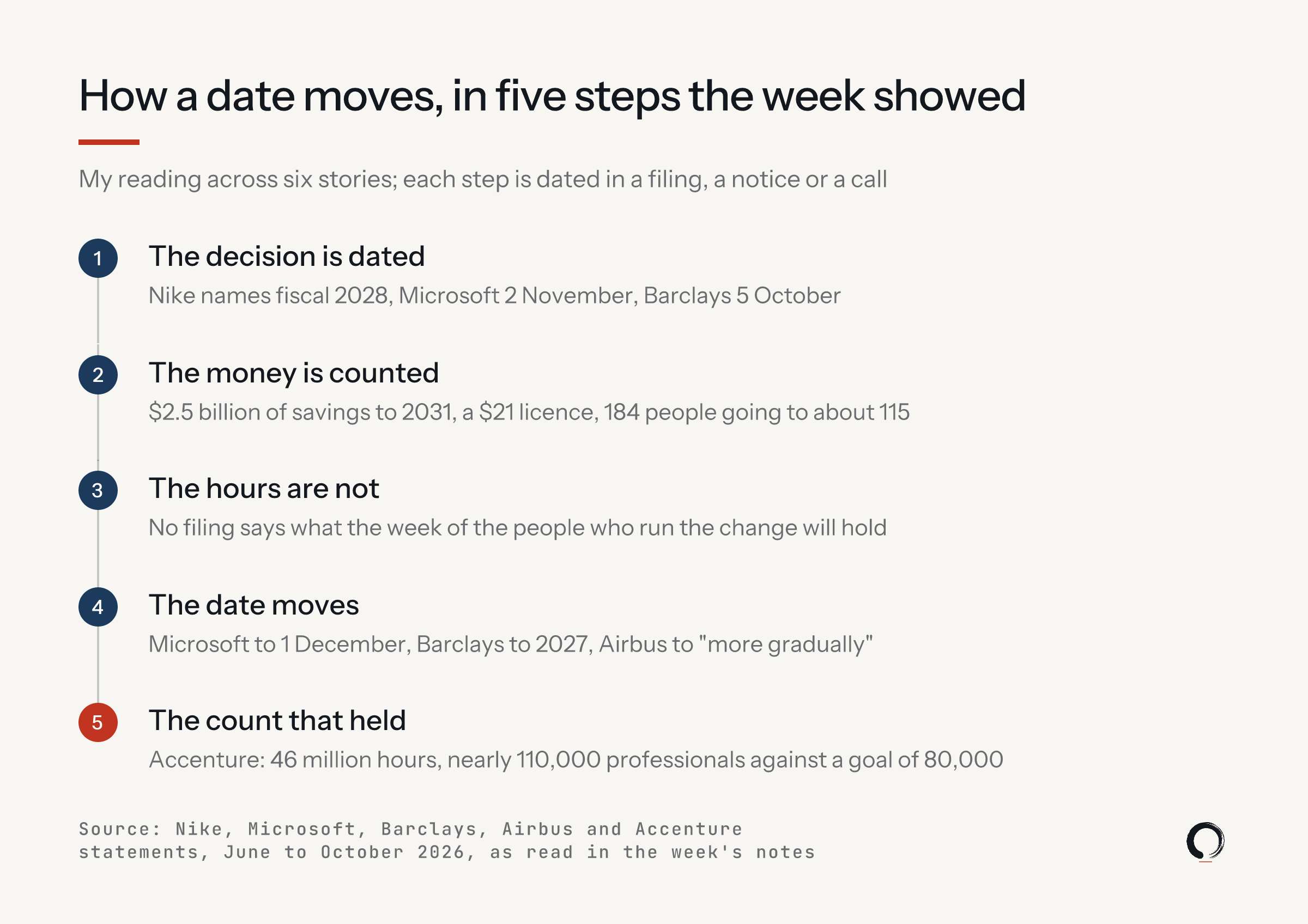
Read through the week's six lenses, from the hours in a calendar to the setting of the work, the stories show one pattern: companies publish the decision and the money, rarely the hours of the people who run the change, and then the date moves.
That last step is my reading; the dates and the figures are the companies' own.
The short version
Microsoft, Barclays and Airbus each moved a date this year, and none of the three published the hours the change asks of the people who run it.
Accenture published its training hours, its budget and its result, and passed its own goal by nearly 30,000 people.
The hours tend to be worth more than the budget: at Accenture, $2.3 billion of working time against a $1 billion budget, on my arithmetic.
The week in six
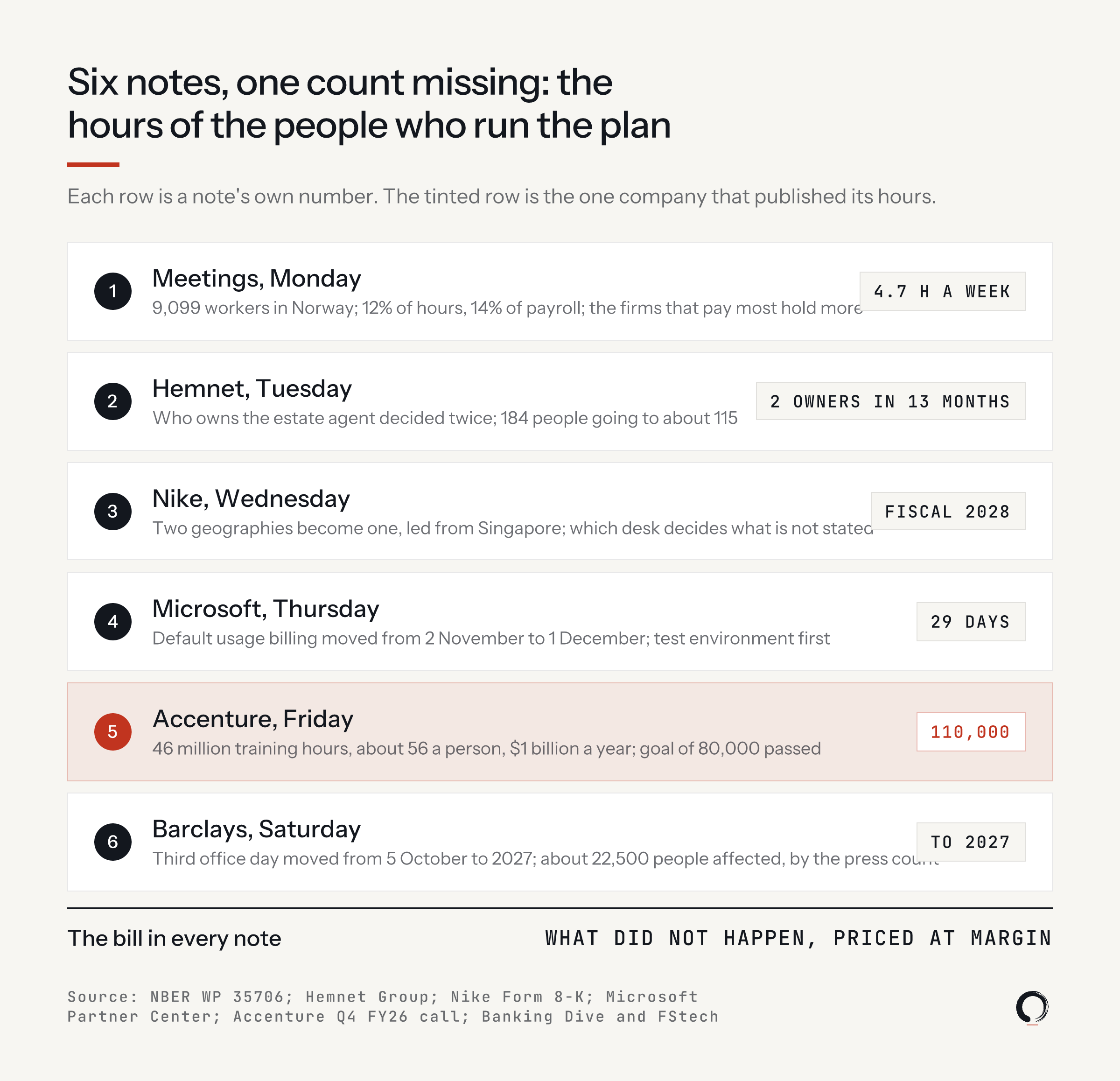
Monday, time management: "Higher-paying firms spend more of the week in meetings". A study of 9,099 workers in Norway put meetings at 14% of payroll; the firms that pay most hold more. Read Monday's note
Tuesday, work organisation: "Hemnet's sales chief got a new boss after 13 months". Hemnet named a Chief Sales Officer in September 2025 and a Chief Commercial Officer over sales and partners in October 2026. Read Tuesday's note
Wednesday, communication, coordination and cooperation: "Nike folds Greater China into a geography led from Singapore". Nike dated the merger of two geographies for fiscal 2028 and did not say which decisions will sit where. Read Wednesday's note
Thursday, strategy implementation: "Microsoft pushed metered-by-default Copilot billing back a month". The default-on date moved from 2 November to 1 December, with a test environment 29 days before. Read Thursday's note
Friday, integrated training: "Accenture spends $1 billion a year training 814,000 people". Accenture reported 46 million training hours, $1 billion a year, and $923 million, mostly severance, to exit people it could not retrain. Read Friday's note
Saturday, working conditions: "Three companies added an office day; two delayed it". Airbus, Target and Barclays each added a weekly office day in 2026, and two of the three dates then moved. Read Saturday's note
What the six show together
The question the six answered is one I did not set on Monday. When a company changes the way it works, what does it count?
Every story this week has a dated decision and a priced one.
Nike's filing counts $2.5 billion of savings, about €2.2 billion, to fiscal 2031. Hemnet's release counts 184 people going to about 115 and SEK 80 to 85 million of yearly savings, about €7.1 to 7.6 million.
Microsoft's notices count a $21 licence and a cap of 4,000 credits a user. Barclays' notice counts three days a week from 5 October.
What none of those documents counts is the week of the people who run the change.
Which desk decides the price of a shoe in Shanghai. Who answers an estate agent's question about a capped fee. What a partner's seller says in a renewal meeting on 1 December.
The money had a line in every filing this week; the hours of the people who run the plan had a line in one.
That one is Accenture. It published the hours, 46 million, the money, $1 billion, the cost of the exits, $923 million, and the result, nearly 110,000 professionals against a goal of 80,000.
Whether the hours caused the result is not established, and Julie Sweet credits AI and growth. Still, Accenture is the one company this week that could answer the question.
Now look at what happened where the hours were not counted.
Microsoft's date moved by a month, and a test environment appeared in the gap. Barclays' date moved by a quarter, and each exception became a line manager's decision. Airbus went from a date to "more gradually".
Hemnet decided who owns the estate agent twice in 13 months. I read those four as one event seen four times: the calendar doing the count the plan left out.
We are extending the implementation period for UK colleagues to ensure colleagues have the right support as we move through the transition. Barclays executive committee, 2026
Monday's study is the control. Among 9,099 workers in Norway, meetings take 14% of payroll, roughly NOK 88,000 a head a year, about €8,200, and the firms that pay most hold more of them. The authors say the link is not causal.
But the pattern runs the other way from the calendar clear-out many commercial leaders are advised to run. The firms with the dearest hours spend more of them in meetings, and they earn the most.
Which lens carried the most weight? Time management, read as the hour itself.
Every note came back to it: hours in meetings on Monday, the hands a question passes through on Tuesday, days from signal to decision on Wednesday, 29 days of sandbox on Thursday, 56 hours a person on Friday, 80 minutes of travel on Saturday.
The six lenses turned out to be six ways of asking where the hours go.
The symptoms repeated. Lost output, the hour that produced nothing, appears in all six notes. Work done twice appears in five. People leaving appears in two: on Friday those who leave with the skill, on Saturday those who leave over a Tuesday.
The bill the week kept pointing at is the one that leaves no trace. None of the six stories produces an overtime line or an extra salary.
The bill is the listing not sold, the consumption never switched on, the renewal that closes a month late.
I price each at the margin it should have earned, and in every note that is more than the pay of the people on the path.
"Dates move all the time; this is ordinary project management." It usually is, and that is the point: a date that moves is usually a count arriving late, the hours the people needed, found out in October rather than June.
Accenture counted in advance, at $1 billion a year, and still paid $923 million to exit the people it said it could not retrain. The count does not remove the bill. It tends to tell you which bill you are paying.
What this does not establish
A reader will conclude that counting hours keeps dates, and the week does not go that far. Target published no count and its rule is in force. Microsoft gave no reason for its new date, and Accenture credits AI and growth for its result.
What would settle it is a count inside one company: the hours planned for the people who run a change, written down before the date, and the date then held against it.
Where Kihon stands
I read the six as one missing line: the hours of the people who run a plan, counted before the date is set.
That is the line Kihon counts, the gap between the quarter a plan is decided and the week it is run, and this year that gap moved three dates in public.
When a leadership team is about to sign a date like 1 December, the Executive Workshop puts that count on the table in one session: which desks the change crosses, what each week will hold, and what the hours are worth at margin.
The method behind it has been applied in more than 2,000 organisations since 1978 (see the record), and my doctoral research asks what it costs a B2B company when the way of working lags behind the plan.
If a date is in your own diary, thirty minutes on your own numbers is where we would begin.
One thing to try this week
- List every dated change your commercial organisation has signed for the next two quarters.
- Write, for each, the hours the people who run it will need, before the date.
- Price those hours at margin and put the figure beside the saving or the budget.
Three questions to ask
Why did three companies move a date this year?
None gave a full reason. Barclays named support for colleagues, Airbus named listening to its people, and Microsoft's notice gives none.
What did Accenture count that the others did not?
The hours. It reported 46 million training hours, $1 billion of spend, $923 million of exits and revenue per person, each with a date.
What should you count before your next date?
The hours the people who run the change will need, by role, priced at margin. A week of counting usually tells you more than the plan.
Sources
- Deming, Løken, Willén and Xu, "Meetings", NBER Working Paper 35706, September 2026
- Inc., 30 September 2026
- The Business Times, 30 September 2026
- Hemnet Group, press release, 1 October 2026
- Hemnet Group, press release, 29 September 2026
- Hemnet Group, interim report Q2 2026, 17 July 2026
- Hemnet Group, press release, 27 August 2025
- Hemnet Group, executive management page, read 6 October 2026
- Civista Bancshares, Form 8-K exhibit 99.1, 1 October 2026
- The Globe and Mail, 1 October 2026
- Eos Energy Enterprises, Form 8-K exhibit, 25 August 2026
- The Motley Fool, Nike Q1 fiscal 2027 earnings call transcript, 1 October 2026
- Nike, Form 8-K, Pace programme, 1 October 2026
- Nike, Form 8-K exhibit 99.1, results release, 1 October 2026
- Nike, Form 10-K, fiscal 2026
- KOIN via Yahoo Finance, Beaverton staff to relocate, 1 October 2026
- Footwear News via Yahoo Finance, Asia-Pacific plan, 2 October 2026
- Microsoft Learn, Partner Center announcements, usage-based billing default on from 1 December 2026, 1 October 2026
- Microsoft, Copilot Credits Guide (PDF), October 2026
- Microsoft Learn, Partner Center announcements, Copilot Business SKUs now live, 4 December 2025
- Microsoft Learn, Partner Center announcements, the new Copilot, 25 September 2026
- Microsoft Learn, usage-based billing and cost management for Copilot Credits, 30 September 2026
- CRN, Microsoft delays default Copilot usage-based billing to 1 December, 2 October 2026
- Atlassian, usage-based pricing, 1 September 2026
- Atlassian Support, how Rovo credits work, read 8 October 2026
- The Motley Fool, Accenture Q4 fiscal 2026 call transcript, 1 October 2026
- Accenture, Q4 fiscal 2026 earnings presentation, 1 October 2026
- Accenture, fiscal 2026 results news release, Form 8-K exhibit, 1 October 2026
- Accenture, Form 10-K for the fiscal year ended 31 August 2025
- The Motley Fool, Accenture Q4 fiscal 2025 call transcript, 25 September 2025
- Fortune, Accenture's $865 million reinvention, 27 September 2025
- Fortune, Accenture CEO Julie Sweet on AI use and promotion, 13 March 2026
- Salesforce, State of Sales, seventh edition, 3 February 2026
- Salesforce, State of Sales announcement, 3 February 2026
- Banking Dive, Barclays moves its office date to 2027, 2 October 2026
- FStech, Barclays delays three-day office mandate, 30 September 2026
- Banking Dive, Barclays employees and union push back on office rules, 21 September 2026
- InvestmentNews, Barclays faces staff revolt over return-to-office rules, 17 September 2026
- Personnel Today, Barclays' latest return-to-office mandate, 17 September 2026
- Barclays PLC, Annual Report 2025, 10 February 2026
- Reuters via Investing.com, Airbus backs down on return-to-office after protests, 21 August 2026
- industry TALKS, the Airbus Spain strike and the 4 September proposal, 8 September 2026
- elDiario.es, Airbus staff strike over pay and remote work, 3 July 2026
- CoStar News, Target to require more time in the office, 16 July 2026
- Twin Cities Business, Target issues return-to-office orders, 10 July 2025
- Retail Dive, Target names COO and chief merchant, 10 February 2026
- Target Corporation, 2025 Annual Report (Form 10-K), fiscal year ended 31 January 2026
Your turn: which dated change in your commercial organisation has a budget beside it but no count of the hours? Reply to this email, or write to cemgorer@kihonlabs.com. I read every reply.