
On 1 October Microsoft told its partners a date had moved. From 1 December 2026, usage-based billing is on by default for new Microsoft 365 Copilot Business licences sold through its partners, in the markets where the change is available. The notice says the date had been 2 November.
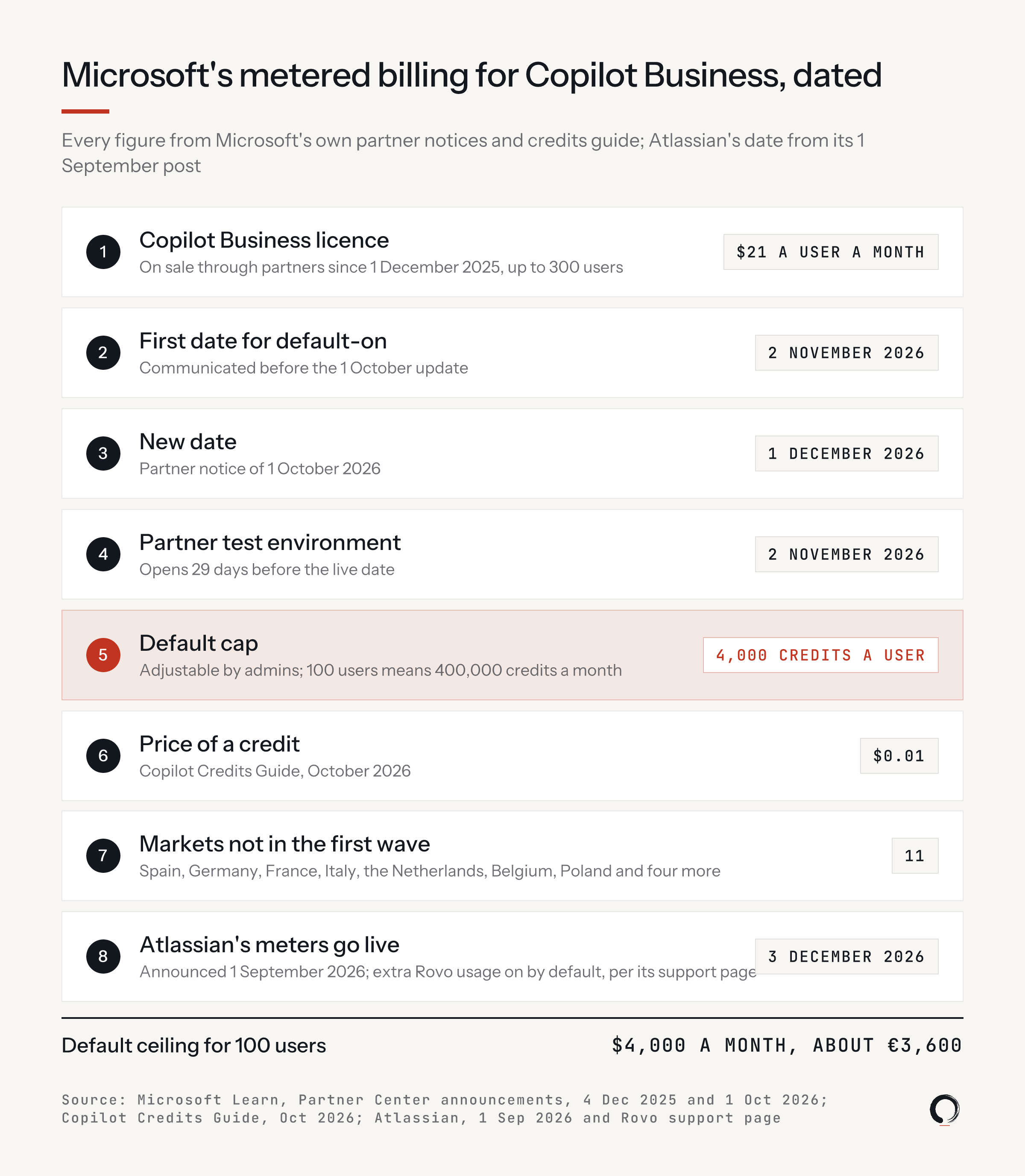
In between, on 2 November, partners get a test environment, "to help drive partner technical readiness and testing". Each new licence carries a default cap of 4,000 Copilot Credits a user a month. Admins can change it.
A credit costs one cent, by Microsoft's Copilot Credits Guide of October 2026. So the default ceiling is about $40 a user a month, roughly €36. The licence itself has cost $21 a user a month, about €19, since 1 December 2025.
A pricing decision reaches revenue on the day one seller can explain it to one customer, and Microsoft has just given that day one more month. I read this as a strategy-implementation problem. The plan is set and priced. Whether it reaches the working week of the people who sell and serve it is the open question.
The short version
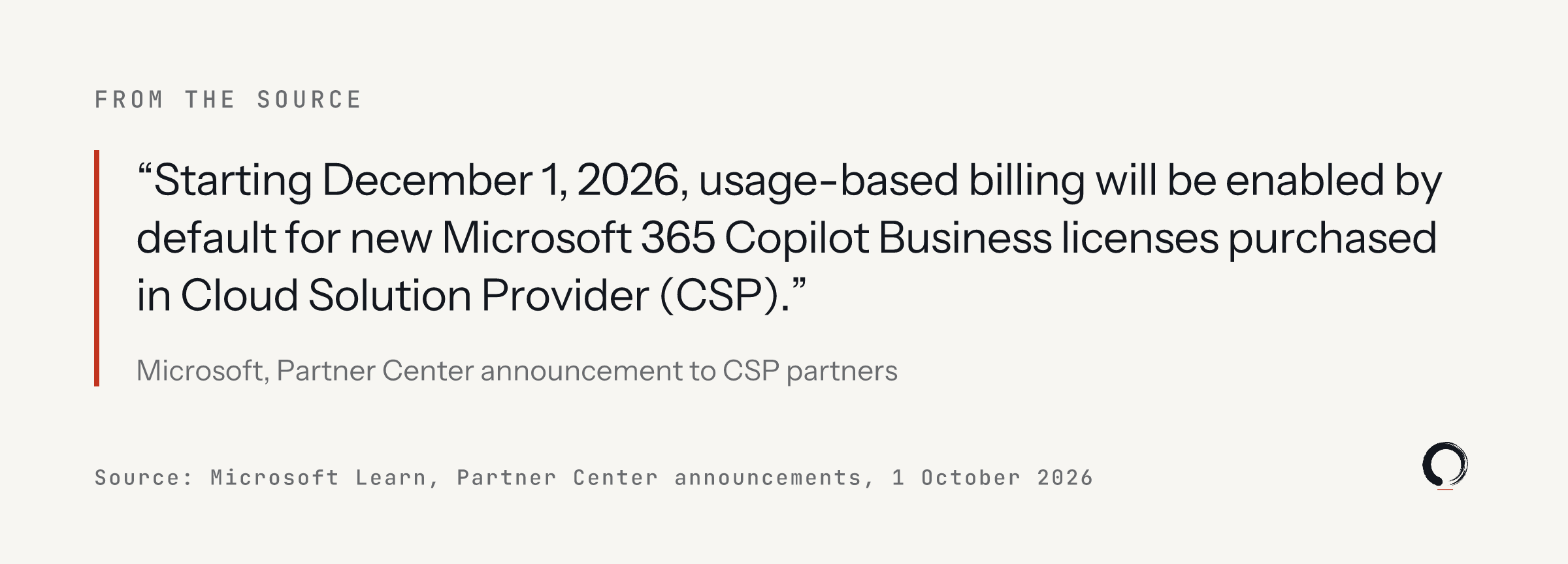
From 1 December, new Copilot Business licences in Microsoft's partner channel come with usage billing switched on, unless someone turns it off.
The default cap on that use, about $40 a user a month, is worth nearly twice the $21 licence.
Partners have 29 days between the test environment and the live date, and eleven markets, Spain among them, wait.
What Microsoft decided, and when
Copilot Business went on sale through partners on 1 December 2025 at $21 a user a month, for customers of up to 300 users. On 25 September 2026 Microsoft put the new model in one sentence: "User subscriptions support everyday Copilot value, while usage-based billing gives customers flexibility to access advanced capabilities."
The 1 October notice is the piece that touches a seller's week. Partners are asked to "familiarize your teams with the upcoming change and the preset monthly limit" and to "help your customers understand their usage-based billing options". It gives no reason for the new date. It names eleven countries left out of the first wave: Australia, Belgium, Brazil, France, Germany, India, Italy, Korea, the Netherlands, Poland and Spain. Microsoft's own case for the default is less work, not more: new licences "include the Azure subscription setup needed for usage-based billing", with "less effort spent on multistep billing configuration".
CRN reported on 2 October that partners can set the limit to zero, and that the Azure subscription for metered billing is now created at purchase. Reading Microsoft's partner FAQ, CRN adds that the transacting partner "is ultimately responsible for all charges under the CSP transacting account, including unexpected consumption". One partner, Chris Regan of B&R Business Solutions, told CRN that teaching customers how consumption pricing works is "definitely a new revenue stream for us".
Atlassian is on the same calendar. On 1 September its chief product and AI officer, Tamar Yehoshua, wrote that "the value of software outgrows what seat count alone can capture". Billing for its metered capabilities "will go into effect on December 3, 2026", and its Rovo support page says extra usage is "enabled by default", with admins able to disable it. Two companies, two December dates, and in both a default somebody has to explain.
One renewal, before and after
Take the smallest unit: a partner's seller renewing a 100-user customer on 1 December. Microsoft's own example uses that size.
Before, the seller sold 100 licences at $21, which is $2,100 a month, about €1,900. If the customer wanted usage-based products such as Cowork, CRN reports, the partner or the customer set up an Azure subscription afterwards.
After, the licence arrives with the Azure subscription and a default policy of 4,000 credits a user. For this customer that is up to 400,000 credits a month, $4,000, about €3,600, charged on actual use.
On my reading from outside, the seller now explains, in the same meeting, a ceiling worth nearly twice the licence, what a credit buys, and who approves a user who hits the limit.
Microsoft has published the dates, the cap and the training material, not the conversation.
On that reading, the seller who tested the sandbox sells a ceiling. The one who did not sells a risk, and the customer's admin sets the limit to zero.
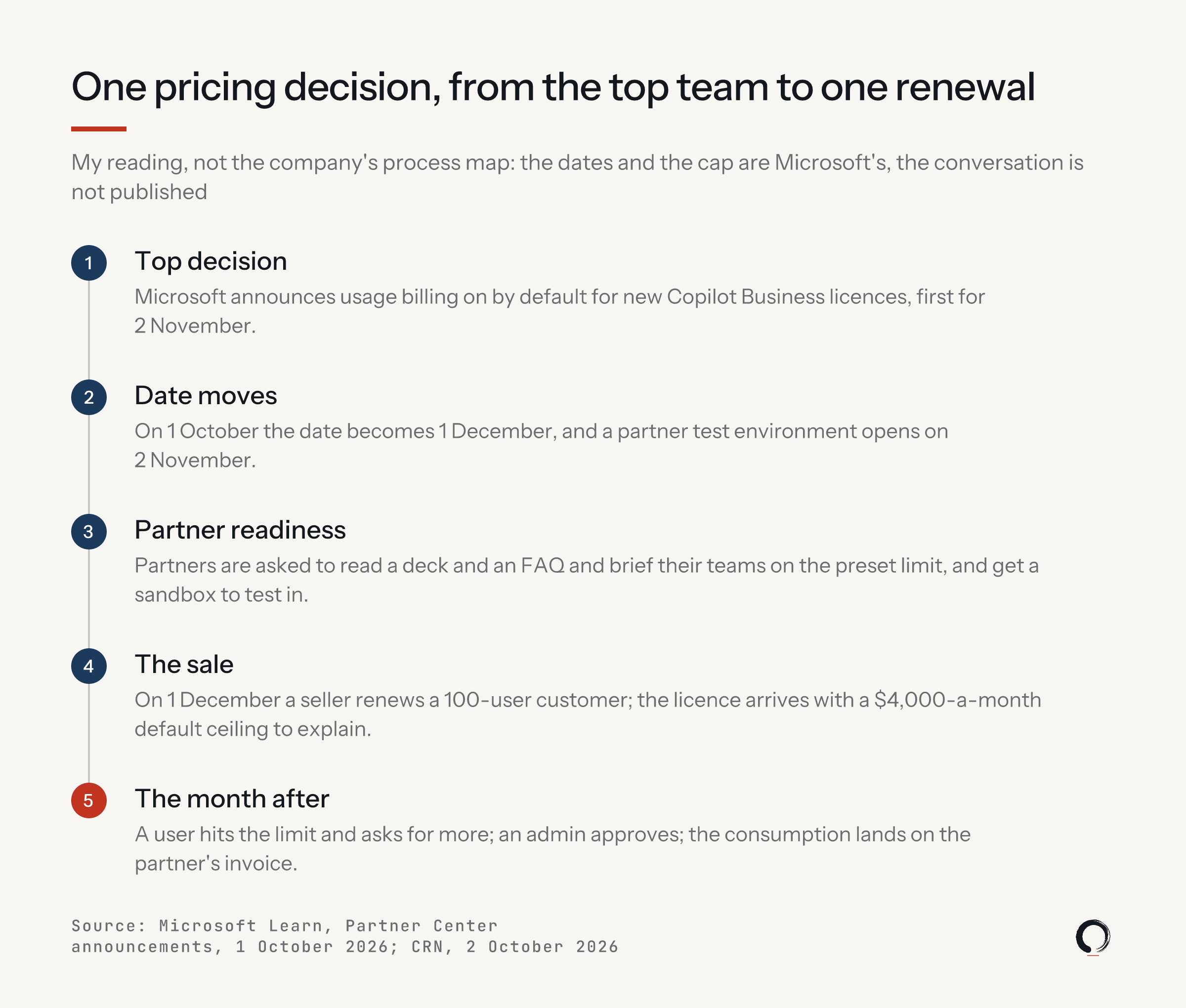
The cause sits in how a plan reaches the working week. The decision is dated and priced. Whether the people who sell it can explain it by the date is not yet known.
On that reading, the symptoms are work done twice, a limit set to zero in December and reset in January, and targets missed, when consumption that was meant to grow never starts. The bill is what did not happen. I would price it at the margin the metered layer should have produced.
The bill, in the company's own units
Microsoft's example customer has 100 users. The licence is $2,100 a month, about €1,900. The default ceiling on metered use is $4,000 a month, about €3,600.
Suppose a seller who was not briefed turns the ceiling into a fear, and the admin sets the limit to zero. Suppose a briefed seller would have activated a quarter of the ceiling. That is $1,000 a month, about €890, or $12,000 a year, about €11,000, from one customer: nearly half the licence revenue again.
A partner with 20 such customers loses $240,000 a year, about €210,000, of consumption that did not happen. The quarter and the 20 are my placeholders. The 100 users, the $21, the 4,000 credits and the cent are Microsoft's.
"This is channel plumbing at Microsoft, not my commercial organisation." It is also the shape of every pricing change you will make: a decision, a date, and a person who says the new price out loud. You control the days between the two.
What this does not establish
I would not conclude that Microsoft moved the date because partners were not ready. The notice gives no reason. The one partner CRN quotes says the shock has passed. What would settle it is a count: on 8 December, the share of new tenants whose default limit was changed in the first week.
Where Kihon stands
I read a one-month delay and a sandbox as the honest cost of a pricing strategy reaching the people who sell it, and most of that cost is never counted. This is the gap Kihon counts: the distance between the quarter a plan is decided and the week it is run.
When a revenue system has to be taken through a change like this, that is Kihon's Operation work: the handover from the decision to the sellers' calendar, with a date and an owner for each step. My doctoral research asks what it costs when the way of working lags behind the plan, and this is the case in software and technology this quarter. If you have a pricing date in your own diary, thirty minutes on your numbers is where it starts: kihonlabs.com/contact.
One thing to try this week
- List every pricing or packaging change your company has dated for the next two quarters.
- Write, for each, the day a customer first hears it from your people, and count the days between.
- Book the briefing for the people who sell and serve in the first half of those days.
Three questions to ask
How many days between the decision and the first customer?
Microsoft gave its partners 29 days of sandbox before 1 December. Count your own, from sign-off to the first customer conversation.
Who explains the default, and can they?
The person in the renewal meeting. Ask three of them to explain the new price to you in two minutes.
What does a wrong default cost us?
On Microsoft's example, up to $4,000 a month per 100 users, about €3,600, against a $2,100 licence.
Sources
- Microsoft Learn, Partner Center announcements, "Update: Usage-based billing is default on for new Microsoft 365 Copilot Business licenses starting December 1, 2026", 1 October 2026
- Microsoft, Copilot Credits Guide (PDF), October 2026
- Microsoft Learn, Partner Center announcements, "Now live: Microsoft 365 Copilot Business SKUs, bundles, and promotions", 4 December 2025
- Microsoft Learn, Partner Center announcements, "Introducing the new Copilot: One connected experience, designed for the next phase of AI-powered work", 25 September 2026
- Microsoft Learn, Usage-based billing and cost management for Copilot Credits, 30 September 2026
- CRN, "Microsoft delays default Copilot usage-based billing to Dec. 1, adds spending cap option", 2 October 2026
- Atlassian, "Atlassian's usage-based pricing: AI value with predictability and control", 1 September 2026
- Atlassian Support, "How Rovo credits work", read 8 October 2026
Your turn: How many days did your last pricing change give the people who had to explain it? Write to me at cemgorer@kihonlabs.com, or answer on LinkedIn. I read every reply.