
Barclays told its UK colleagues in July that most of them would work three days a week in the office from 5 October, up from two. Senior leaders would do four.
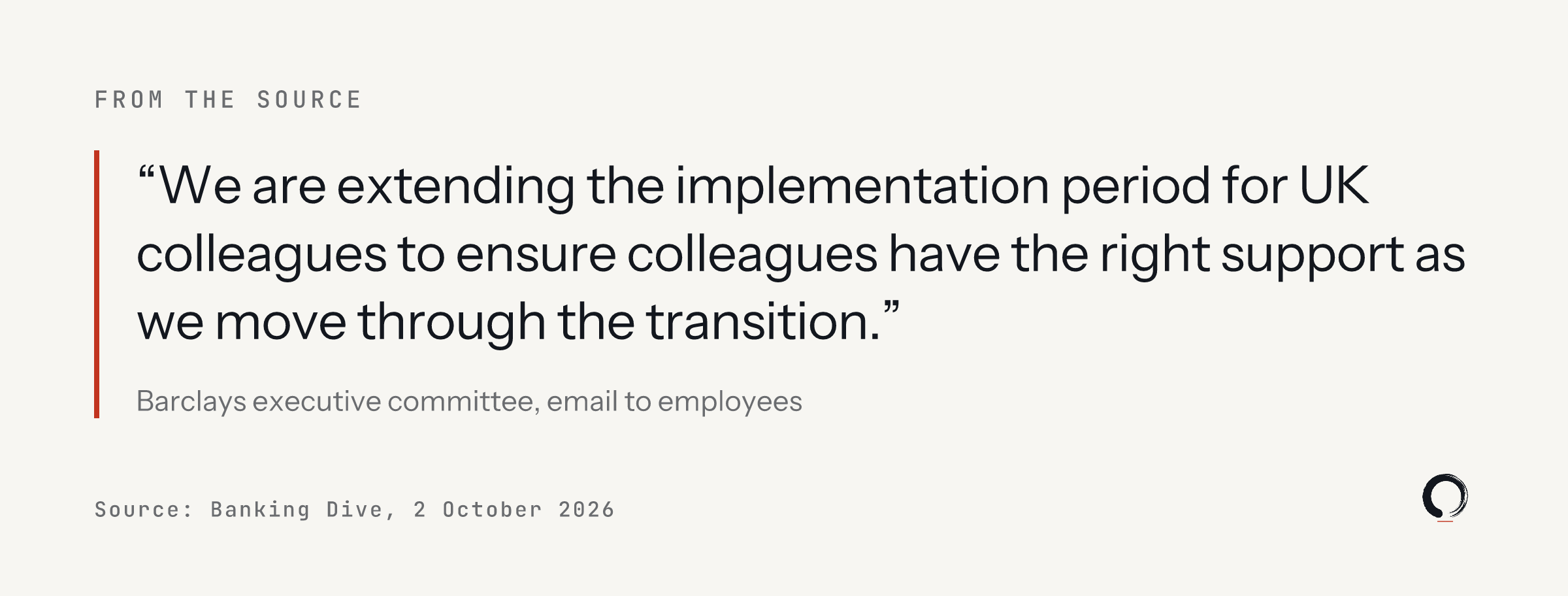
Then its executive committee wrote to them: "We are extending the implementation period for UK colleagues to ensure colleagues have the right support as we move through the transition."
The new date is the start of 2027, FStech reported on 30 September and Banking Dive on 2 October.
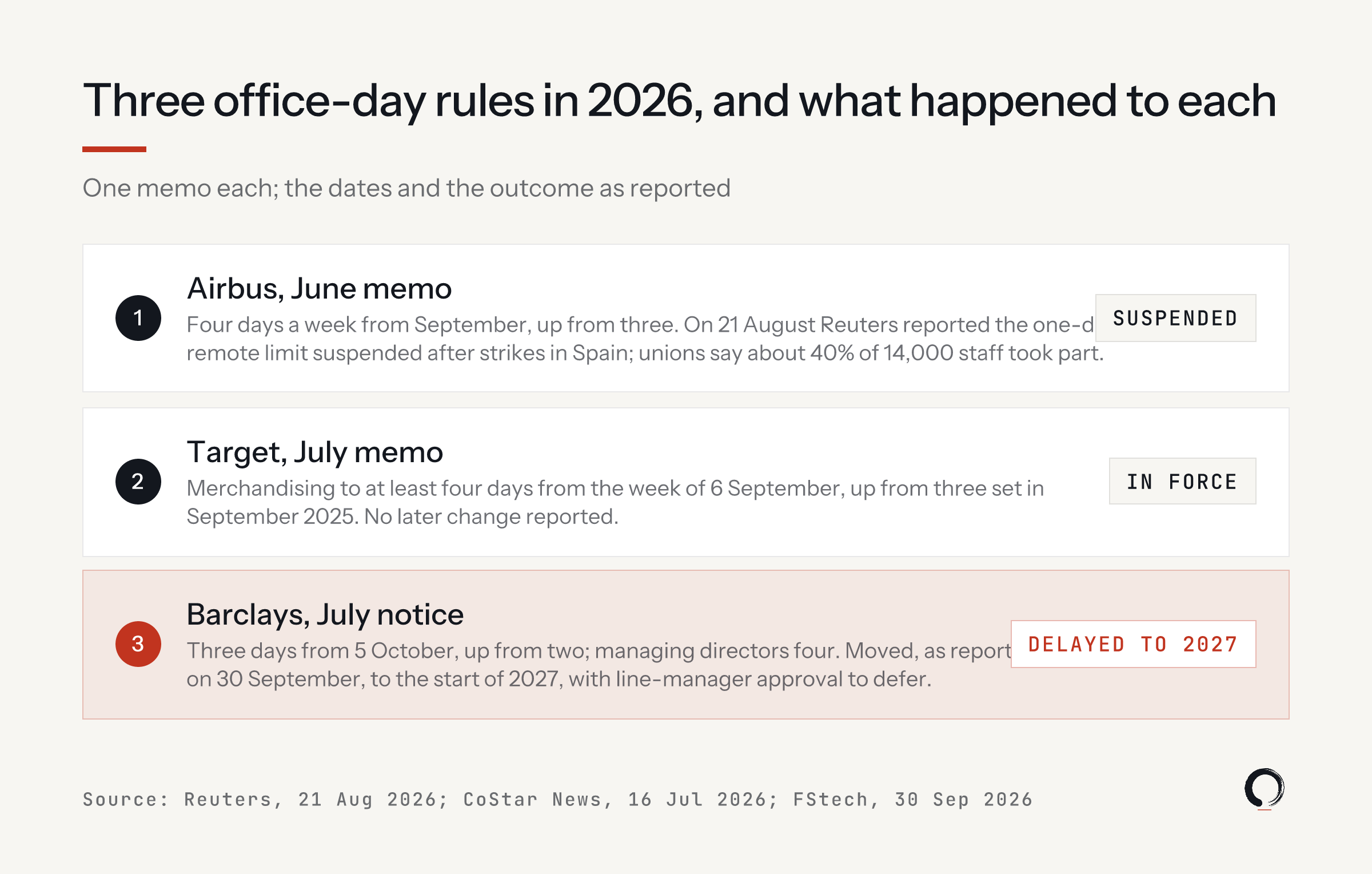
Airbus went first. In June its chief executive wrote to staff, and the plan put white-collar staff on site four days a week from September, up from three. On 21 August, after strikes in Spain, Reuters reported that managers may let staff keep arrangements that average two remote days a week, and a spokesperson said the company would "implement this transition more gradually".
Target went the other way. CoStar News reported on 16 July that its merchandising division goes to at least four days a week from the week of 6 September. I found no later report that the date moved.
Three companies changed the week of thousands of people with one memo each, and I found no public count, from any of the three, of what the extra day costs the people who live it. This is a working-conditions problem: the setting of the work changed, and the dates show how people answered.
The short version
Airbus, Target and Barclays each added one office day a week in 2026, and two of the three dates then moved.
At Barclays each delay is now a line manager's decision, made while the flexible-working policy is reviewed.
The cost sits in hours and in people who leave, and you can count both before you sign.
Three memos, three outcomes
The Airbus plan covered white-collar staff, Reuters reported. In Spain, strikes ran from 1 July, and unions put participation at about 40% of 14,000 employees. On 21 August a spokesperson said the objective "remains the same" and that "effective change requires listening to our people". The proposal put to the unions on 4 September keeps two remote days a week, industry TALKS reported.
Target's merchandising division, the buyers and planners who choose the assortment, went to three office days in September 2025. Rick Gomez, then chief commercial officer, wrote that it would "help us grow our business faster". CoStar reported on 16 July that the same group goes to at least four days from the week of 6 September. A spokesman said in-person time "has enabled faster decision-making, stronger partnerships". Neither report says how many people the rule covers.
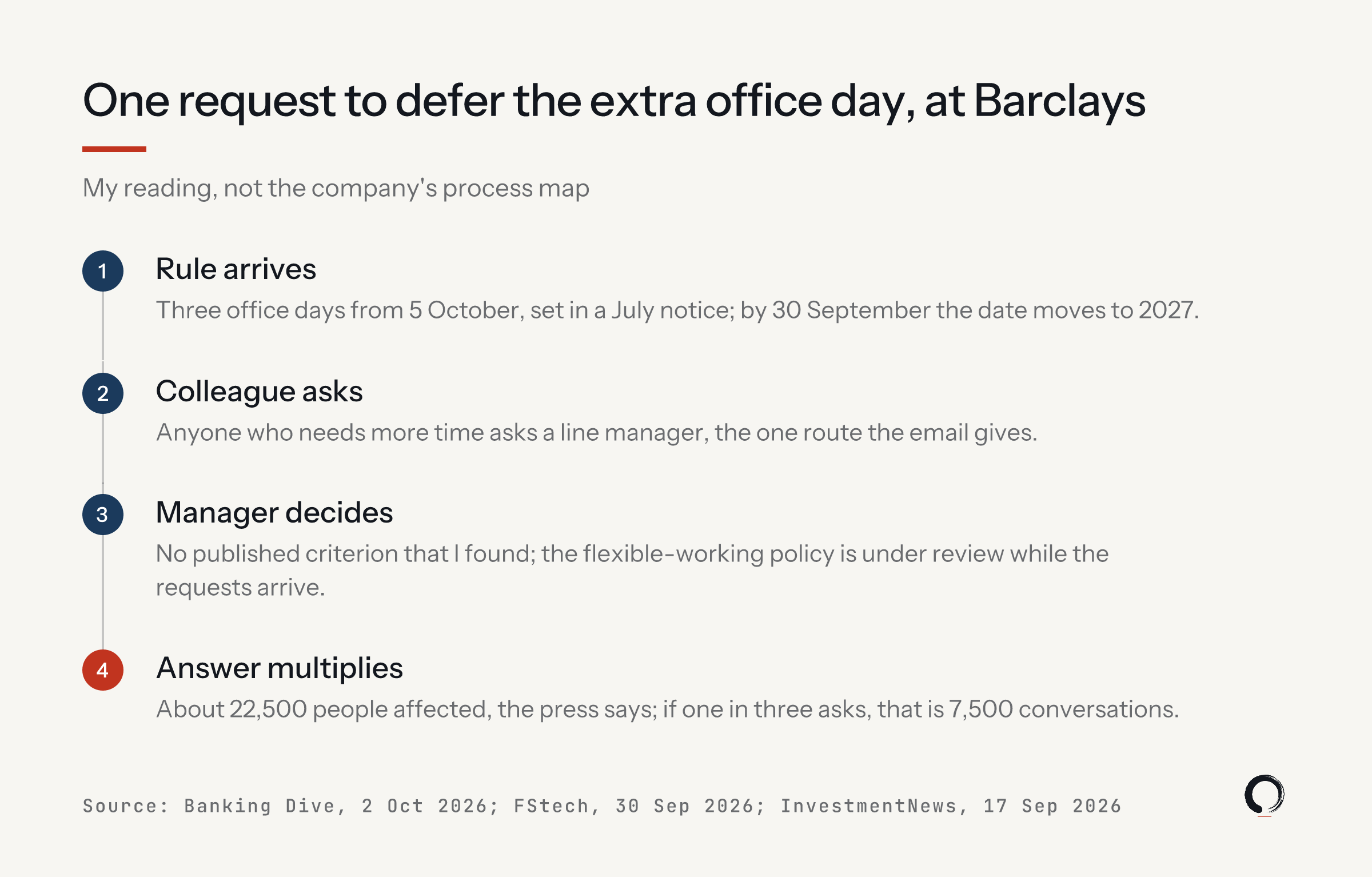
Barclays first asked for three days in January 2025, Personnel Today reported. The July notice made three the minimum for most UK colleagues and four for managing directors. The press puts the UK workforce at about 45,000 and the affected group at roughly half, operations and technology first. Unite, which the press says represents about 36,000 of them, asked for exemptions above 40 minutes or 35 miles each way, one office day for carers, and a one-off payment before March 2027. By 30 September the date had moved to 2027. Anyone who wants the extra time must ask a line manager.
One extra day, one request, one manager
Take one Barclays colleague who works two office days today and commutes 40 minutes each way, the union's threshold. The rule adds one day: 80 minutes of travel a week, plus fares and childcare.
The email gives one route for anyone who needs more time: ask your line manager. How that request travels inside is my reading from outside; the bank has published no process.
I found no published criterion for the manager, and the flexible-working policy is under review in the same weeks the requests arrive.
Now multiply by the roughly 22,500 people the press says are affected.
If one in three asks, that is 7,500 conversations, two people in each, before a single extra day is worked.
I read the three cases the same way. The cause is the setting of the work: where it is done and how far you travel to do it.
The symptoms are people's work: colleagues who leave, colleagues who do not come in, decisions that wait on an answer about a Tuesday.
The bill is what did not happen, and I price an hour at the margin it should have produced, never at salary.
The bill, in the company's own units
Barclays reported group income of £29.1 billion for 2025, about €34 billion, and about 93,000 colleagues. That is roughly £313,000 of income per colleague a year, about €370,000, or £174 an hour on an 1,800-hour year, about €210.
The conversations first: 7,500 of them, an hour each, two people, is 15,000 hours, about £2.6 million, roughly €3.1 million, before anyone travels.
Then the leavers. Suppose one in fifty of the 22,500 leaves over the rule: 450 people, each seat empty for 90 working days. At £1,250 of income a day per colleague, that is about £51 million, roughly €60 million, of work that did not happen.
Every input in those two paragraphs except the £29.1 billion, the 93,000, the 45,000 and the half is a placeholder. The method is not.
"Office days are an HR policy. Why is this a revenue question?" Because at Target the rule lands on the people who choose what the stores sell, and at Barclays, by the press account, on operations and technology first. The hours and the leavers reach your commercial numbers before any HR report.
What this does not establish
Office rules do not fail on this evidence: Target's rule is in force, Airbus says its objective "remains the same", and Barclays moved a date, not the rule. Nor does it show that an extra day cuts or raises output, because none of the three has published a measure. What would settle it is a count: hours added per person, and leavers in the two quarters after the rule, against teams it did not touch.
Where Kihon stands
I read these three memos as changes to working conditions made without a number for what they cost the people who do the work. We count it before the memo goes out: hours added to each week, requests a manager must decide, people likely to leave, priced at margin. When a leadership team is about to sign a rule like this, the Executive Workshop puts that count on the table in one session, desk by desk. If a date like 5 October is in your own diary, thirty minutes on your own numbers is where we would begin.
One thing to try this week
- Count the travel hours your next office rule adds, per person per week, before you sign it.
- Write the exemption rule in one line with a name under it, so no line manager decides alone.
- Ask the ten people most likely to leave what the rule costs them, and write the answers down.
Three questions to ask
Did the three companies give the same reason?
Nearly. Airbus named knowledge transfer and faster decisions, Target faster decisions and stronger partnerships, Barclays the benefits of working together in person, with collaboration and leadership visibility for its senior leaders' extra day. None gave a number.
What did the delay change at Barclays?
The date and the decision-maker. The rule stands, but until 2027 each exception is a line manager's call.
What should you measure before your own rule?
Hours added per person per week, and leavers in the two quarters after the date, against teams the rule did not touch.
Sources
- Banking Dive, Barclays moves its office date to 2027, 2 October 2026
- FStech, Barclays delays three-day office mandate after staff backlash, 30 September 2026
- Banking Dive, Barclays employees and union push back on office rules, 21 September 2026
- InvestmentNews, Barclays faces staff revolt over tightened return-to-office rules, 17 September 2026
- Personnel Today, Barclays' latest return-to-office mandate sparks staff backlash, 17 September 2026
- Barclays PLC, Annual Report 2025, 10 February 2026
- Reuters via Investing.com, Airbus backs down on return-to-office after protests, 21 August 2026
- industry TALKS, the Airbus Spain strike and the 4 September proposal, 8 September 2026
- elDiario.es, Airbus staff strike over pay and remote work, 3 July 2026
- CoStar News, Target to require more time in the office as part of turnaround plan, 16 July 2026
- Twin Cities Business, Target issues return-to-office orders, 10 July 2025
- Retail Dive, Target names COO and chief merchant, 10 February 2026
- Target Corporation, 2025 Annual Report (Form 10-K), fiscal year ended 31 January 2026
Your turn: when your company last changed its office days, who counted the hours it added to each person's week? Write to me at cemgorer@kihonlabs.com, or answer on LinkedIn. I read every reply.