
On 1 October Accenture told investors what a year of training looks like at its size.
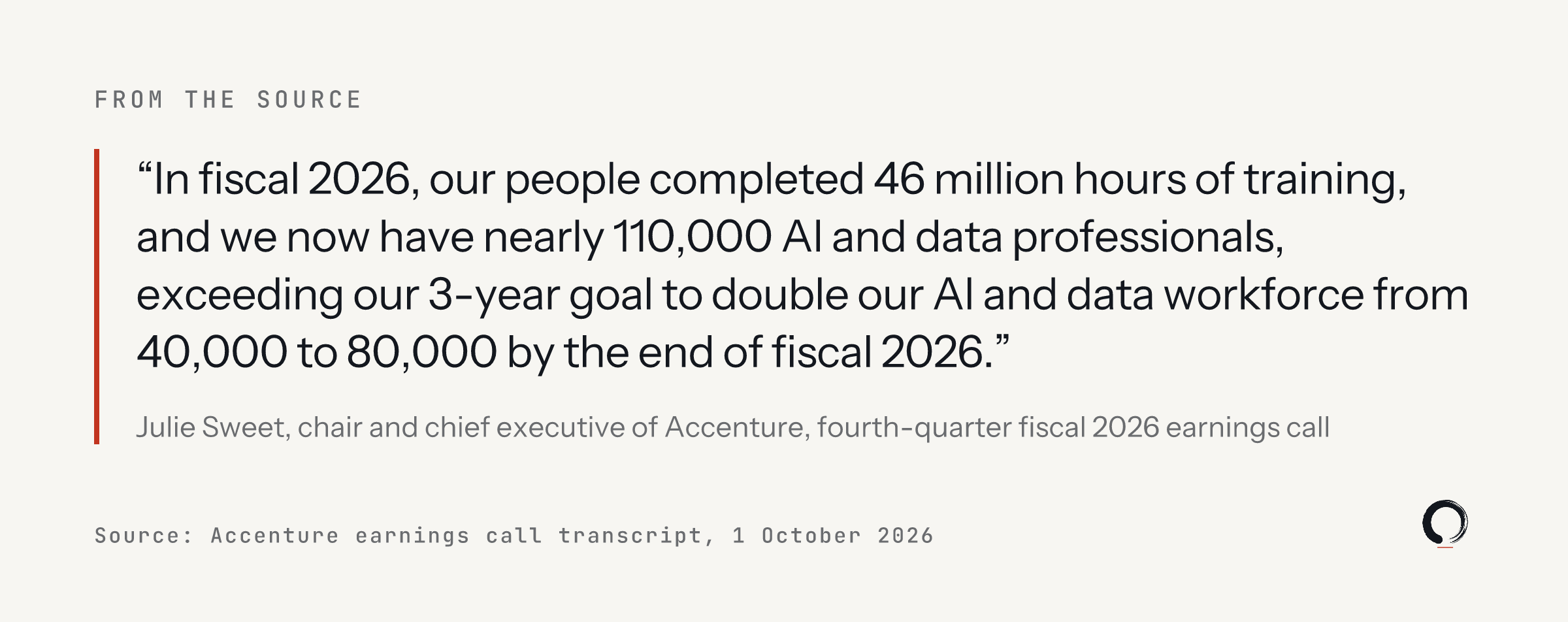
Its people completed 46 million hours of training in the year to 31 August 2026. Chair and chief executive Julie Sweet said so on the earnings call. The company put $1 billion, about €890 million, into learning and development. It now has nearly 110,000 AI and data professionals, against a three-year goal of 80,000.
A year before, on 25 September 2025, the previous year's call carried the other half of the decision.
Sweet said Accenture was "exiting on a compressed timeline, people where reskilling, based on our experience, is not a viable path for the skills we need". The six-month programme behind that sentence cost $923 million, about €830 million, "primarily for severance".
Accenture publishes training as a ledger: the hours, the money, the cost of exiting the people it could not retrain, and whether revenue per person rose afterwards. I read this as a training problem in the plain sense. Do the skills a new way of working needs reach the people who do the work, in time?
You can keep the same ledger for your commercial organisation.
The short version
Accenture spent about $1 billion a year on training in each of the last two years, and 46 million hours in the latest.
That is about 56 hours a person, and the company says revenue per person rose in the same year.
The people it could not retrain cost $923 million, mostly severance, to exit.
What Accenture reported, year by year
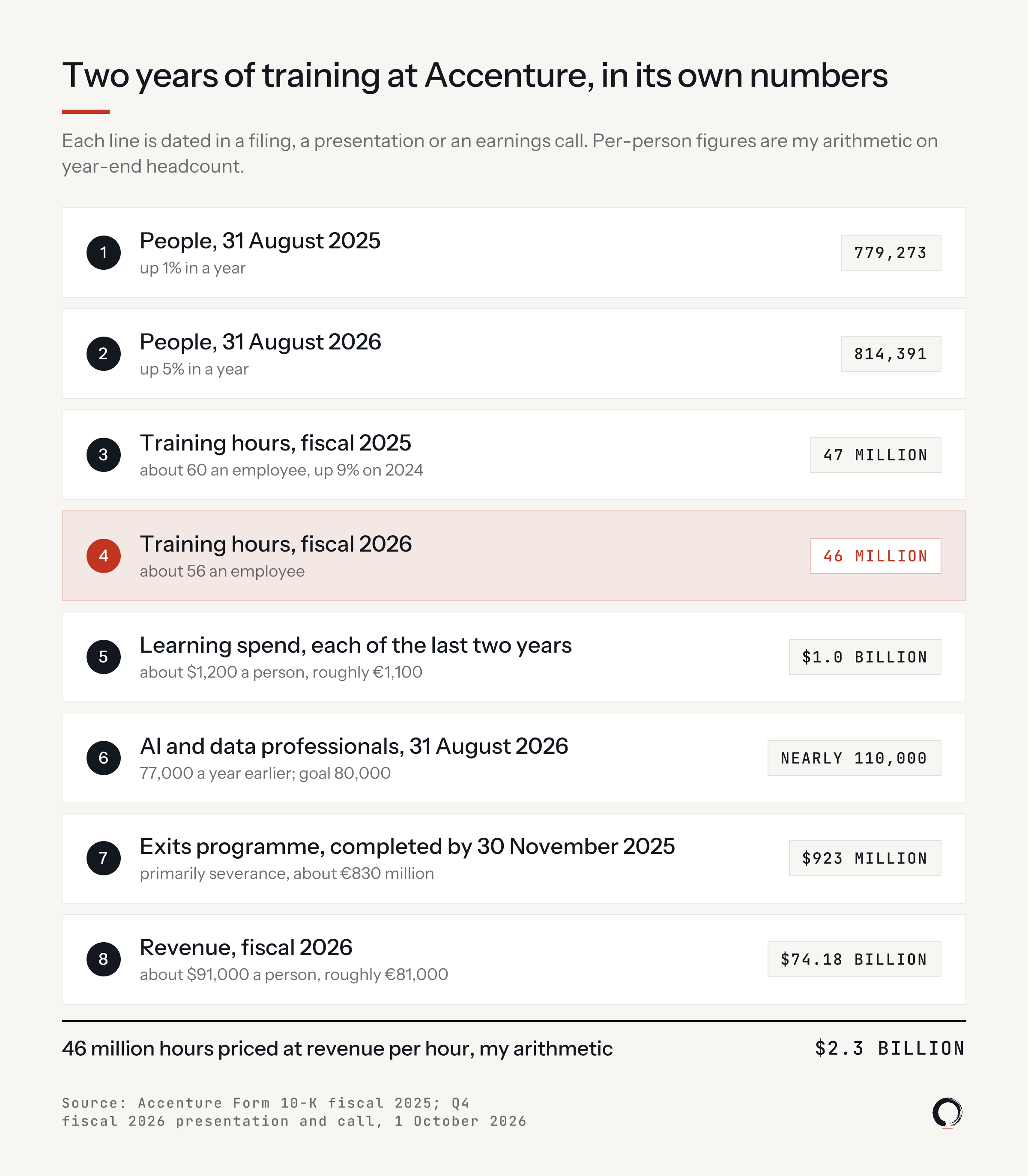
The annual report for the year to 31 August 2025 gives the starting point. Accenture employed approximately 779,000 people and invested approximately $1.0 billion in learning. It delivered approximately 47 million training hours, up 9% on the year before.
It had approximately 77,000 AI and data practitioners, and attrition excluding involuntary terminations was 14%.
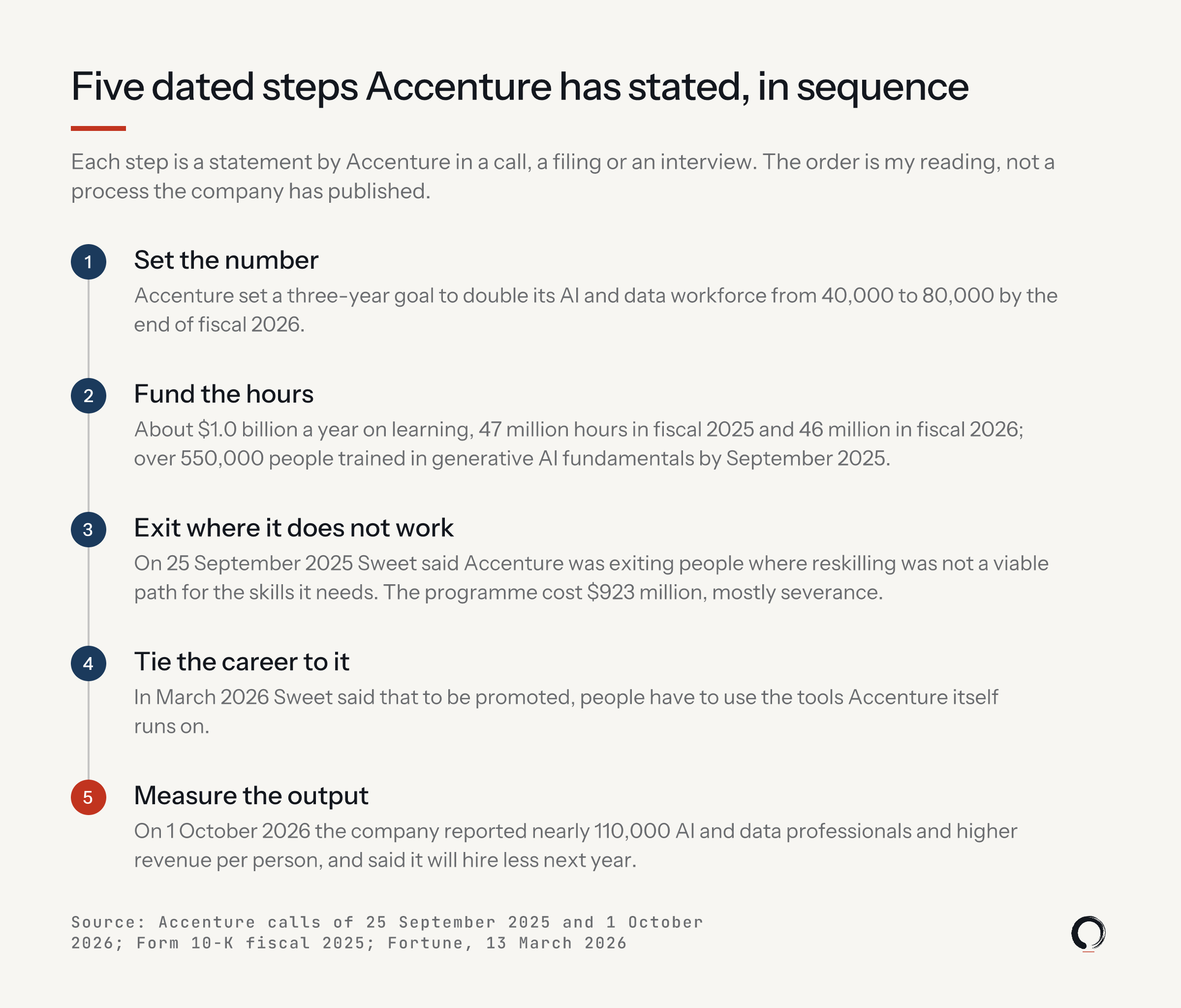
On 25 September 2025 Sweet set out a three-part talent strategy. Upskilling was "our primary strategy", with over 550,000 people already trained in the fundamentals of generative AI.
The second part was the exits. Chief financial officer Angie Park gave a charge of $615 million, with about $250 million more expected. It covered severance and the sale of two acquisitions. No number of people exited was given. The third part was finding efficiencies in how Accenture operates, including through AI.
In March 2026 Sweet told a podcast, as Fortune reported on 13 March: "If you want to get promoted, you've got to do the things that we do in order to operate Accenture."
On 1 October 2026 the presentation put headcount at 814,391, up 5% in a year, with voluntary attrition at 13%. Revenue was $74.18 billion, about €66 billion, up 6% in dollars and 5% in local currency.
Asked how headcount growth of 5% fits a model with more AI in it, Sweet said: "you saw that we increased revenue per person this year". She put the rise "in part due to AI, but we're also in growth mode".
Hiring next year "will be below what we've been hiring this year". No split of training hours by role is given.
The hours cost more than the budget
Take the smallest unit: one account manager, one new skill, one quarter.
Suppose there are no scheduled hours. The skill is learned on live customers. The first explanation is wrong. The customer asks finance, and a colleague redoes the quote. That is work done twice, and a renewal that closes a month late.
With the hours, the first mistakes land in a role-play and cost exactly the hour.
Salesforce's State of Sales is a vendor survey of 4,050 sales professionals in 22 countries, published on 3 February 2026. It found that 46% of reps rarely get feedback on their sales conversations. 41% do not get enough chances to role-play before customer calls. I read those as the hours that were not scheduled.
Accenture's five dated statements, read in order, are one way to schedule them. The order is my reading from outside, and Accenture has published no process map.
The cause sits in training: whether the people who face customers were taught the skill before the customer asked.
The symptoms are work done twice, targets missed, and people who leave with the skill. The bill is what did not happen. I would price the untrained hour at the margin it should have produced, never at the salary.
The bill, in the company's own units
Accenture's revenue of $74.18 billion over 814,391 people is about $91,000 a person, roughly €81,000. On a year of 1,800 working hours, that is about $50 of revenue an hour, roughly €45.
The 46 million training hours, at $50 an hour, are $2.3 billion of working time, about €2.1 billion. That is more than twice the $1 billion budget.
The real price of training is the hours.
The same hours are 56 a person, seven working days a year. For a commercial team of 100 people that is 5,600 hours, the full year of three people. The 1,800-hour year and the team of 100 are my placeholders. The rest are Accenture's.
"Hours measure attendance, not skill." True, and Accenture's own proof is not the hours. It is nearly 110,000 professionals against a goal of 80,000, and revenue per person, which rose.
What this does not establish
I would not conclude that the hours caused revenue per person to rise. Sweet herself credits AI and growth. The 47 million and 46 million hours may also be counted differently in the two documents.
What would settle it is a measurement by role: hours per person in each commercial function, against that function's output two quarters later.
Where Kihon stands
I read Accenture's two years as a training ledger most commercial organisations never keep: hours, money, exits and output, each with a date. We keep that ledger for commercial teams, and we price the hours at what they should have produced.
A Diagnosis puts a team's training hours and spend next to its revenue per person, by role, and names the skills that leave when people do. If you want the count on your own numbers, thirty minutes on your own figures is enough to begin.
One thing to try this week
- Count the training hours your commercial team logged last quarter, by role, next to each role's revenue.
- Price those hours at revenue per hour, never at salary, and put the figure beside the training budget.
- List the three skills your next motion needs and name who has them, who is learning them and who is not.
Three questions to ask
How many training hours did our commercial team log?
Most companies cannot answer. Accenture can, to the million. Start with the number by role.
Is training a cost line or a revenue line?
Both, and the revenue side is larger. Accenture's budget is $1 billion. The hours are worth about $2.3 billion at revenue per hour.
What does one untrained person cost us?
What did not happen: the renewal that slipped, the quote done twice. Price it at margin.
Sources
- The Motley Fool, Accenture Q4 fiscal 2026 call transcript, 1 October 2026
- Accenture, Q4 fiscal 2026 earnings presentation, 1 October 2026
- Accenture, fiscal 2026 results news release, Form 8-K exhibit, 1 October 2026
- Accenture, Form 10-K for the fiscal year ended 31 August 2025
- The Motley Fool, Accenture Q4 fiscal 2025 call transcript, 25 September 2025
- Fortune, Accenture's $865 million reinvention, 27 September 2025
- Fortune, Accenture CEO Julie Sweet on AI use and promotion, 13 March 2026
- Salesforce, State of Sales, seventh edition, 3 February 2026
- Salesforce, State of Sales announcement, 3 February 2026
Your turn: How many training hours did your commercial team log last quarter, and could you tell the board? Write to me at cemgorer@kihonlabs.com, or answer on LinkedIn. I read every reply.