
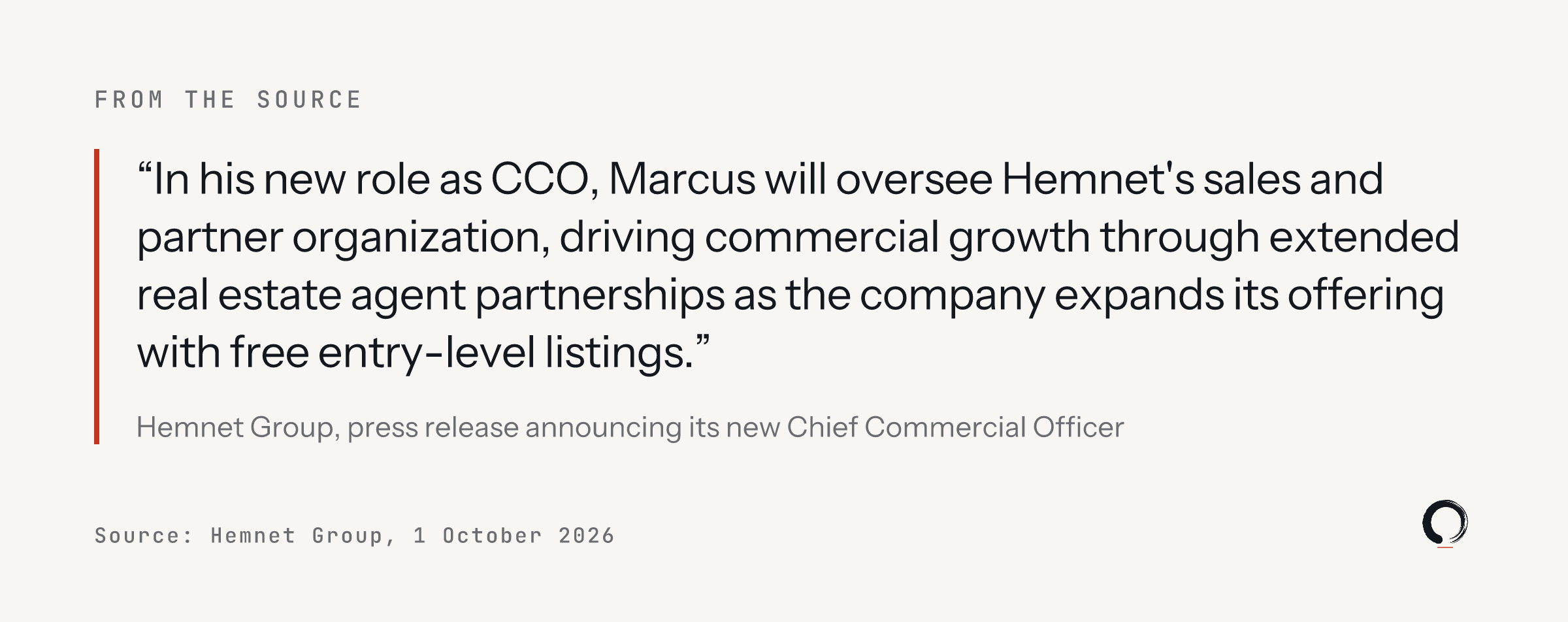
On 1 October Hemnet, the Swedish property platform, announced a new Chief Commercial Officer.
Marcus Hartwall, lately of the Irish portal Daft.ie, will oversee the sales and partner organisation and report to the chief executive.
Marcus Westerlund, Chief Sales Officer since 1 September 2025, becomes Sales & Partnership Director, which the release calls an operational role centred on estate agents and key partnerships.
Thirteen months earlier the same company had promoted him to the top team.
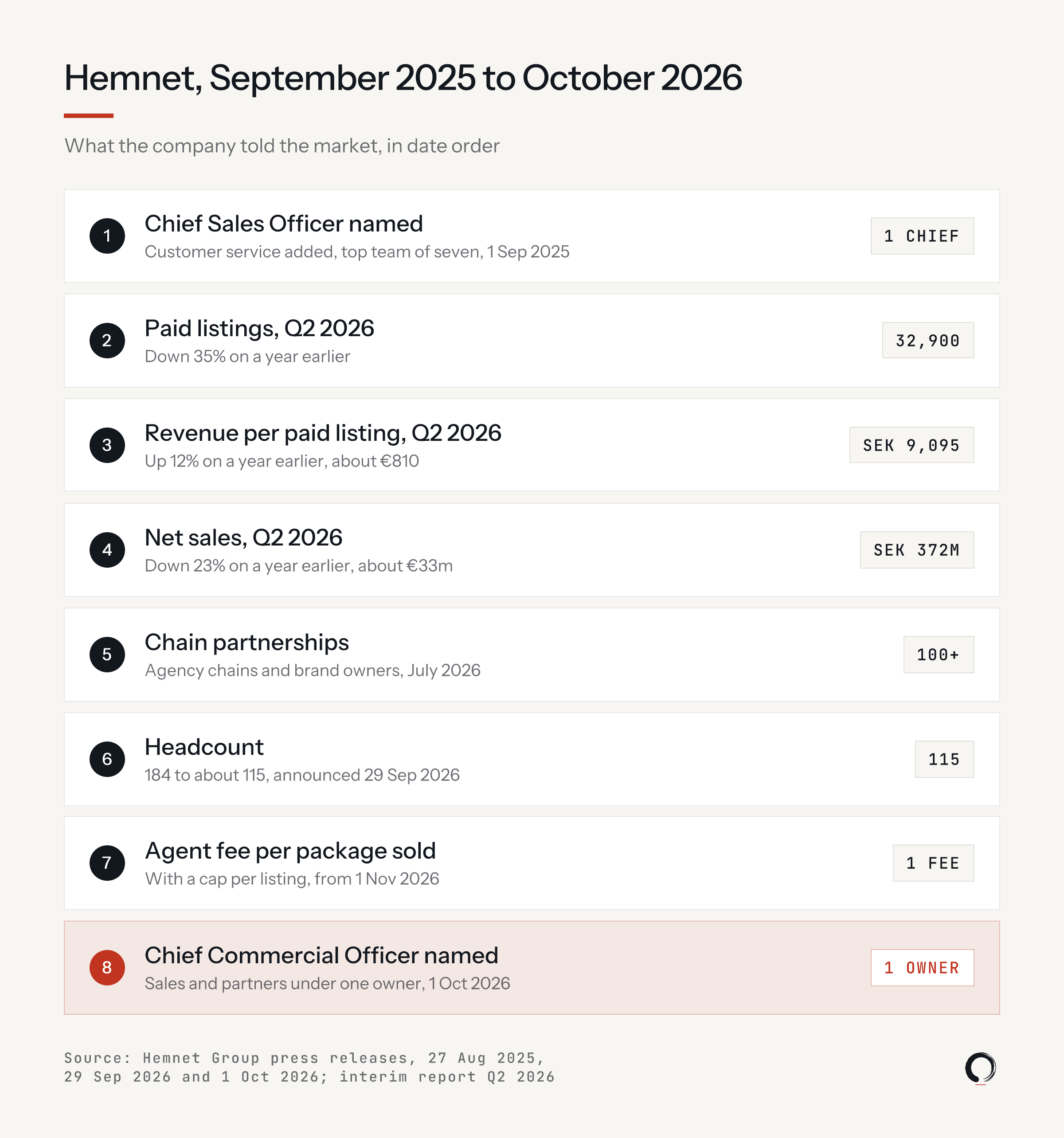
Two days before, on 29 September, Hemnet had told the market three things. Headcount goes from 184 to about 115. Free entry-level listings launch in late October. From 1 November, estate agent firms earn a set fee per package sold.
When the way revenue is earned changes, who owns the customer has to be decided again, and Hemnet decided it twice in 13 months. I read this as a work-organisation problem. The question is who owns what across sales, service, success and partnerships, and how an agent's question changes hands.
The short version
Hemnet changed who owns the estate agent relationship in September 2025 and again in October 2026.
In between, paid listings fell 35% and the company decided to remove roughly 70 of 184 jobs.
An owner named on a chart costs nothing; a handoff nobody wrote down is paid for on every listing.
One owner each, announced on 1 October
Westerlund joined Hemnet as Sales Director in August 2024. On 27 August 2025 the company made him Chief Sales Officer from 1 September. He kept the advertising sales team and agent relationships, and took on customer service from that date.
The top team went to seven.
By July 2026 the chief executive's quarterly letter named a new Customer Success function working with agents. It also counted more than one hundred partnerships with agency chains and brand owners.
The 1 October release gives Hartwall sales and partners. It does not say to whom Westerlund now reports, nor where customer service and customer success sit.
Today's management page lists seven executives and no sales chief.
The same day Civista Bancshares, a $4.3 billion (about €3.8 billion) bank holding company in Ohio, named Mark J. Sams Chief Revenue Officer. He has led treasury management, wealth management, private banking and healthcare solutions since January 2026, as Senior Revenue Officer.
The title followed the work by nine months.
At Civista the work moved in January and the chart caught up in October. At Hemnet the chart moved on 1 October and the work moves after it.
A third case shows what the other two leave out. On 24 August Eos Energy, a US battery maker, made Michelle Buczkowski Chief Commercial Officer, with sales, business development, government affairs, marketing and communications reporting to her. The release says she "owns the path from first customer engagement through order intake and revenue conversion".
That sentence has a start and an end.
The chart and the work move apart
Take the smallest unit: one estate agent recommends a Premium package to a home seller. From 1 November the agent's firm earns a set fee for that package, capped per listing.
Now count who touches it.
Someone in sales sold the package to the firm. Someone in customer service takes the call when the listing does not show. Someone in customer success helps the agent use the tools. Someone in partnerships holds the agreement with the agent's chain. Someone set the cap.
In September 2025 the first two sat under one chief. During 2026 a third team appeared. On 1 October the sale and the partnership got one owner. Service and success are not named.
Now multiply. Hemnet sold 32,900 paid listings in the second quarter, about 2,500 a week, through more than one hundred chain partnerships. Soon it will do so with roughly 115 people.
Every agent question with no written owner crosses at least one desk.
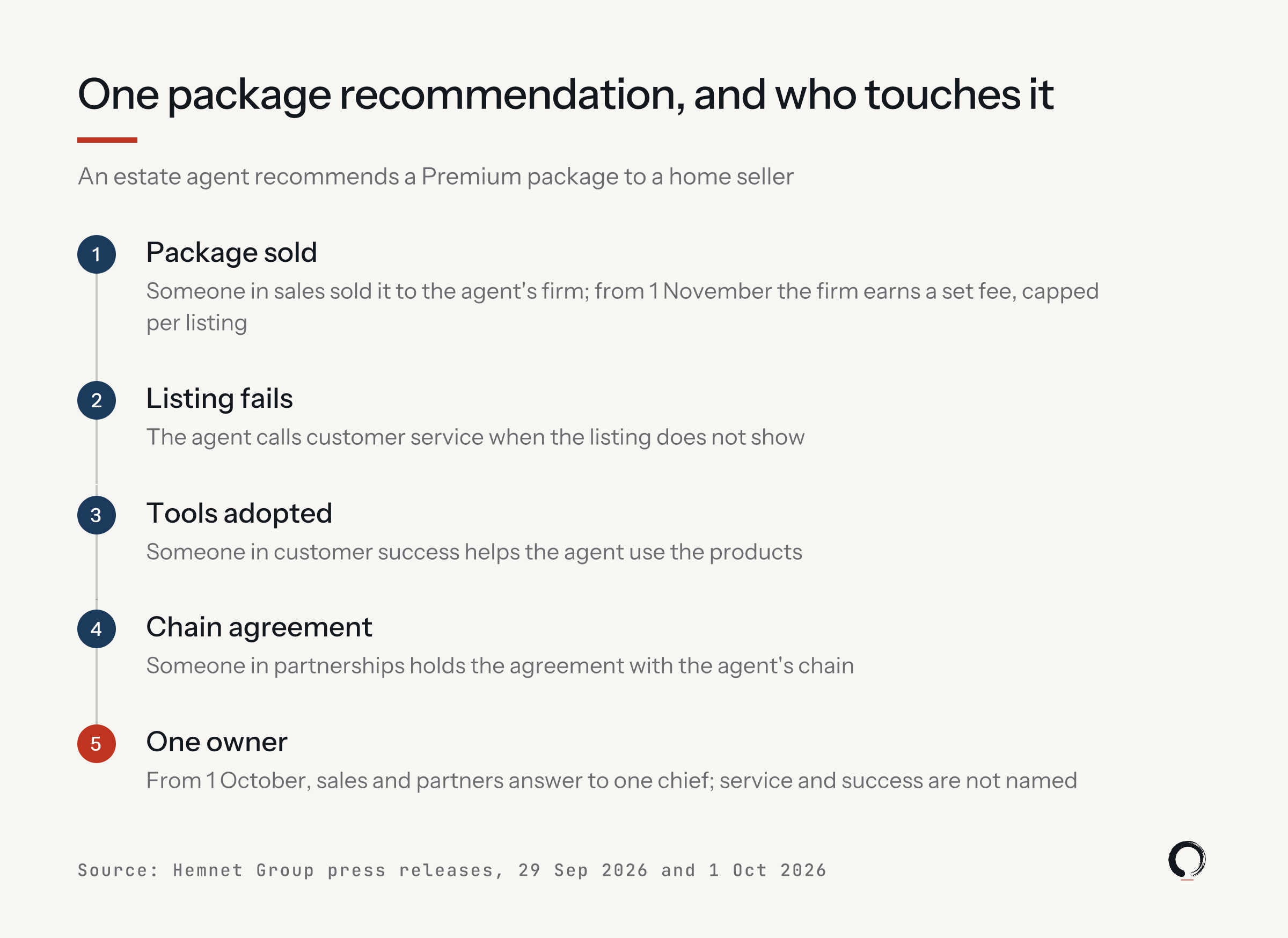
The cause sits in how the work is organised. Five people can touch one package, and the release names an owner for two of them.
The symptoms are work done twice, when two desks answer the same agent, and targets missed, when nobody recommends the upgrade.
The bill is what did not happen.
I would price a lost listing at the margin it should have earned. Hemnet's operating margin was 40% in the second quarter, so a lost listing costs far more than the hour spent on the question.
The bill, in the company's own units
Hemnet sold 32,900 paid listings in the quarter at SEK 9,095 each, about €810. Suppose one in a hundred is lost at a handoff: the agent publishes it free, nobody owned the recommendation, the seller never saw the package.
That is 25 home sellers a week without a package, about SEK 230,000 of net sales a week (€20,000), and close to SEK 12 million a year, about €1.1 million, at the second-quarter pace.
The one in a hundred is a placeholder. The SEK 9,095 and the 32,900 are Hemnet's own.
Set it against the SEK 80 to 85 million, about €7.1 to 7.6 million, the restructuring is meant to save each year. A handoff loss of one listing in fourteen would consume the whole saving, and you would not see it on any cost line.
"A new chief is a hiring decision. The work underneath stays the same." The hire comes with a seat over sales and partners, and the sales chief moves to an operational role.
What this does not establish
I would not conclude that the reorganisation caused the fall in listings or will reverse it.
By the company's own account, revenue timing and the housing market did most of it.
What would settle it is a count. How many agent questions cross more than one desk in a week, taken in October and again in December.
Where Kihon stands
I read two changes of owner in 13 months as a handoff problem. The chart names who owns the agent; the agent's question still crosses sales, service, success and partnerships, and every crossing without a written rule is a place where a package goes unsold.
Kihon exists to catch exactly this before it reaches the P&L. Writing those rules down, one line and one name per crossing, is what Build does with a commercial team; the chart changes in a day, and this is the work that follows it. If your own chart moved this year, thirty minutes on your handoffs is where we would start.
One thing to try this week
- Write one owner's name next to each customer type your revenue comes through.
- Take the last ten customer questions that crossed a desk and count the hands each passed through.
- For every crossing with no written rule, write the rule in one line with a name under it.
Three questions to ask
Who owns the estate agent at Hemnet now?
Sales and partners sit under the new commercial chief, and the former sales chief runs agent relationships day to day. Where customer success and customer service sit is unstated, and that is the handoff I would watch.
Why does a pricing change redraw who owns the customer?
Because from 1 November an agent firm earns per package, with a cap. Whoever sets the cap, sells the package and holds the chain agreement must answer as one, or the agent gets three answers.
What would you measure first in your own company?
The number of hands one customer question passes through, by type of question. A week of counting tells you more than your chart does.
Sources
- Hemnet Group, press release, 1 October 2026
- Hemnet Group, press release, 29 September 2026
- Hemnet Group, interim report Q2 2026, 17 July 2026
- Hemnet Group, press release, 27 August 2025
- Hemnet Group, executive management page, read 6 October 2026
- Civista Bancshares, Form 8-K exhibit 99.1, 1 October 2026
- The Globe and Mail, 1 October 2026
- Eos Energy Enterprises, Form 8-K exhibit, 25 August 2026
Your turn: which customer question in your organisation crosses more than one desk before it is answered? Write to me at cemgorer@kihonlabs.com, or answer on LinkedIn. I read every reply.