

Barcelona, 29 November.
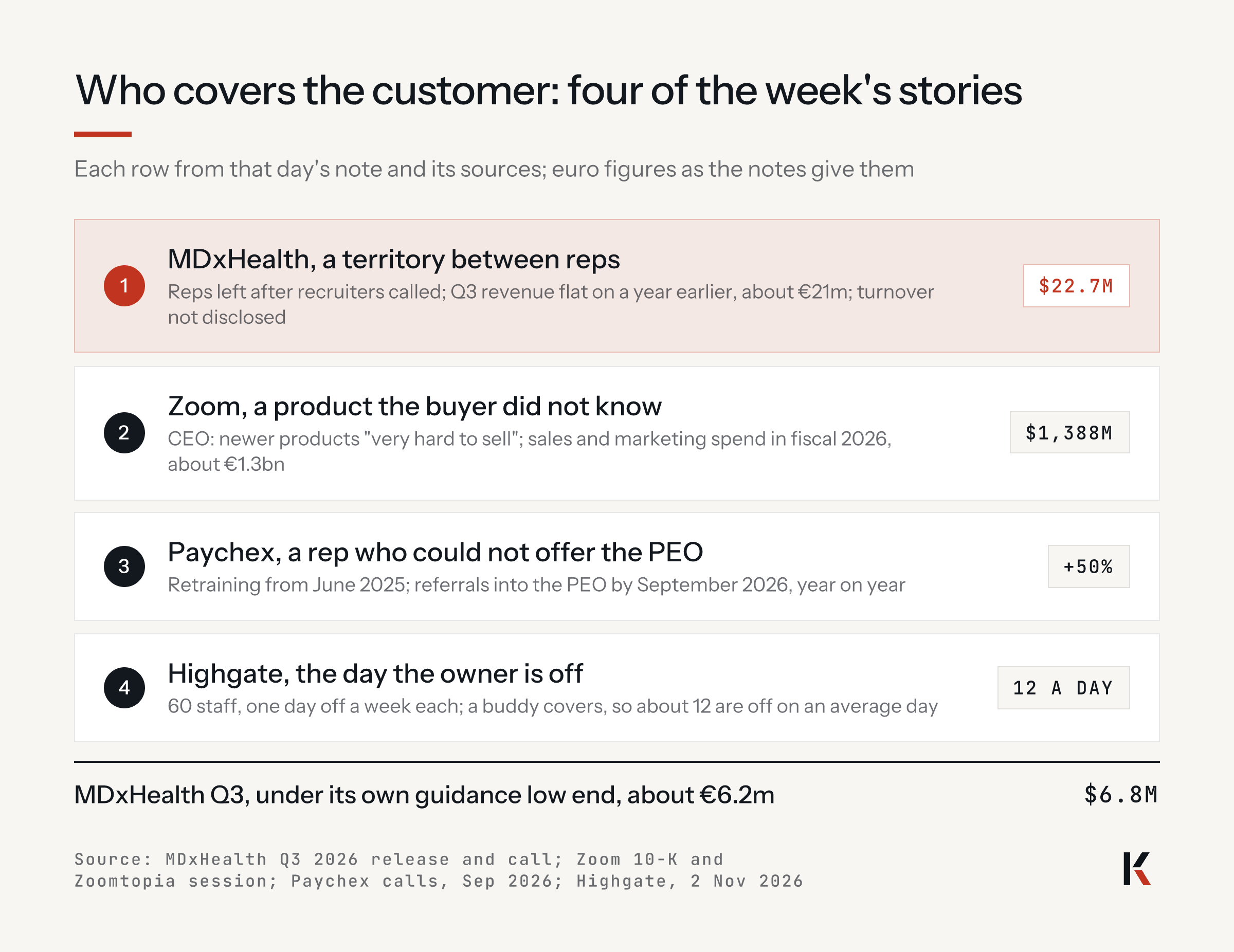
On 12 November, MDxHealth explained a flat quarter. Sales reps had left, it said, after aggressive approaches from outside recruiters.
Neither its release nor its call says who looked after their urologists in the meantime.
Eleven days later, Zoom's CEO said many customers do not know what Zoom offers. On Saturday, Highgate described who answers a client when the account owner is off.
Four of the week's six stories turned on one question: who covers the customer when the usual person cannot? The notes used six lenses: time, work organisation, coordination, strategy, training and working conditions. This question ran across four of them.
The short version
Four of this week's six stories turned on who answers the customer when the usual person is gone, off, or cannot present the product.
Highgate and Paychex wrote the cover into the work; MDxHealth and Zoom changed the reporting line at the top.
Where the cover was written into the work, the company reports a result, and neither result is separated from other causes.
The week in six
Monday, time management: “CSMs spend 65% of their week on low-value work”. Bain's survey of 235 leaders put 26 of a customer success manager's 40 hours into routine work. Read Monday's note
Tuesday, work organisation: “After reps left, MDxHealth put sales under the CEO”. Reps left after one of their four tests was dropped; third-quarter revenue was flat at $22.7 million, about €21 million. Read Tuesday's note
Wednesday, communication, coordination and cooperation: “Zoom ended CRO and CMO roles over product awareness”. Its CEO says many customers do not know the newer products; one president now leads marketing and sales. Read Wednesday's note
Thursday, strategy implementation: “monday.com cut 20%; sales disruption lasted longer than expected”. The cut has a date, 22 July; the end of the disruption it caused has none yet. Read Thursday's note
Friday, integrated training: “Paychex retrained its reps; cross-sell referrals rose almost 50%”. Retraining began in June 2025; by September 2026, referrals into the PEO were up almost 50%. Read Friday's note
Saturday, working conditions: “Highgate pays full salary for 28 hours; revenue tripled”. Each person takes one day off a week and a buddy covers; revenue is about three times higher, by its own count. Read Saturday's note
The week's teardown
Thursday's note was the teardown. monday.com reported the visible cut: about 20% of the workforce on 22 July. Net charges were $45 million to $55 million, about €41 million to €50 million. Savings: about $100 million a year.
The cost nobody books is the sellers' weeks between July and the end of the disruption, which the finance chief declined to size.
On the company's own guidance, one point of fourth-quarter growth is worth about $3.3 million, about €3.0 million. Read the teardown
What the six show together
The question the week answered is a plain one. When the person who usually answers a customer is gone, off, or cannot present what the company offers, who answers instead?
I read it through the socio-economic approach, SEAM, developed by Henri Savall and the ISEOR team in Lyon. It reads three lists together. The cause, the symptoms, the bill.
The cause, in four notes, sat in work organisation and training. MDxHealth's reps left over the summer. Its sources speak only of “fortifying impacted territories”.
Zoom's CEO says the habit was to hand each new product to the sales chief. Paychex's enterprise reps were, in its CFO's words, “only out selling a technology solution”.
Each story reaches the commercial organisation at a named point. At MDxHealth it is the quarter: the CEO puts flat revenue down to turnover in the sales force.
By the note's arithmetic, that quarter fell about $6.8 million, about €6.2 million, under its own guidance.
At Zoom it is the bid: “As long as ZVA is part of their RFP processes, we have a high confidence,” its CEO says. Zoom spent $1,388 million, about €1.3 billion, on sales and marketing last year.
At Paychex it is the upgrade. An ASO client that moves to the PEO brings about 3.5 times the revenue.
At Highgate it is the contract. Its 60 staff are each off one day a week, so about 12 are off on an average day, by my arithmetic. A customer reaches the same team, not always the same person.
Two of the four wrote the answer into the work itself. Highgate publishes its process. Each person picks a day off mid-month. A buddy or buddy group covers the workload.
Paychex taught it, from June 2025. Its CEO describes the rep's answer to a client who asks about health costs:
Guess what, I can't. Let me get one of my PEO partners in to talk to you. John Gibson, Paychex CEO, 2026
That is a rep who cannot answer, and knows who can.
Fifteen months after the retraining began, referrals into the PEO were up almost 50%.
The other two answered later, and at the top.
MDxHealth eliminated its chief commercial officer role and Zoom ended its CRO and CMO roles, each decided after the gap had been named.
The symptoms came back in two forms. One was staff turnover. MDxHealth lost reps; Brick Media counted six voluntary departures in 2022 and none so far in 2026.
The other is what the method calls a lack of direct productivity. Zoom's sellers told the CEO the newer products were “very hard to sell”. Paychex's CEO described the learning months as “how do I put these talk tracks in?”
The bill the week kept pointing at is what did not happen. The bid Zoom was not asked into. The upgrade not proposed. The test not ordered.
The method calls these non-production and non-creation of potential. They are priced at the margin they should have carried, not at a salary.
“Recruiters took MDxHealth's reps, and Zoom just had its best enterprise growth in 13 quarters. These are different stories.” They are. Yet in each, the company's own answer changed who holds the customer.
Monday and Thursday stand apart.
Bain's customer success managers are in their seats. Their gap is 26 of 40 hours on routine work.
monday.com's gap is a missing end date, read in the teardown.
Three laws from the week.
A territory without a named owner is paid for in the next quarter.
A product the account owner cannot present rarely reaches the customer's bid list.
Cover written into the work is a process. Cover found after the gap is a reorganisation.
To every CEO, CFO and CRO: for your fifty largest accounts, who answers tomorrow if the owner is gone?
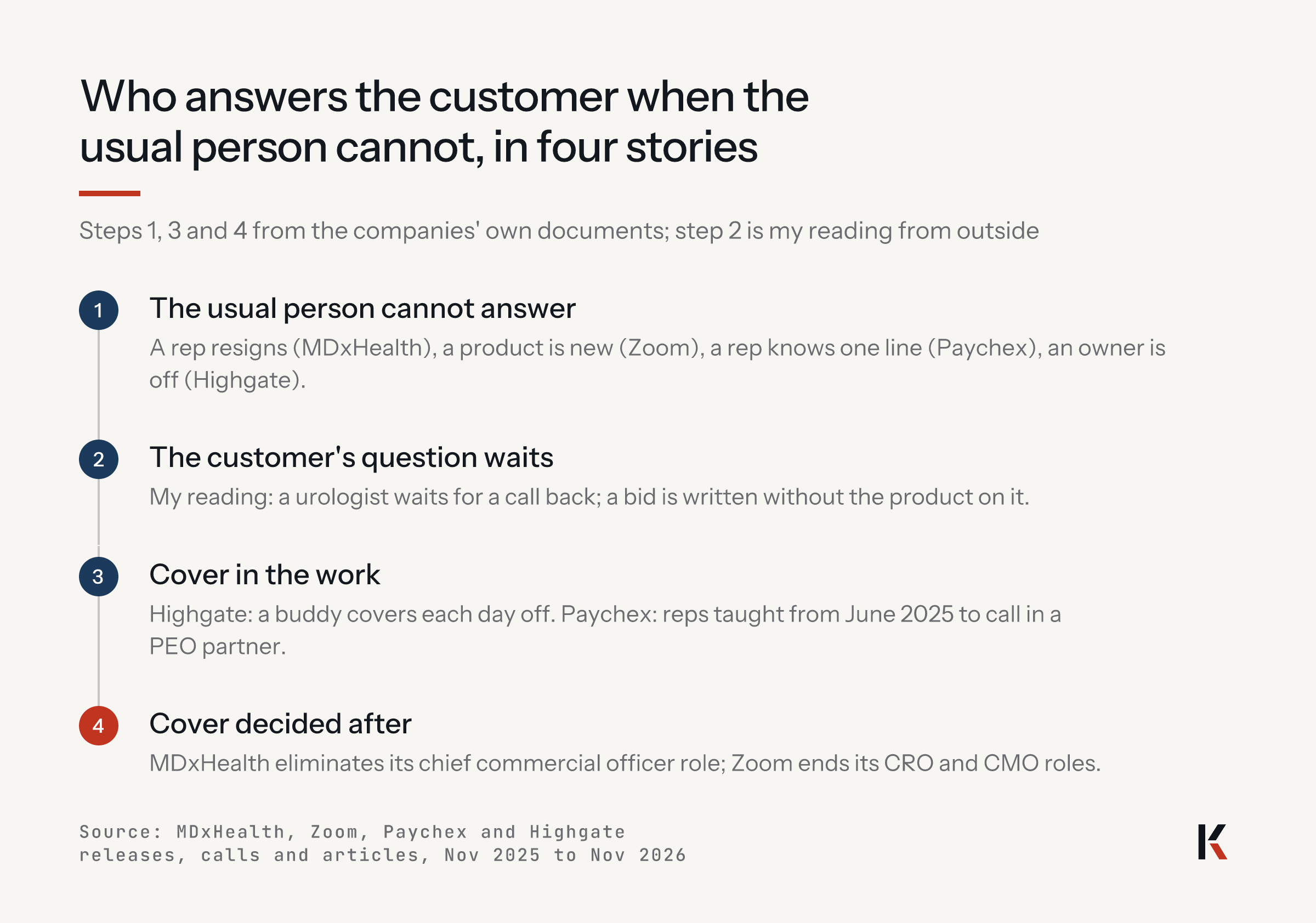
You may conclude that written cover protects revenue. The notes do not go that far: Highgate counts its own revenue, Paychex mixes training with incentives, and Zoom's quarter closed before its change. Days without an owner, beside each account's renewals, would settle it.
I read the week as a design question that tends to be answered only once a seat is empty. An account between owners is the kind of leak we count.
We count the days it waited, and the orders, renewals and bids that moved in those days.
Writing the cover before the gap, the named back-up, the handover and the products each owner can present, is what Build does at Kihon. To start from your own accounts, thirty minutes on your own numbers.
Three moves before the next seat empties
- Name a back-up owner for each of your fifty largest accounts.
- List the products each account owner cannot yet present to a customer.
- Count the days each territory had no named owner this year.
What a CEO should ask the CRO
Who owns an account the day its owner resigns?
A named person, in writing, with the account's renewal and reorder dates. MDxHealth's sources answer only with “fortifying impacted territories”.
Which products can every account owner present today?
Ask for the list by person, not by team. Zoom's CEO says sellers called the newer products “very hard to sell”.
How many days did each territory go uncovered?
Count from the resignation to the new rep's first productive quarter. MDxHealth's CEO expects one to two quarters of ramp.
Sources
- MDxHealth, third-quarter 2026 results release (Form 6-K exhibit), 12 November 2026
- The Motley Fool, MDxHealth Q3 2026 earnings call transcript, 12 November 2026
- The Motley Fool, Zoom Q3 fiscal 2027 earnings call transcript, 23 November 2026
- Stock Analysis, Zoomtopia 2026 Investor Session transcript, 20 October 2026
- Zoom Communications, Form 10-K for the fiscal year ended 31 January 2026
- SEC, Form 3 for Graeme Geddes, President, Go-to-Market, event of 10 November 2026
- monday.com, Form 6-K on the 2026 restructuring plan, 22 July 2026
- The Motley Fool, monday.com Q3 2026 earnings call transcript, 9 November 2026
- The Motley Fool, Paychex Q1 fiscal 2027 earnings call transcript, 23 September 2026
- AlphaStreet, Paychex Q4 fiscal 2026 earnings call transcript, 24 June 2026
- Highgate IT Solutions, Four years of the four-day week: what the numbers show, 2 November 2026
- Fortune, A CEO gave his employees Fridays off. Three years later, revenue is up about 160%, 8 November 2026
- Bain & Company, Customer Success at a Crossroads, 17 December 2025
- Each note lists its own sources in full.
Your turn: which of your accounts had no named owner for a day this year, and who noticed first? Reply to this email, or write to cemgorer@kihonlabs.com. I read every reply. If your CFO or CRO should see this, forward it.