
On 20 October 2026, at Zoom's investor session at Zoomtopia, marketing chief Kim Storin described the reaction marketing wants more buyers to have: "Oh, wow, I did not know that Zoom did that." Pipeline, she said, was up more than 50% on a year earlier.
Later in the same session, CEO Eric Yuan called one habit a mistake. Whenever Zoom built a product, he said, the company would say: "We have a great product. Graeme is this great guy, just give it to him. He can sell a lot."
For Contact Center and Zoom Phone, he said, that worked well. For the newer products, such as My Notes and ZoomMate, it did not. "Customers do not know that. Sales teams, they say, 'Wow, it is very hard to sell.'" His answer that day was product-led marketers for each new product, managed by himself.
Twenty-one days later, on 10 November, Graeme Geddes became President, Go-to-Market, a date fixed by a form Zoom filed with the SEC on 19 November. On 23 November, on the third-quarter call, Yuan said why.
Many of Zoom's customers, its CEO says, do not know what Zoom sells, and the company's answer was to make the two teams that speak to buyers one. On my reading this is a communication and coordination problem between product, marketing, sales and the buyer. The remedy Zoom chose is a new reporting line.
The short version
Zoom's CEO says many customers do not know it sells Phone, Contact Center, a virtual agent and a revenue tool.
On 10 November the sales chief became President, Go-to-Market; he now leads marketing, sales, channel and customer success, and the CRO and CMO roles are gone.
Zoom spent $1,388 million, about €1.3 billion, on sales and marketing last year. It gives no count of the bids it was never asked to make.
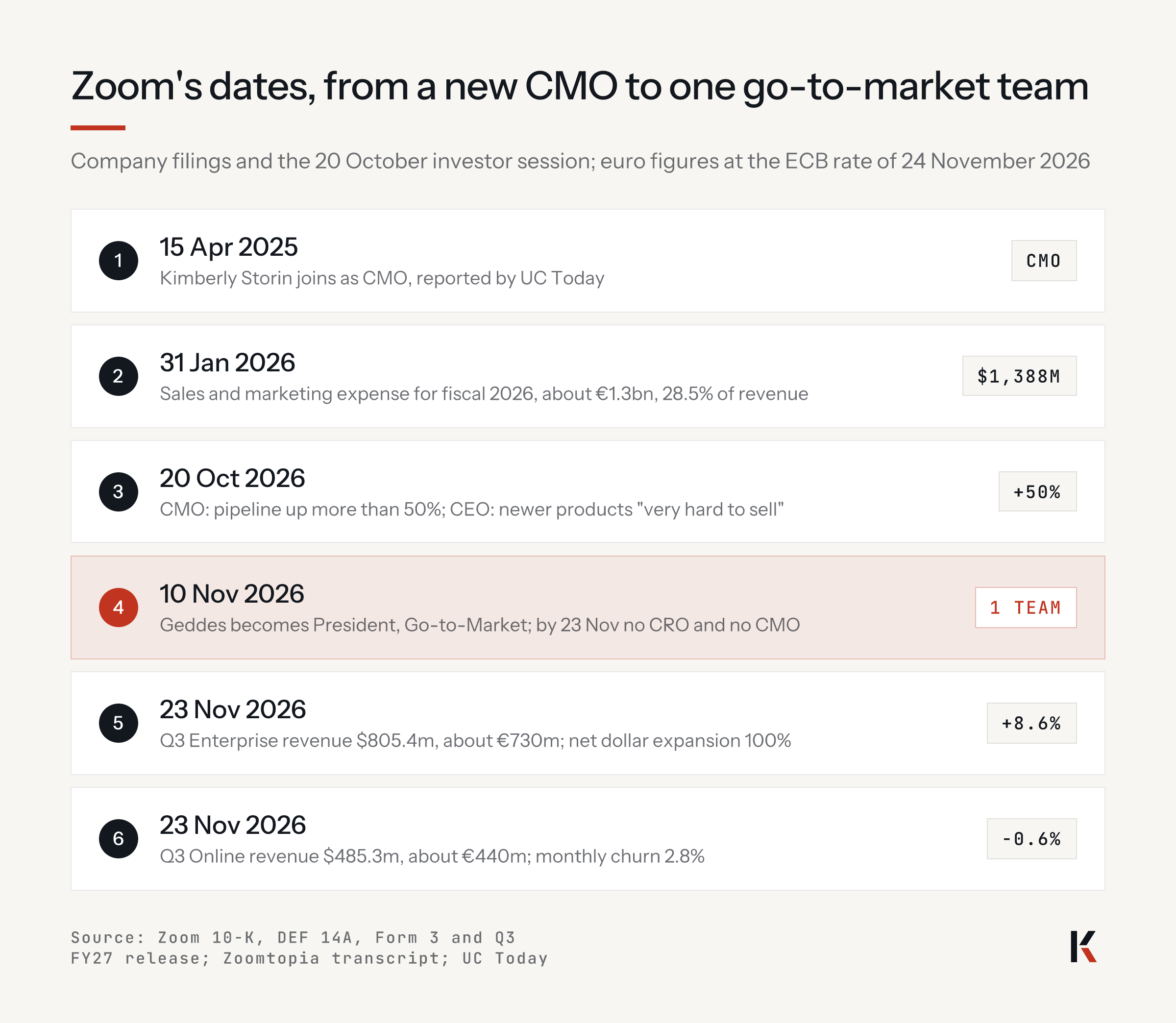
Three dates, one gap between what Zoom built and what buyers knew
Before the change, Zoom's annual report for the year to 31 January 2026 describes two organisations: a sales force organised by customer size, region and vertical, with a channel team, and a marketing organisation for brand awareness, customer acquisition and retention, and product adoption.
The company had 7,438 employees. Its proxy statement of 30 April lists four executive officers; neither the sales chief nor the marketing chief is among them.
Storin joined as CMO in April 2025, UC Today reported. At Zoomtopia Geddes was introduced as Chief Sales Officer; on 23 November Yuan called him the former Chief Revenue Officer.
Zoom's team page now says Geddes leads marketing, sales, solution engineering, channel, professional services and customer success.
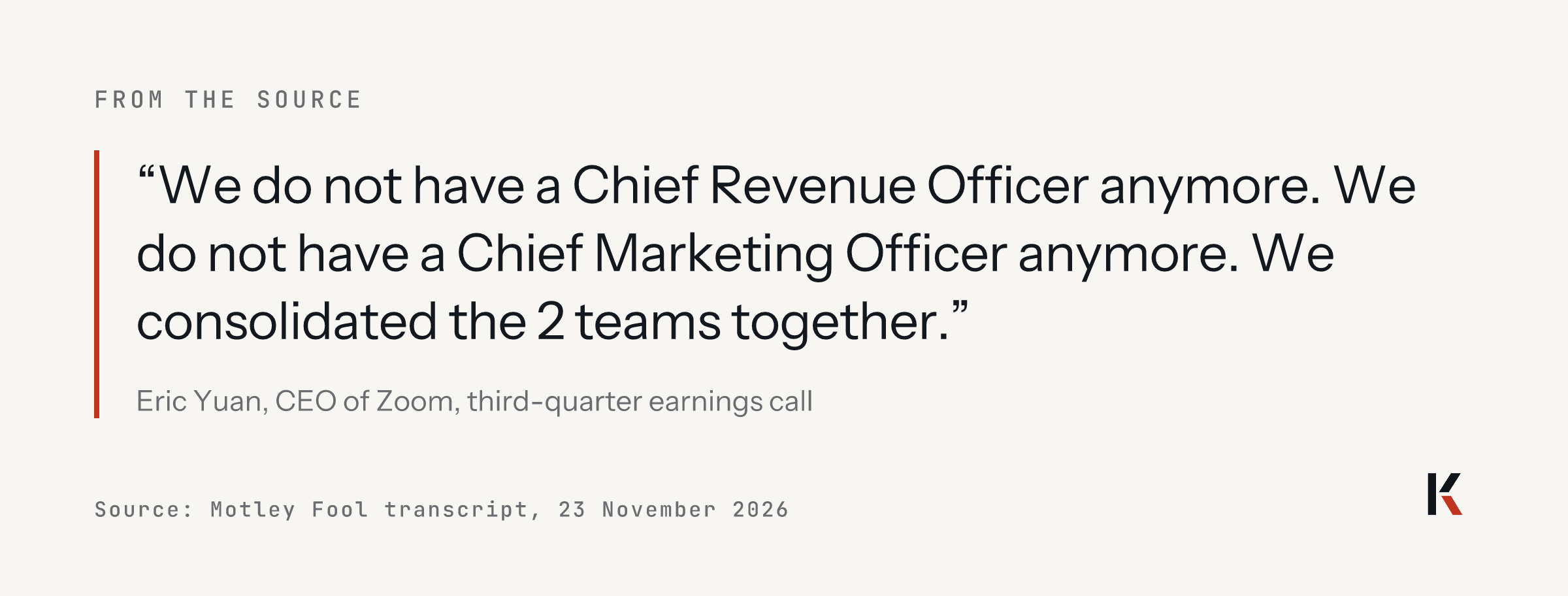
On 23 November Yuan told analysts: "We do not have a Chief Revenue Officer anymore. We do not have a Chief Marketing Officer anymore. We consolidated the 2 teams together." The aim was "to simplify the lead generation, to make sure it's just one team".
The documents do not say whether Storin or anyone else left, how many people changed reporting line, or how many bids Zoom missed.
The quarter was good. Revenue was $1,290.6 million, about €1.2 billion, up 4.9%. Enterprise revenue was $805.4 million, about €730 million, up 8.6%, which the company calls its strongest pace in 13 quarters.
Customers paying more than $100,000 a year reached 4,732, up 8.5%; enterprise net dollar expansion was 100%, up from 98%. Online revenue fell 0.6% to $485.3 million, about €440 million, which the CFO puts down to one price increase in the second half against two in the first. Monthly online churn was 2.8%.
CFO Michelle Chang puts the enterprise growth down to progress on Zoom's three priorities, moving to larger customers, a wider product set, AI and lower churn. Asked about the go-to-market, she added territory design, pricing and discounting, and investment in channel.
One bid for a contact centre, before and after one team
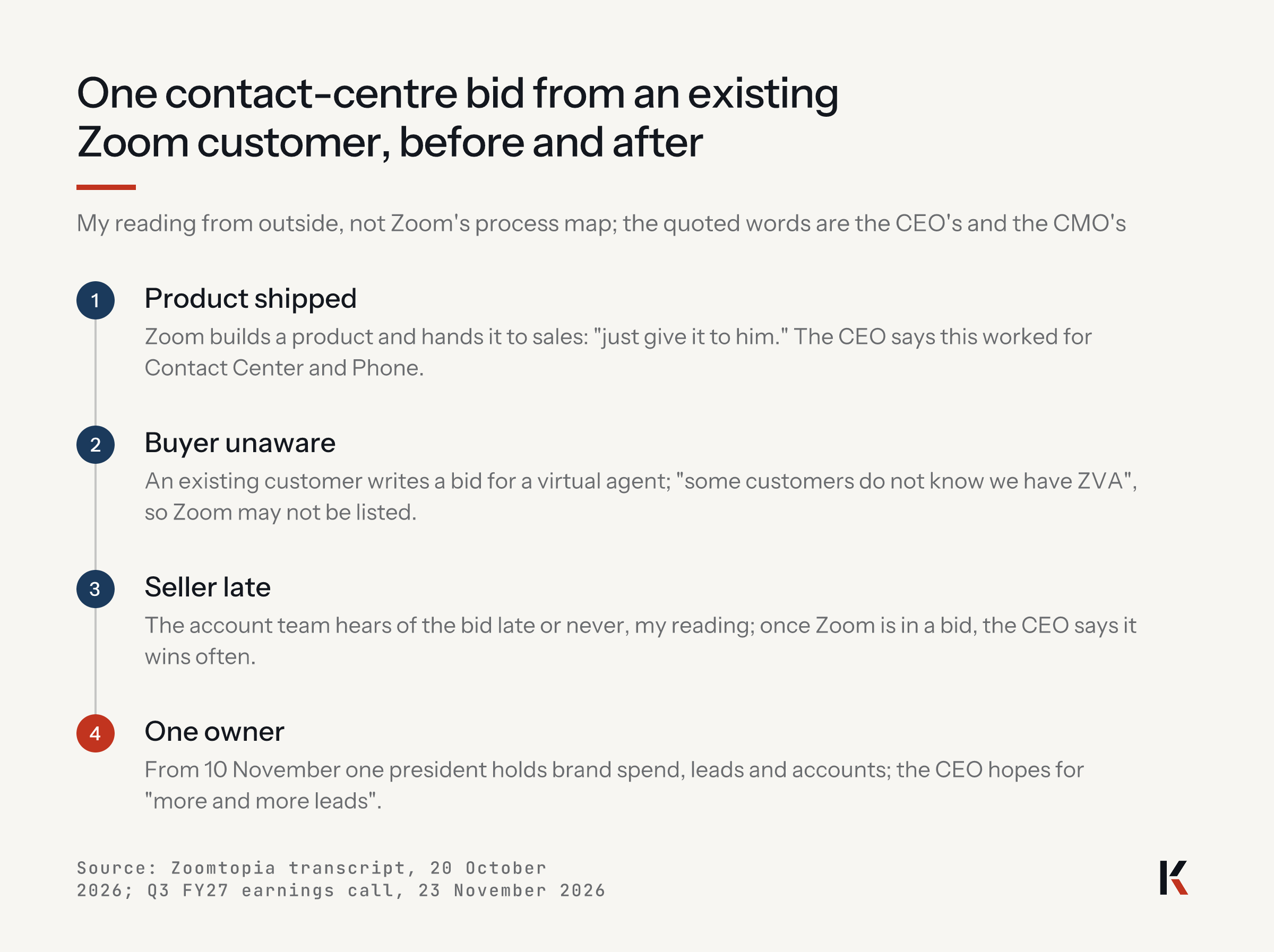
Take one existing Zoom Meetings customer writing a request for proposals for a contact centre. How that bid travels inside Zoom is my reading from outside; the company has published no process.
Yuan's two sentences on it: "some customers do not know we have ZVA" and "As long as ZVA is part of their RFP processes, we have a high confidence." Once Zoom is in a bid, he says, its win rate against major competitors is "pretty high".
Before: the product team ships the virtual agent. Marketing buys awareness for the broad brand and, as Storin said, makes trade-offs between personas. The account team owns the meetings renewal and hears of the bid late or never.
After 10 November: one president holds the brand spend, the lead flow and the account team. What changes is that one person can see the gap and spend against it.
I read this with the socio-economic approach (SEAM, developed by Henri Savall and the ISEOR team in Lyon). The family is communication, coordination and cooperation: product knew, marketing knew in general, and the seller met a buyer who did not.
The symptom is lost direct productivity: seller hours spent proving a product exists. Of the newer products, Yuan says, sellers told him they were "very hard to sell".
The larger cost sits in bids never entered, which the method calls non-creation of potential. It is priced at the margin a contact-centre contract would have carried, not at anyone's salary.
€1.3 billion a year on sales and marketing, and many customers still did not know
Zoom's sales and marketing expense in fiscal 2026 was $1,388.3 million, about €1.3 billion. On my arithmetic that is 28.5% of revenue, or about $26.7 million, about €24 million, a week.
Against that spend, the one retention figure Zoom publishes for enterprise is net dollar expansion of 100%. On my reading, the installed base, taken together, paid Zoom the same as a year earlier.
Zoom does not publish the bids for phone or contact centre that named it, the share of large customers with a second product, or the leads passed to sales in a quarter. Without them no euro figure for the gap would be honest, so I give none.
The objection: "Zoom just posted its best enterprise growth in 13 quarters; the problem is solving itself." That quarter closed on 31 October, before the change, and the company puts the growth down to larger customers, more products, AI and lower churn.
The conclusion you may jump to is that one go-to-market president fixes awareness. I would not conclude that: Zoom also names price increases, investment in channel and new AI products. The test is a count Zoom could publish: the share of bids for a second product that include Zoom, before and after the change.
The gap Zoom describes opens earliest at a scale-up: the second product ships, the founder hands it to the sales lead, and nobody owns the sentence "we also sell this". At Kihon that unowned sentence is a hidden cost, counted in bids never received. The Executive Workshop puts your product, marketing and sales leaders in one room with the last twenty bids you lost or never saw, and asks for each who knew and who was told. Start with thirty minutes on your bid list.
What a CEO would ask before merging marketing and sales
How many of your last 20 bids named your second product?
Pull the last 20 requests for proposals from existing customers and count those that listed your newer product. The rest measure the awareness gap in units.
Who owned a new product's first 90 days in market?
Name one person, not two teams. On my reading, Yuan's "just give it to him" describes a handover with no owner for awareness.
What will one team measure that two did not?
Zoom has promised "more and more leads" and gives no baseline. Set yours now: leads passed, bids entered and the share of large customers with a second product.
Sources
- The Motley Fool, Zoom (ZM) Q3 2027 earnings call transcript, call of 23 November 2026
- Zoom Communications, third-quarter fiscal 2027 results, Form 8-K exhibit 99.1, 23 November 2026
- SEC, Form 3 for Graeme Lambourne Geddes, President, Go-to-Market, event of 10 November 2026, filed 19 November 2026
- Stock Analysis, Zoomtopia 2026 Investor Session transcript, 20 October 2026
- Zoom Communications, Form 10-K for the fiscal year ended 31 January 2026, filed 27 February 2026
- Zoom Communications, proxy statement (DEF 14A), 30 April 2026
- Zoom, Our Team, read 25 November 2026
- UC Today, Zoom names Kimberly Storin CMO, 15 April 2025
- SiliconANGLE, Zoom's conversations-to-completion strategy is starting to pay off, 24 November 2026
Your turn: which of your products would your best customer fail to name, and who owns telling them? Write to me at cemgorer@kihonlabs.com, or answer on LinkedIn. I read every reply.