
On 9 November 2026 an analyst asked monday.com's chief revenue officer, Casey George, about the third quarter's sales problems and the slower business with larger customers.
He named longer sales cycles and two causes. The first was the move to bigger customers, who bring more stakeholders and look harder at AI spend.
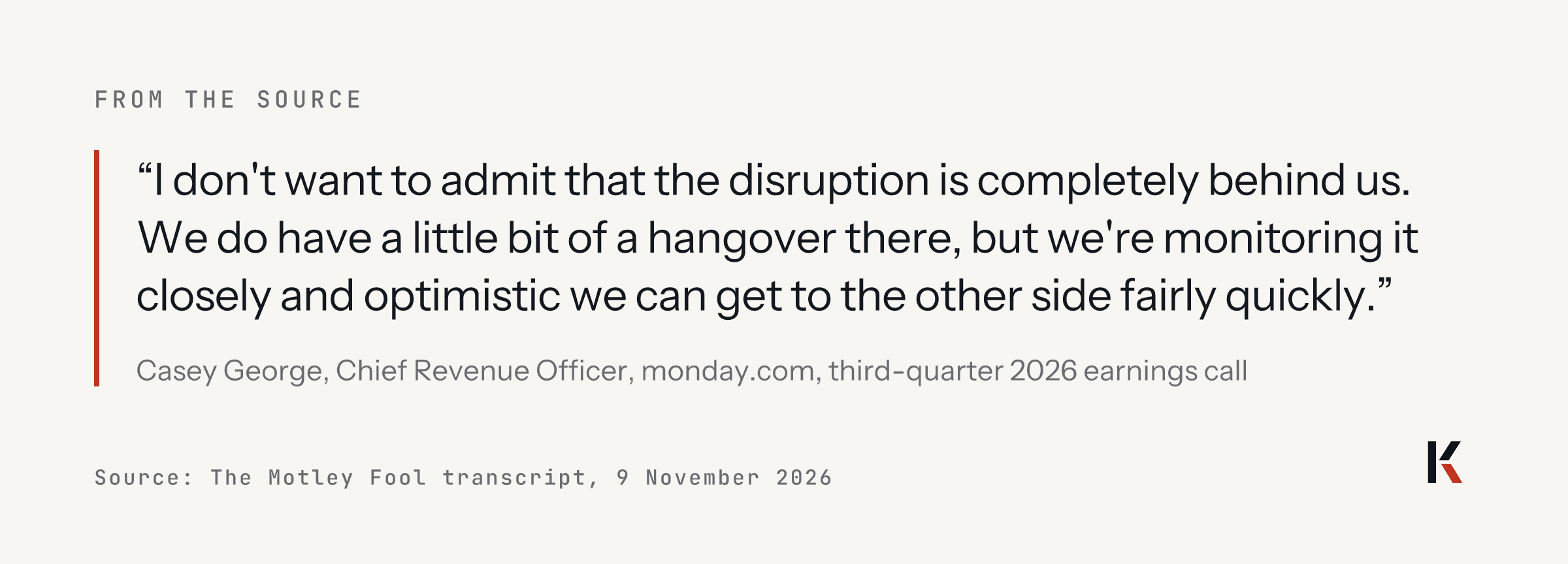
The second was the July workforce reduction. Its disruption, he said, "lingered candidly a little longer than we thought".
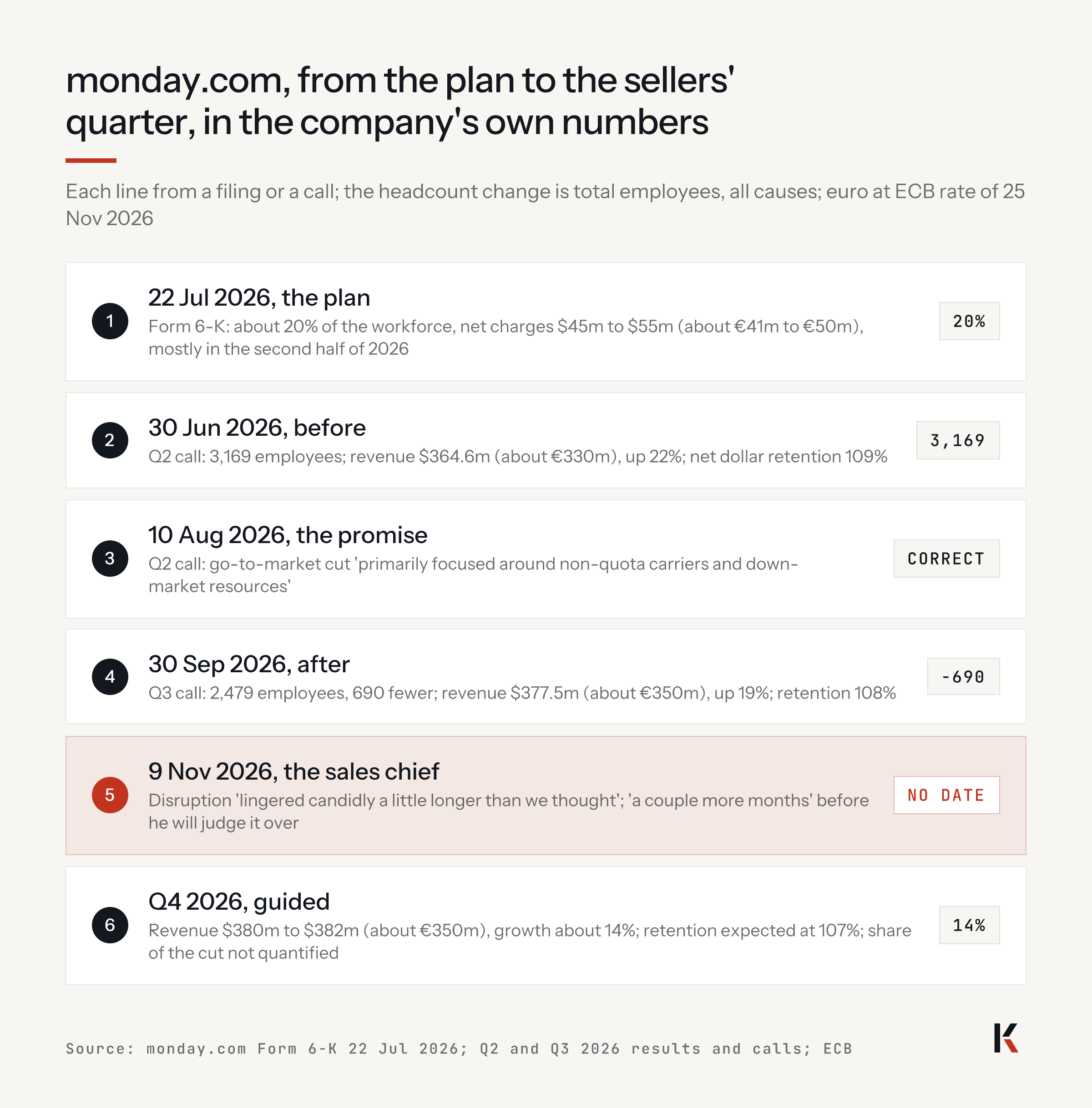
The plan had a date. On 22 July 2026 monday.com told the SEC it would cut about 20% of its workforce to fit its structure to what it calls the AI Work Platform. The estimated net charges: $45 million to $55 million, about €41 million to €50 million.
On 10 August George said the go-to-market cut was "primarily focused around non-quota carriers and down-market resources". Asked whether quota-carrying reps at the high end were unchanged, he answered: "Correct."
On 9 November the company reported 2,479 employees at the end of September, 690 fewer than at the end of June. Revenue grew 19%, against 22% the quarter before. The fourth quarter is guided to about 14%.
The company dated the cut to one day; it has not yet dated the end of the disruption. I read that as a strategy-implementation problem: a plan set at the top in July, and the quarter of the people who sell.
The short version
monday.com cut about 20% of its staff on 22 July 2026 and said the go-to-market cut was aimed mainly at non-quota and down-market roles.
On 9 November its sales chief said the disruption had lasted longer than expected and was not yet fully behind the company.
Growth went from 22% to 19% to a guided 14%, and the company will not say how much of that is the cut.
Aimed at non-quota roles; sellers' quarter slowed
The filing of 22 July gives the plan: about 20% of the workforce, $30 million to $35 million of severance and related costs, most of it in the second half of 2026. It keeps the 2026 growth outlook at 19% to 20%, raises the operating margin outlook from about 13% to about 15%, and says hiring continues in key areas. It gives no number of people and no split by function.
On 10 August the chief financial officer, Eliran Glazer, kept the second quarter's beat out of the full-year number. "There is going to be a short-term impact," he said.
An analyst checked what he had heard: no change to how the company sells, just overall disruption? "Correct," Glazer said.
George said the sales team was being trained "as we go", with no big training event needed.
On 9 November co-CEO Eran Zinman named three headwinds: the restructuring and its "near-term disruption", a weaker down market, and "longer sales cycles" around AI.
Glazer was asked how much of the fourth-quarter slowdown came from the reduction. "I would assume that there is an impact on the numbers, but I don't want to quantify it exactly." Stability was "probably a few quarters" away, "throughout 2027".
What the documents do not give: how many of the 690 worked in go-to-market, which non-quota roles went, or any output per seller. The annual report for 2025 counts 3,155 employees at 31 December and does not count the commercial teams. Sales and marketing cost $630.9 million in 2025, about €580 million.
What changed around a seller whose seat did not change
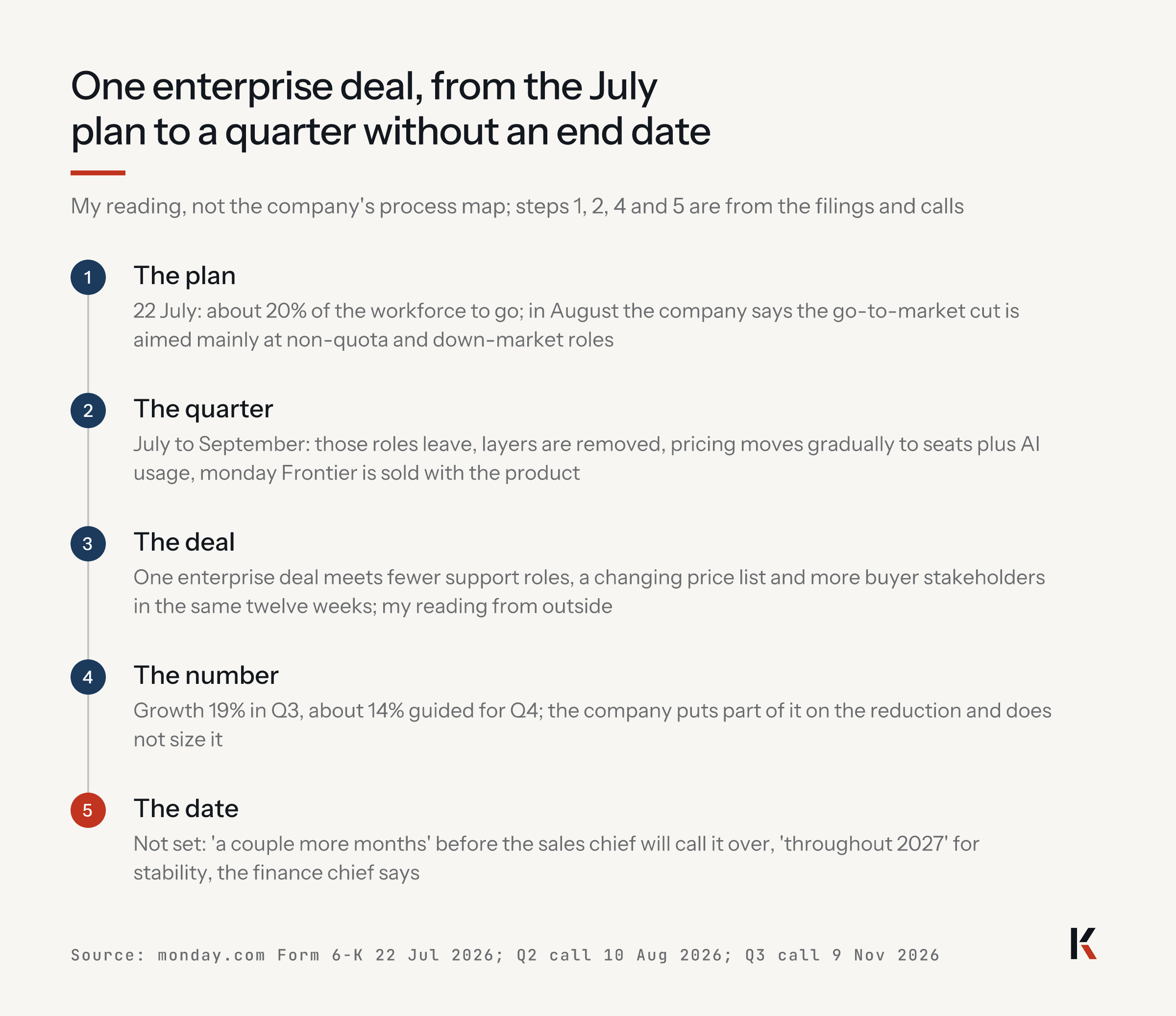
The company's own list of what moved is long. Fewer management layers and smaller teams, in Roy Mann's words in August. Non-quota and down-market roles reduced. Pricing moving "gradually" from seats to seats plus AI usage. A new forward-deployed engineering offer, monday Frontier, sold together with the product.
Now take one enterprise deal in your own third quarter. How it travels inside monday.com is my reading from outside; the company has published no process.
Before the cut your account executive had support roles, one price list and one buyer group. In the quarter the support roles are fewer, the price list is changing, engineers are being offered with the deal, and the buyer brings more stakeholders.
None of these is the seller's own change. All of them pass through the seller's twelve weeks at once.
Multiply by every quota-carrying seat and you have what George called "a lot of noise in the system".
My reading of the cause is how the plan reached the people who carry the number: several changes at once, one date for the cut and none for the rest. The symptoms are in the company's words: longer cycles, slower growth in large customers, retention drifting from 109% to 108% and an expected 107%. The company ties part of that retention pressure to the lapping of its earlier price rises.
The socio-economic approach to management, developed by Henri Savall and the ISEOR team in Lyon, calls the growth that did not arrive non-production, and the expansion not proposed non-creation of potential. I would price the sellers' lost weeks at the margin they should have produced, not at their salary.
Eight points of growth between two calls
Growth was 22% in the second quarter, 19% in the third and about 14% in the fourth-quarter guidance. Eight points in two quarters. The company says the 22% included about 1.1 points of favourable currency.
The fourth-quarter midpoint of $381 million is $3.5 million, about €3.2 million, above the third quarter's $377.5 million, about €350 million. On the company's own range, one point of fourth-quarter growth is worth about $3.3 million, about €3.0 million. That is my arithmetic on its guidance.
The savings are counted: about $100 million a year, about €91 million, most of it to be reinvested in AI, employee retention and the services team. The cash paid out for restructuring in the third quarter is counted too: $47.2 million, about €43 million.
What you cannot find in any filing is the sellers' weeks between July and the end of the disruption. "A couple more months", by the sales chief's reckoning. "A couple of quarters" of 2027, by the finance chief's.
The company can answer that higher small-customer churn is by design, that the savings fund AI, and that the down market was slowing anyway. All three are on its calls, and the full-year range held at about 20%. Yet the company itself puts part of the slowdown on the reduction and declines to size it.
I would not conclude that the cut caused the slowdown. The company also names the small-customer market and more careful buyers, and does not split the three. The measurement that decides it is output per quota-carrying seller, quarter by quarter, before and after 22 July. monday.com has not published it.
A restructuring plan has one date. The disruption it causes has none until someone writes it down, and that second date is where Kihon works.
When your commercial organisation has to carry a plan through a change, we count the weeks your sellers lose and the renewals and expansions that move with them. The change then has an end as well as a start.
That is our Operation work, built for companies in software and technology that run a reorganisation and a pricing change in the same year. If your 2027 plan has a cut in it, thirty minutes on the second date: kihonlabs.com/contact.
Three dates to write before the next cut
- Write the date the disruption is expected to end, next to the date of the cut.
- List every change that reaches a seller's quarter at the same time, and delay one.
- Count output per quota-carrying seller monthly, so the end date is measured, not felt.
Sources
- The Motley Fool, monday.com Q3 2026 earnings call transcript, 9 November 2026
- monday.com, Form 6-K on the 2026 restructuring plan, 22 July 2026
- monday.com, third-quarter 2026 results, Form 6-K exhibit, 9 November 2026
- monday.com, Q2 2026 earnings call transcript (LSEG), 10 August 2026
- monday.com, second-quarter 2026 results, Form 6-K exhibit, 10 August 2026
- monday.com, Form 20-F for fiscal 2025, 13 March 2026
Your turn: when your company last cut roles around the sales team, who wrote down the date the disruption would end? Write to me at cemgorer@kihonlabs.com, or answer on LinkedIn. I read every reply.