
On 24 June 2026 an analyst put it to Paychex that the sales force it had bought with Paycor "wasn't sort of fully engaged the whole fiscal year".
John Gibson, the chief executive, rejected the word, then answered with a list.
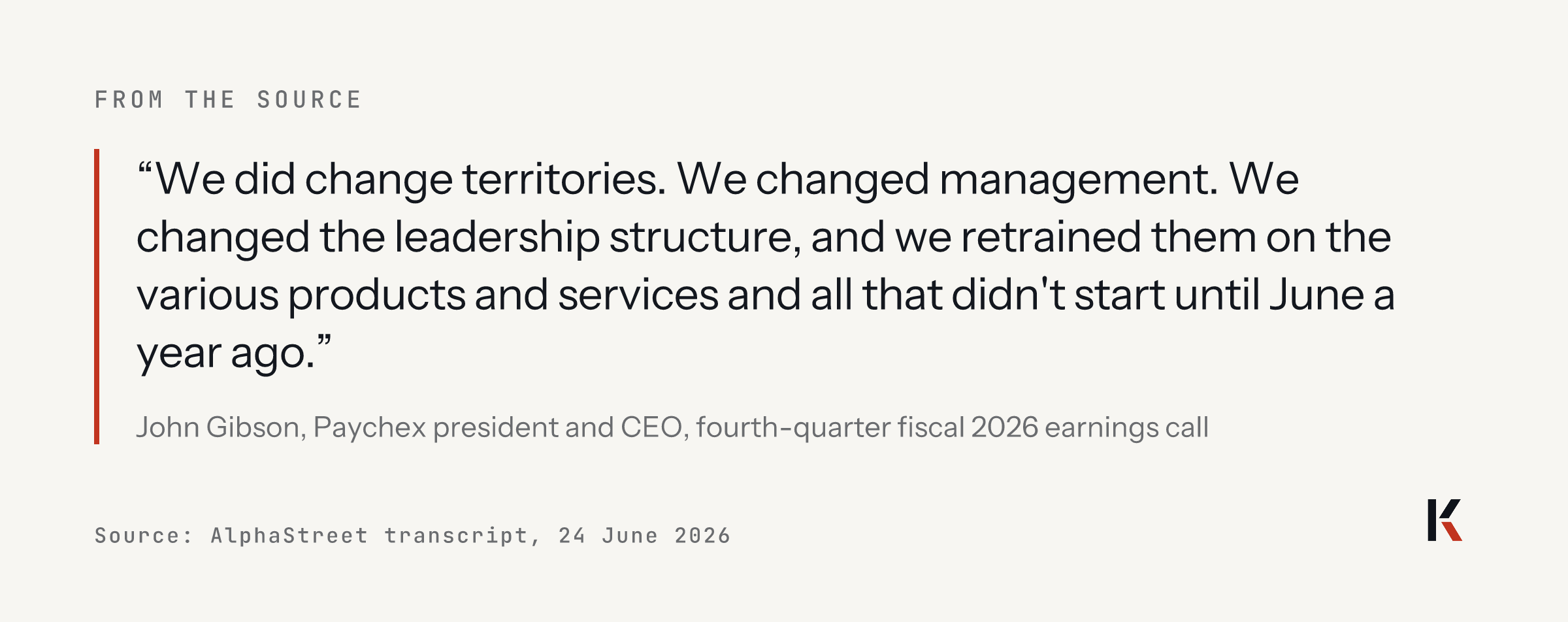
"We did change territories. We changed management. We changed the leadership structure, and we retrained them on the various products and services and all that didn't start until June a year ago."
On 23 September he reported the other end of the list. Paychex is "driving training, enablement and incentives so that all of our reps are presenting the best solution", in sales and in customer success.
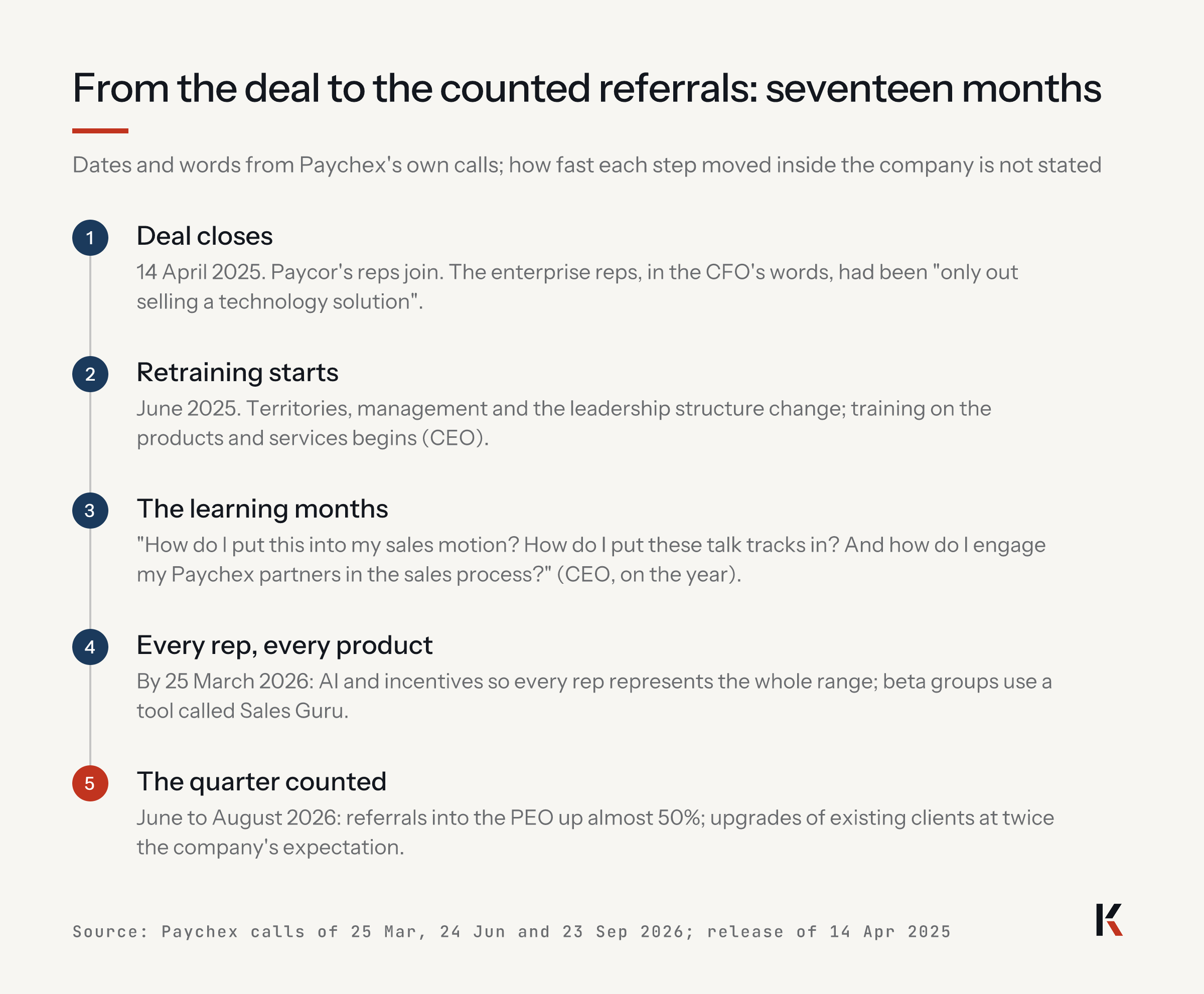
Referrals from its sales teams into its PEO, the outsourced HR service, were up almost 50% on a year earlier.
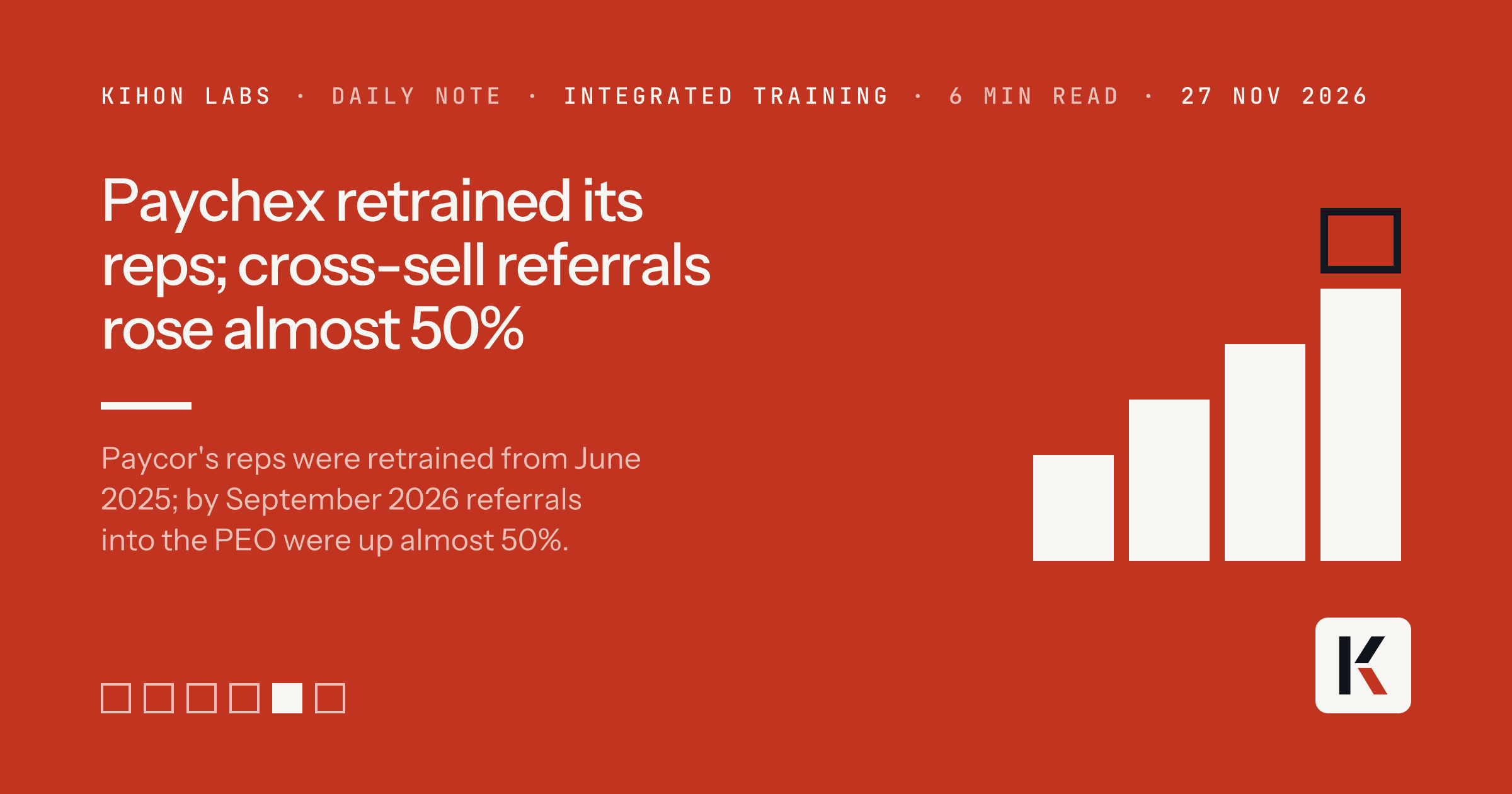
Paychex's calls give a rare dated record of retraining a sales force: the teaching started in June 2025, and fifteen months later the company said the results beat its own plan.
That makes it an integrated-training story: what the people who face the client were taught, and how long it took to reach the order book.
The short version
Paychex bought Paycor, a company of about 2,900 people, for about $4.1 billion of enterprise value, about €3.7 billion, and began retraining the reps in June 2025.
A year later the CEO said the acquired reps had been "very engaged" with "good success"; what took time was learning: "How do I put this into my sales motion?"
By September 2026 referrals into the PEO were up almost 50%; the company also credits incentives and rising health costs.
Six dates from the company's own record
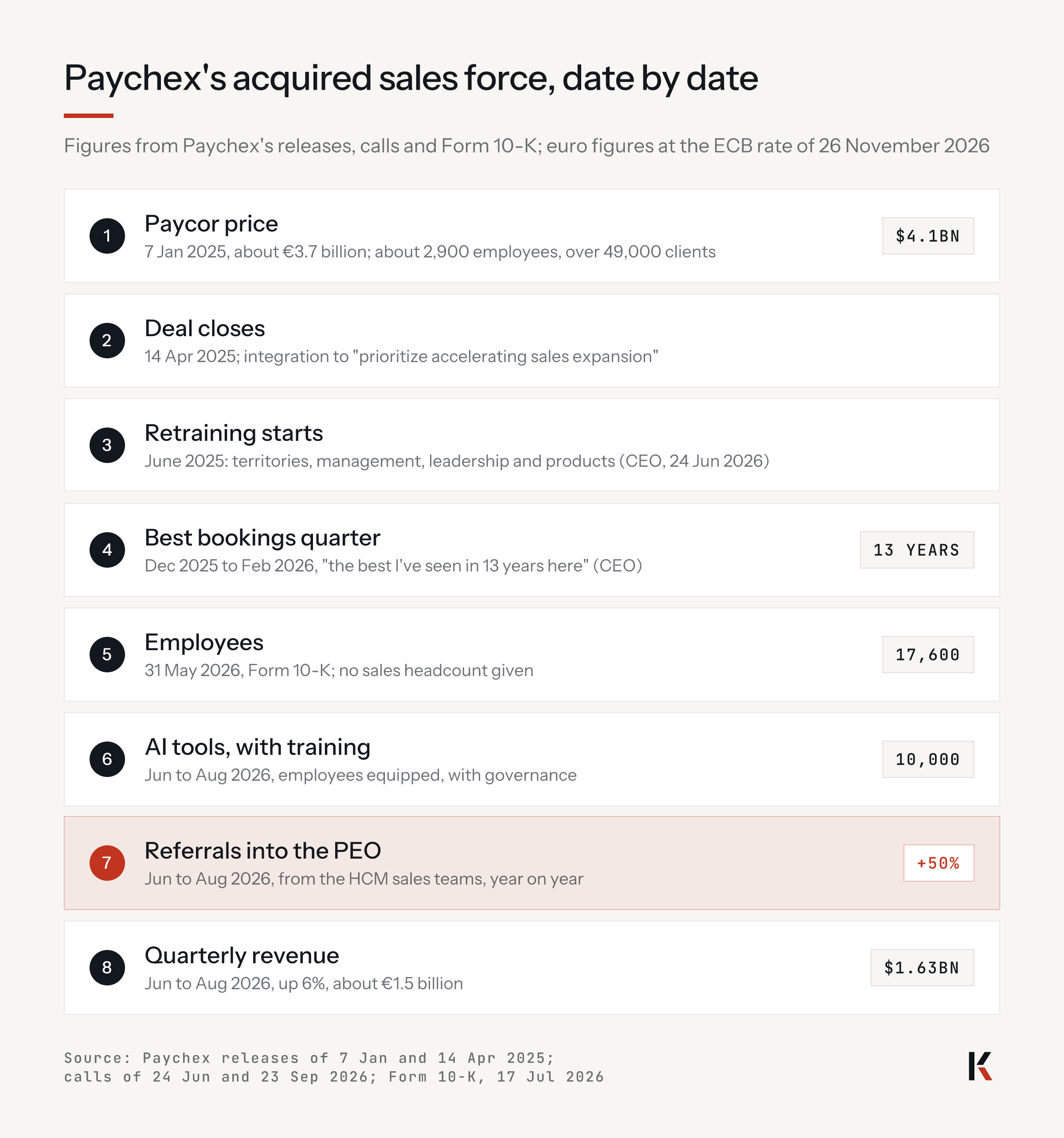
7 January 2025: Paychex agreed to buy Paycor for about $4.1 billion of enterprise value. Paycor had about 2,900 employees and over 49,000 clients.
The deal, the release said, "significantly expands Paychex's sales coverage".
14 April 2025: the deal closed. The integration would "prioritize accelerating sales expansion and product innovation", Gibson said that day.
June 2025: the retraining began, with the changes of territory, management and leadership Gibson listed a year later. How many reps it covered is not stated.
25 March 2026: AI and incentives were being used so that "every sales rep in the market" represents "the entire capabilities of the company", Gibson said.
24 June 2026: bookings had improved every quarter, and the third quarter was "the best I've seen in 13 years here".
In fiscal 2026, Paycor's clients with under 100 employees had moved to the SMB segment, and Paychex's clients with 100 or more to the enterprise segment.
23 September 2026: first-quarter revenue was $1.63 billion, about €1.5 billion, up 6%. PEO and Insurance Solutions grew 12%.
Management Solutions grew 4%, "slightly below our expectations" in the CFO's words, because clients were moving from one line to the other.
In the same quarter Paychex gave 10,000 employees AI tools, "giving them the training and education". The 10-K counts 17,600 employees at 31 May 2026 and gives no sales headcount.
What one rep could say before, and after
Take one enterprise rep and one client.
Before, in the CFO's words, the enterprise reps were "only out selling a technology solution".
Paychex itself "used to be a lot more siloed and compartmentalized", Gibson said: a payroll client first, then ASO, then PEO.
After, Gibson describes the conversation himself. The client says health inflation is a problem and asks for help.
The rep's answer: "Guess what, I can't. Let me get one of my PEO partners in to talk to you." The rep earns a commission on that referral, the CFO said.
When an ASO client upgrades to the PEO, Gibson said, the revenue is about 3.5 times.
Gibson's words for the months after June 2025: "learning and then getting accustomed to, okay, how do I put this into my sales motion? How do I put these talk tracks in?"
He would not call those months a lack of engagement: "We were very engaged and we had good success." ASO and retirement penetration "really exceeded our expectations", he said, and Paychex beat its fiscal 2026 synergy targets.
Read through the socio-economic approach, SEAM, developed by Henri Savall and the ISEOR team in Lyon, the root is a training problem. The person facing the client had not yet been taught the whole product range.
The symptom is lack of direct productivity: a rep in front of a client question with no second product to offer.
The kind of cost is what the method calls non-creation of potential: upgrades not proposed in the learning months, priced at the 3.5 times they would have carried.
What the learning year cost, in Paychex's own units
No source gives a cost for the training, and I give none.
Each ASO client not offered the PEO in the learning months left about 2.5 times its own revenue unproposed, on the company's 3.5 ratio. That is my arithmetic on Gibson's figure, not a Paychex number.
The visible side is stated: salespeople added, AI investment at five times the prior year, and over $100 million, about €91 million, of cost synergies.
The invisible side, on my reading, is the start of the year: in Gibson's words, bookings "got better and better" every quarter, so they began lower.
A vendor survey shows the usual alternative. Revenue Innovations, a consultancy that sells its own method, asked 419 go-to-market leaders in March 2026.
Six in ten said a new selling method had faded within 90 days of its rollout. Only 30% said frontline managers coached it consistently.
One objection: the referrals rose because health costs rose and clients went shopping. Gibson said so himself. He also said the rep's answer to that shopping client is now "let me get one of my PEO partners in". My reading: demand only becomes a referral when the rep can present the product.
You will want to conclude that the retraining produced the 50%. The company does not separate it from incentives, changed territories and managers, more salespeople, AI tools and clients shopping for cheaper benefits.
The number that separates them is referrals per rep by training cohort and by month, which Paychex has not published.
Fifteen months is longer than any kickoff. At Kihon we treat the months between the first training session and the first changed client conversation as a cost line: upgrades not proposed, priced at the revenue they would have carried.
For a company that has just bought or merged a sales force, that count is the Diagnosis: the leak found and priced in your own referrals per rep, by cohort and by month. Paychex sits in software and technology. Thirty minutes on your training dates: kihonlabs.com/contact.
What a CFO would ask Paychex
How many of the acquired reps are still there?
Not stated. The 10-K counts 17,600 employees and no sales headcount; the calls say sales headcount was added through the year.
What did the learning year cost in referrals?
Not stated either. The company gives the end point, referrals up almost 50%, and the start, June 2025. Referrals per rep by month would price the months between.
Which part was training, and which part was pay?
Both, in the company's account: "training, enablement and incentives" in one sentence, and the CFO's "you got to get the incentives right".
Sources
- The Motley Fool, Paychex Q1 fiscal 2027 earnings call transcript, 23 September 2026
- Paychex via GlobeNewswire, Paychex Reports First Quarter Fiscal 2027 Results, 23 September 2026
- AlphaStreet, Paychex Q4 fiscal 2026 earnings call transcript, 24 June 2026
- The Motley Fool, Paychex Q3 fiscal 2026 earnings call transcript, 25 March 2026
- Paychex, Form 10-K for the fiscal year ended 31 May 2026, 17 July 2026
- Paychex, Paycor Acquisition Complete, 14 April 2025
- Paychex, Paychex Enters Agreement to Acquire Paycor, 7 January 2025
- MarketScale, Six in ten sales methodology rollouts fade within 90 days, 15 November 2026
Your turn: when your company last added a product line, on what date could every rep and customer success manager present it, and who wrote that date down? Write to me at cemgorer@kihonlabs.com, or answer on LinkedIn. I read every reply.