
On 8 July 2026 Cynthia Koetsier, general manager of Cisco Benelux, wrote on Cisco's EMEA news site. The subject was where her sales team's time went. Quoting, pricing, deal approvals and internal reporting. Pulling information from separate systems, and preparing and recapping meetings by hand.
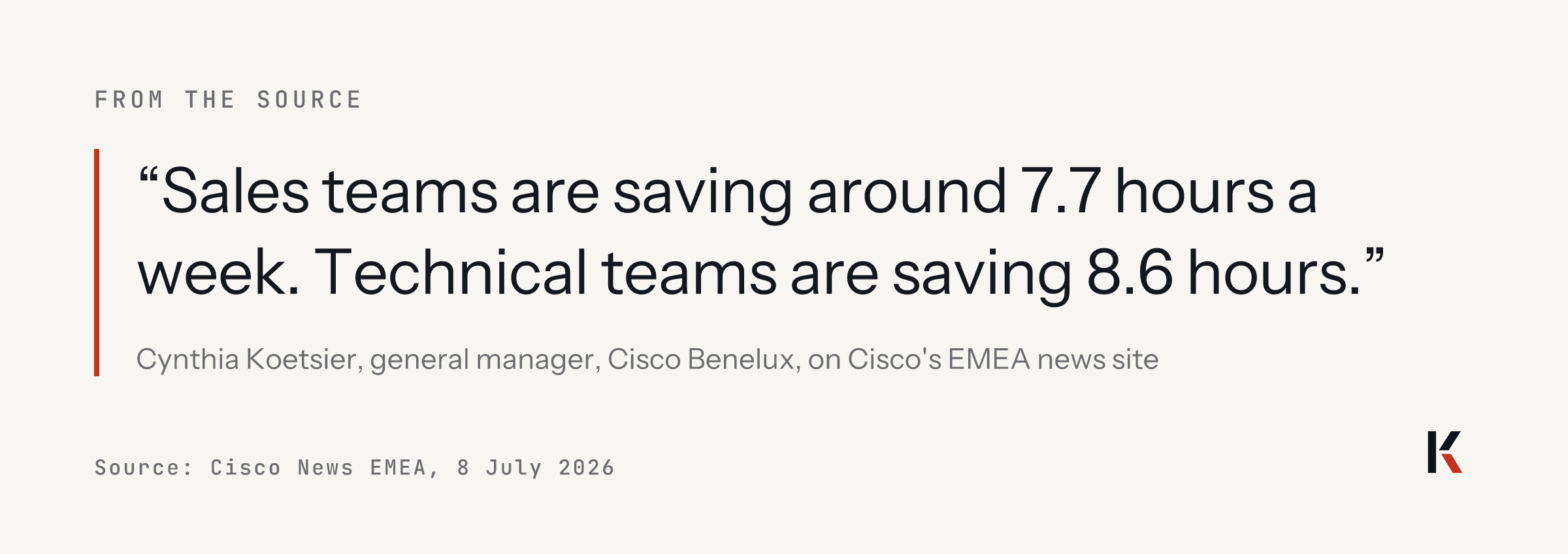
Three months into a programme called "Powered by AI", she published a count. More than half of the sales and technical teams were surveyed. Sales teams said they were saving around 7.7 hours a week; technical teams said 8.6.
The post also says how the hours were won. It "was never about pushing new software or tools", Koetsier writes. Sales leaders ran every hands-on session. The tool list was cut after too many tools caused confusion.
Cisco's Benelux team counted the hours its sellers got back and named who freed them; the number still missing is what a seller did with 7.7 hours.
This is a time-management story in the plain sense: where a seller's week goes, and who decides what fills it.
I read it through the socio-economic approach (SEAM), developed by Henri Savall and the ISEOR team in Lyon. That method treats freed hours as the start of the count.
The short version
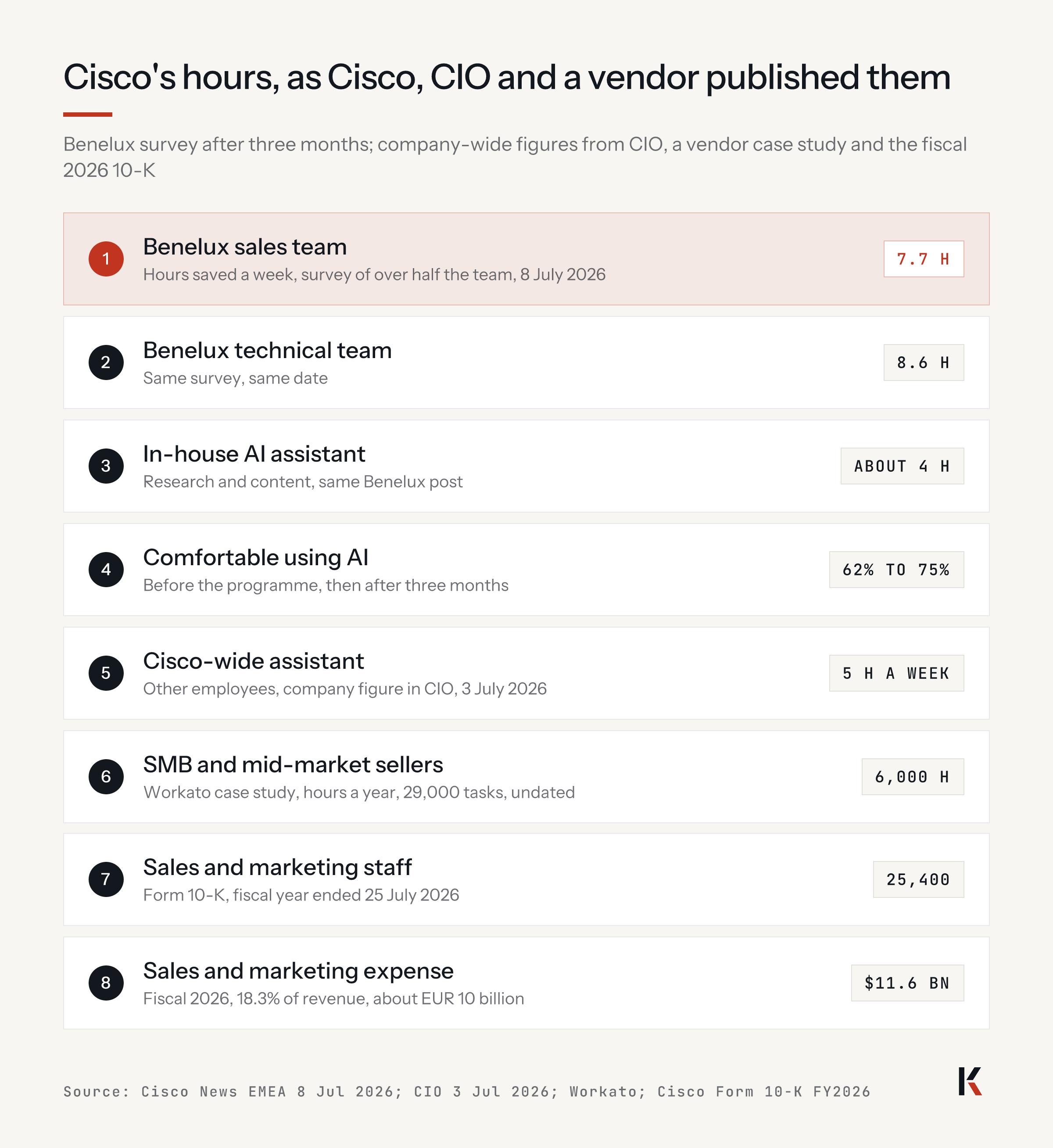
Cisco's Benelux sales team reports around 7.7 hours a week saved per seller; its in-house AI assistant saves about four.
Cisco says the hours came from sessions its sales leaders ran and from a shorter tool list.
The hours come from a survey, and no document gives a figure for what a seller did with them.
Cisco's sellers say 7.7 hours came back
After three months, more than half of the sales and technical teams were surveyed. Sales teams saved around 7.7 hours a week, technical teams 8.6.
The in-house AI assistant, used for research and content, saves about four hours a week on its own. Comfort with AI went from 62% of the team to 75%. The post gives no headcount and no customer or pipeline figure.
Cisco's company-wide assistant has its own figures. CIO reported on 3 July 2026, citing the company, that it saves engineers six hours a week and other employees five.
A vendor adds a third number. Workato says its platform automated 29,000 manual tasks in Cisco's sales operations. It returned 6,000 hours a year to sellers in its SMB and mid-market segment, where some sellers managed over 200 accounts. The case study is undated, and the figures are the vendor's.
The scale comes from Cisco's Form 10-K for the year ended 25 July 2026: about 82,400 employees, about 25,400 of them in sales and marketing.
On 12 August its CFO reported the highest productivity metrics in 30 years, measured by revenue, non-GAAP operating margin and earnings per employee. Revenue was $63.3 billion, about €57 billion, up 12%. Sales and marketing expense was $11.6 billion, about €10 billion, or 18.3% of revenue. It rose 5%, "primarily due to higher headcount-related expenses", with share-based pay and contracted services also named; its share of revenue fell from 19.4%.
Leaders ran every session; hours followed
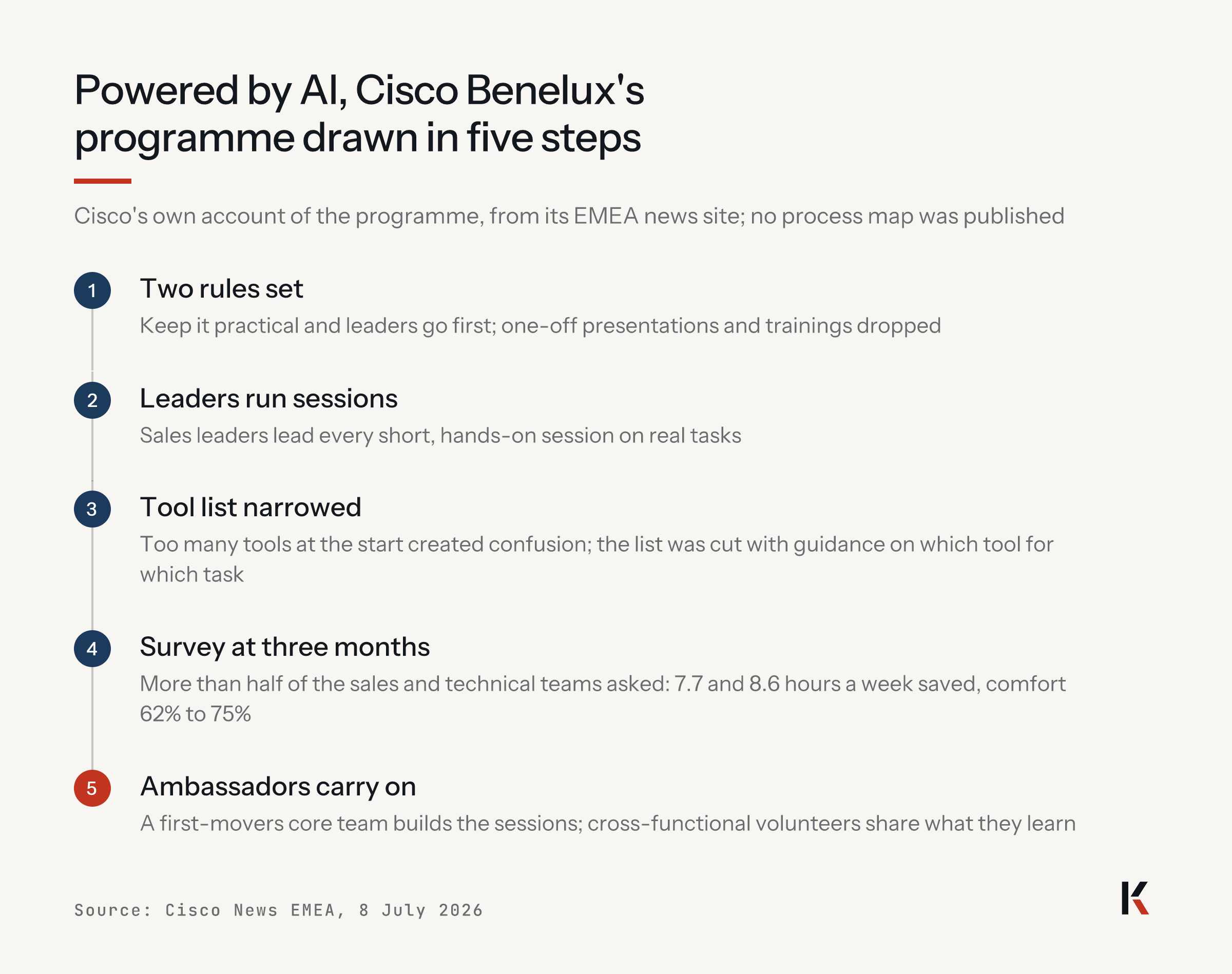
I draw Cisco's description as five steps, in its words.
Two rules were set: keep it practical, and leaders go first.
One-off presentations were dropped for short, regular, hands-on sessions on real tasks.
Sales leaders led every session. Cisco's own data, the post says, shows a team is twice as likely to use AI when its manager does.
The tool list was narrowed.
At three months, the team was asked.
Take one quote, the first item on Cisco's admin list. Before, I picture a seller collecting prices from one system and approvals from another, then typing the recap. After, the assistant drafts the research. The seller checks it.
That walk-through is my reading from outside; Cisco published no process map.
Whether the assistant's four hours sit inside the 7.7, the post does not say. I read them as about half of it; the other 3.7 are not itemised.
On that reading, the half that comes from sessions depends on your leaders, not your licences.
Read as cause and effect, the family is time: a seller's week spent on quotes, approvals and recaps instead of your customers.
The symptoms are lost direct productivity, customer hours that did not happen, and rework. Cisco's own warning covers the last: poor information in, poor results out.
The cost is the customer work those hours did not produce, priced at the margin a customer hour should earn, not at the seller's salary.
A seller's 100 hours a quarter
On a 40-hour week, 7.7 hours is about 19% of a seller's time, close to one day in five.
Over a 13-week quarter that is about 100 hours per seller. For ten of your sellers, about 1,000 hours a quarter, or 25 working weeks.
The assistant's four hours are the part a licence can buy. Cisco's company-wide assistant costs about $10 a user a month, about €9, by the company's figure in CIO; whether the Benelux team used that one, the post does not say.
The other 3.7 hours, on my reading, have no invoice: they come from your leaders' session time and a shorter tool list.
What fills the 100 hours decides whether your quarter gained anything.
Seven hours a week is easy to report in a survey and hard to find in a calendar. That is why your second count matters more than your first. Pull three sellers' calendars and see whether customer meetings rose after the sessions began.
You may conclude that Cisco's sellers now spend a day a week more with customers. The post says the team has "more time to create value", not that customer hours rose by 7.7. The figures are survey estimates. A before-and-after count of customer meetings per seller, from the calendar, would show it.
The Benelux post is the account a leadership team rarely writes about itself: who ran the sessions, what caused confusion, what the team said at three months. We ask a commercial team for that account. Then we ask for the line it leaves out: the customer hours that replaced the admin, priced at margin.
That is the Diagnosis (kihonlabs.com/diagnosis): your team's hours by task, before and after a change, in your own numbers. Cisco is an enterprise in technology; a scale-up copying this programme meets the same question earlier, in my reading at the first renewal cycle after the tools arrive. Thirty minutes on your own numbers: kihonlabs.com/contact.
What a CFO would ask Cisco Benelux
How many sellers answered, and how was 7.7 counted?
More than half of the sales and technical teams were surveyed, the post says. It gives no headcount and no method beyond the survey. A one-month time log would turn your estimate into a measurement.
What did customer meetings per seller do after three months?
Nothing published answers this. The post says the team has more time to act as business partners for customers; the count of customer hours, pipeline or renewals is absent.
Which tools were cut, and what did they cost?
The post says too many tools created confusion and the list was narrowed, without naming them. The licences dropped are a visible saving. The confusion before the cut is a cost no invoice carried.
Sources
- Cisco News EMEA, More Time for Customers: How AI Helped Our Team Reclaim Time, 8 July 2026
- Cisco News EMEA, author page of Cynthia Koetsier, General Manager, Cisco Benelux, read 2 November 2026
- Cisco Systems, Form 10-K for the fiscal year ended 25 July 2026
- Cisco, Fourth Quarter and Fiscal Year 2026 Earnings release, 12 August 2026
- CIO, Cisco's in-house AI assistant is a jack of all trades, 3 July 2026
- Workato, How Cisco Scaled Global Sales Operations with Workato and AI Agents, customer story, undated
Your turn: which of your sales leaders ran the last hands-on AI session, and which admin task did your sellers drop first? Write to me at cemgorer@kihonlabs.com, or answer on LinkedIn. I read every reply.