
On 3 June 2026 Tom Siebel, four weeks back as chief executive of C3 AI, told analysts what the company had found when it looked into how territory assignments had worked in the last year. Each sales organisation, he said, "might have been focused on total of 100 to 150 accounts". From now on each would work "order of 1 thousand account opportunities".
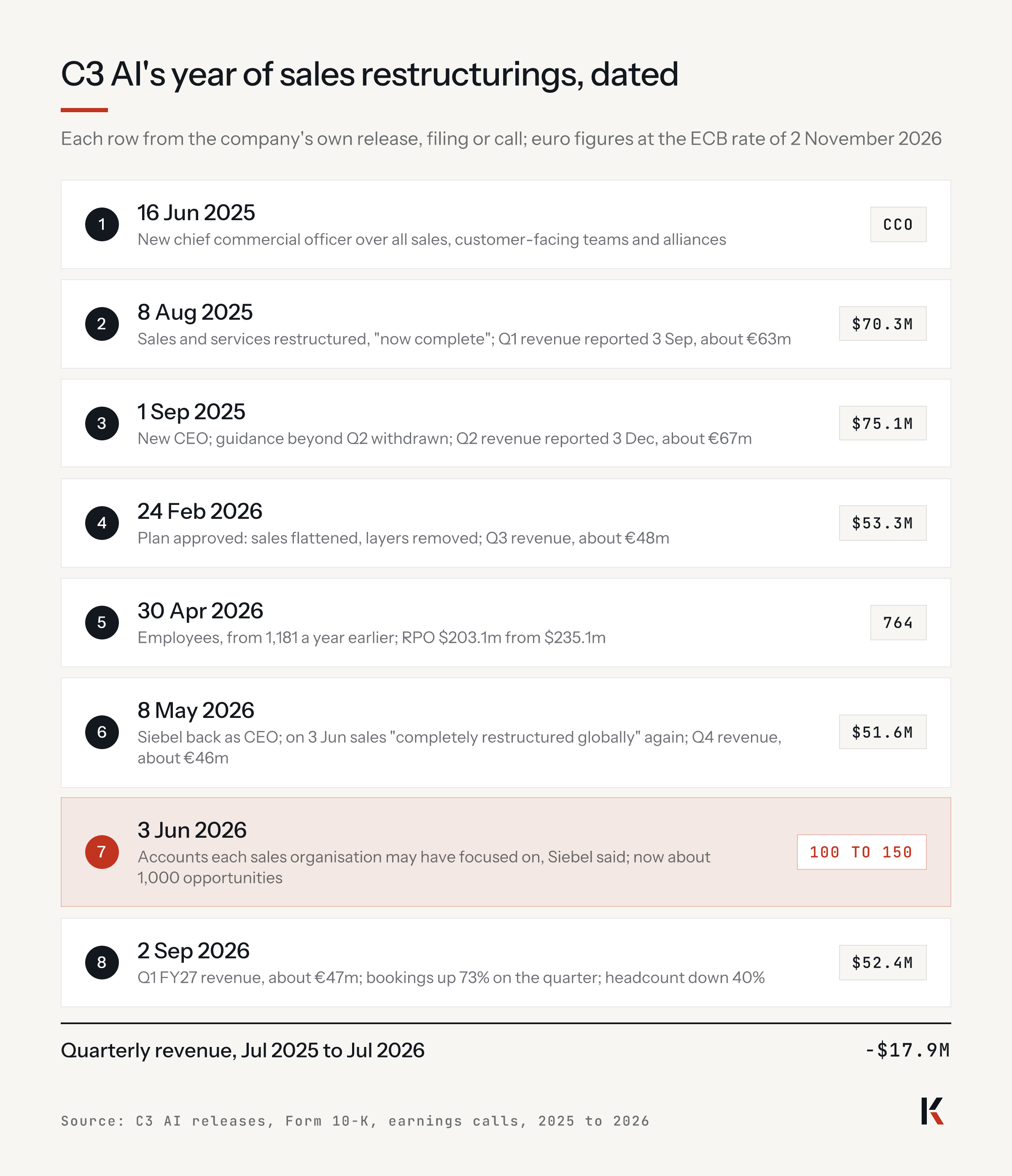
It was the third restructuring of the sales organisation in twelve months. On 8 August 2025 C3 AI said sales and services had been restructured under a new chief commercial officer, and that the work was complete. On 25 February 2026 chief executive Stephen Ehikian said sales had been "restructured and flattened". On 3 June Siebel said it had been "completely restructured globally" again.
Over the same year quarterly revenue went from $70.3 million, about €63 million, to $52.4 million, about €47 million.
The company puts the first fall on the reorganisation and Siebel's health, and the later quarters on sales execution.
I read the year as one work-organisation problem: three changes of who owns the customer, with no quarter long enough for a new owner to settle. C3 AI sells enterprise AI software on subscription; the account is its unit of revenue.
The short version
C3 AI restructured its sales organisation in August 2025, February 2026 and June 2026, each time with new leaders.
Quarterly revenue went from $70.3 million to $52.4 million in that year; the company names the reorganisation, Siebel's health and sales execution as causes.
Siebel said each sales organisation might have been focused on 100 to 150 accounts; in June the target became about 1,000 account opportunities.
Three restructurings, each announced as finished
The first came with Rob Schilling, chief commercial officer from 16 June 2025, over all sales, customer-facing teams and alliances. A general manager for EMEA and new regional leaders followed, and services moved under the same chief.
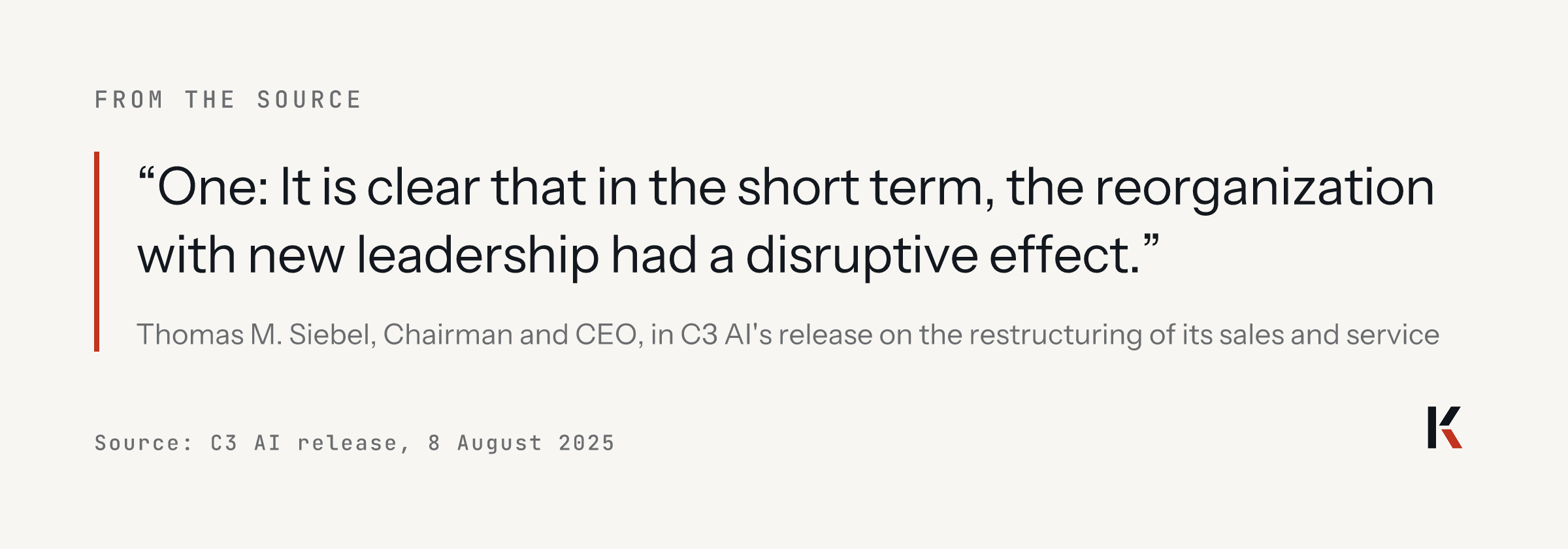
On 8 August Siebel wrote that "the reorganization with new leadership had a disruptive effect". On 3 September he put the shortfall at 70% sales disruption and 30% his not being as involved in the details as before. Ehikian had become chief executive on 1 September.
The second came on 24 February 2026, when the board approved a restructuring plan. The 10-K calls it "Organizational Flattening": layers of management removed, and "proven personnel" placed directly under the chief executive. The plan targets $135 million a year of savings, about €120 million.
The third came with Siebel's return on 8 May 2026; Ehikian stayed on as president. On 3 June Siebel said headcount had gone from about 1,070 in January to roughly 700, and that federal and sales had each been reorganised under a new leader.
The 10-K gives 764 employees at 30 April 2026, from 1,181 a year earlier. The leadership page, read on 3 November 2026, names no chief commercial or chief revenue officer.
The company has not published who now runs sales.
One account changed hands at every restructuring
Take one commercial account in Europe.
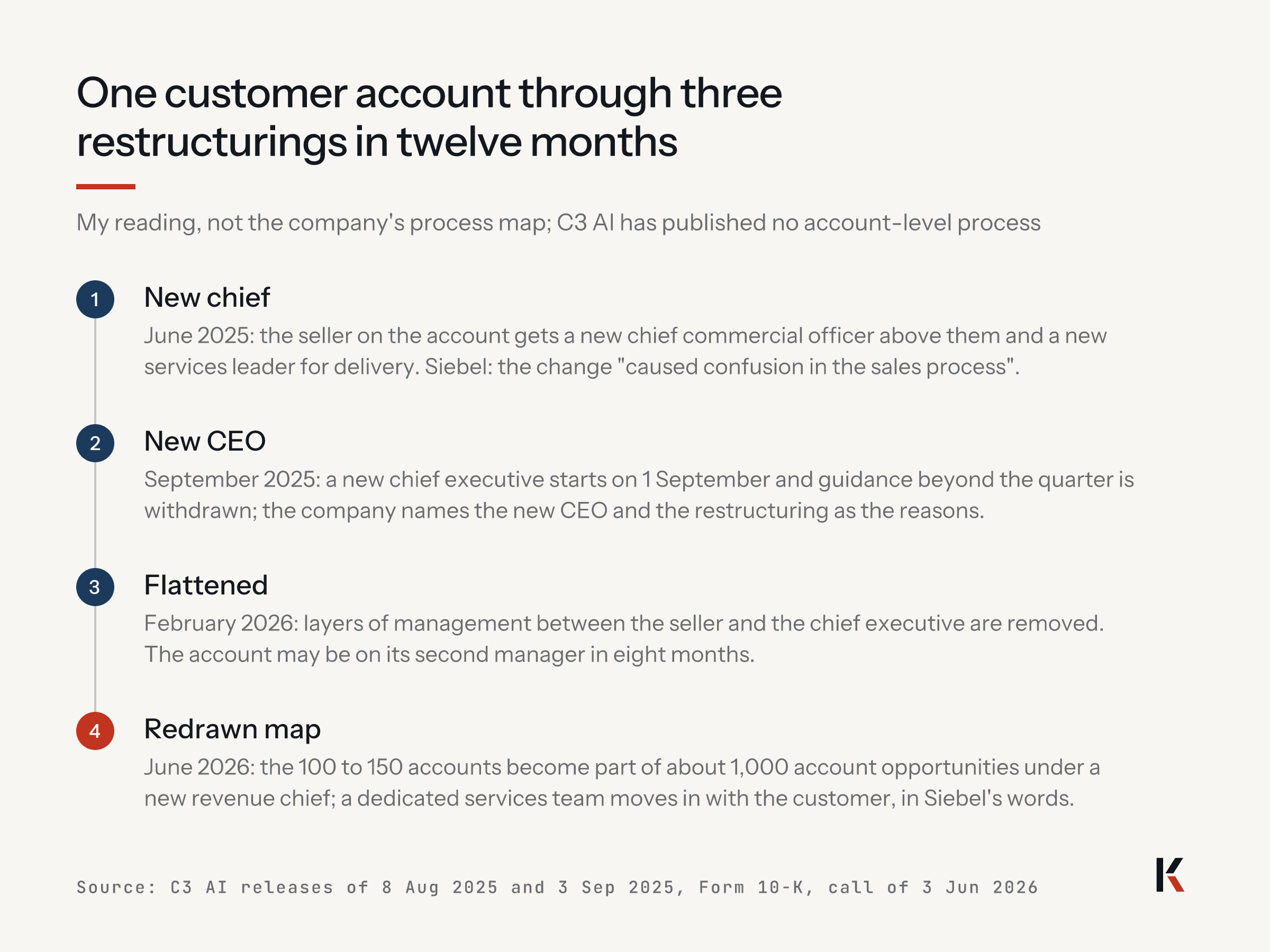
How it travelled inside C3 AI is my reading from outside; the company has published no account-level process.
In June 2025 the seller on that account gets a new chief commercial officer, and delivery gets a new services leader under him. The new leaders arrived "kind of mid-quarter, and it caused confusion in the sales process", Siebel said on 3 September.
In February 2026 the layers between that seller and the chief executive go. In June the map is redrawn: 100 to 150 accounts become part of about 1,000 account opportunities, with a dedicated services team that, in Siebel's words, moves in with the customer.
The customer may have met a new C3 AI owner three times in a year, and I would expect each new owner to spend the first weeks reading the file rather than working it. Across the 44 to 46 agreements C3 AI closed in each of the first three quarters of fiscal 2026, that would mean a pipeline reread from page one.
I read the cause as the way the work was organised: who owned which accounts, and under whom. The symptoms are what you see in people: confusion in the sales process, which is work done twice; leaders replaced within months; a workforce down 35% to 40% on the company's own count.
Most of the cost is revenue that never arrived, priced at the margin an account should have produced, never at a salary. That is how the socio-economic approach, SEAM, developed by Henri Savall and the ISEOR team in Lyon, reads a company; reading a revenue organisation with it is my own inquiry.
The severance was counted; the lost quarters were not
The counted cost is $10.8 million of restructuring charges in one quarter, about €9.6 million. Against it the company sets $135 million a year of savings and free cash flow of $2.1 million in the July quarter.
The uncounted cost sits in the revenue line. From the July 2025 quarter to the July 2026 quarter, revenue fell by $17.9 million a quarter, about €16 million. Remaining performance obligations fell from $235.1 million to $203.1 million in the year to April, about €210 million to €180 million.
Initial production deployments, the paid first phase of a C3 AI customer relationship, fell from 174 to 71. The company says it chose to sign fewer of them, with a higher chance of turning into production contracts.
Sales and marketing spend barely moved: $237.4 million against $239.7 million, about €210 million either year.
So you have a sales organisation that cost about the same, signed 103 fewer first contracts, partly by choice, and focused on roughly a tenth of the accounts it now targets.
The hours spent learning new managers and new maps were paid in full. The 850 or so account opportunities per organisation outside that focus, by my arithmetic on Siebel's figures, are in my reading the larger cost, and no line in the 10-K carries them.
"Revenue fell because the market turned, not because of the org chart," you may say. C3 AI does not say that: on 3 June Siebel said the market is huge, the product is good and "it really is sales execution".
You may conclude that the June 2026 structure works, because bookings rose 73% quarter on quarter in July. I would not go that far. A rise from a low base after a 40% headcount cut says little about who owns accounts.
The number that would show it is one C3 AI has not published: how many accounts changed owner at each restructuring, and how long each took to reach its first new conversation.
To me, three restructurings in a year point to a design problem before a leadership one. Siebel described that coverage as the way territory assignments had worked in the last year. I read it as a territory list that nobody was charged with checking against the market; the company has not said who set it.
Kihon designs that part of a revenue system before anyone has to run it: who owns which accounts, how many each person can hold, and what changes hands when a manager goes.
That is Build, built for software companies whose commercial system grew by hiring rather than by design. If your chief executive has not read your territory list this year, thirty minutes on your own numbers is where I would start.
What a CRO would do before the next reorganisation
- Print the account list each seller actually works, and compare it with the market list the plan assumes.
- Count the accounts that changed owner in the last twelve months, and date each change.
- Freeze ownership of the top fifty accounts for two quarters, whatever the next org chart says.
Sources
- The Motley Fool, C3.ai Q4 fiscal 2026 earnings call transcript, 3 June 2026
- C3 AI, fiscal fourth quarter and full fiscal year 2026 results, 3 June 2026
- C3.ai, Form 10-K for the fiscal year ended 30 April 2026, filed June 2026
- C3 AI, fiscal first quarter 2027 results, 2 September 2026
- The Motley Fool, C3.ai Q1 fiscal 2027 earnings call transcript, 2 September 2026
- C3 AI, preliminary fourth quarter results and leadership update, 12 May 2026
- C3 AI, fiscal third quarter 2026 results, 25 February 2026
- C3 AI, fiscal second quarter 2026 results, 3 December 2025
- C3 AI, fiscal first quarter 2026 results and CEO appointment, 3 September 2025
- The Motley Fool, C3.ai Q1 fiscal 2026 earnings call transcript, 3 September 2025
- C3 AI, restructuring of sales and services organisations, 8 August 2025
- C3 AI, appointment of Rob Schilling as chief commercial officer, 24 June 2025
- C3.ai, Form 10-K for the fiscal year ended 30 April 2025, filed June 2025
- C3 AI, leadership page, read 3 November 2026
- European Central Bank, euro reference rates, 2 November 2026
Your turn: how many of your accounts changed owner in the last twelve months, and who told the customer? Write to me at cemgorer@kihonlabs.com, or answer on LinkedIn. I read every reply.