
Working note of the Kihon research programme, not client evidence.
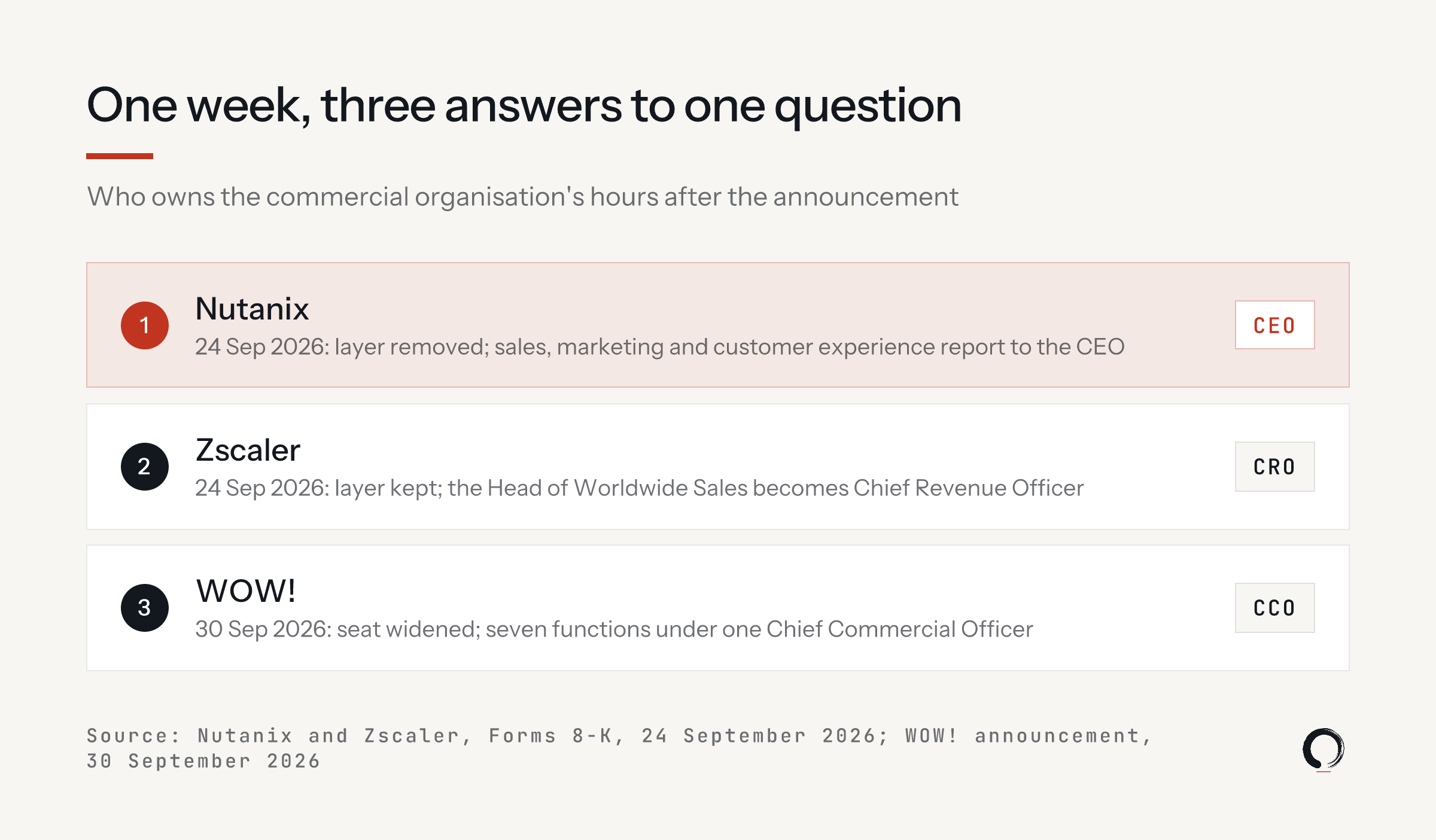
On 24 September Nutanix told the SEC that its President and Chief Commercial Officer would step down on 2 October, and that sales, marketing and customer experience would report to the chief executive. The same day Zscaler promoted its Head of Worldwide Sales to Chief Revenue Officer. Six days later WOW!, a US broadband operator, gave a new chief commercial officer brand, marketing, digital, sales, pricing, product and the call centre in one seat.
Three companies, one question, three answers. Not one of the three announcements says where the hours will come from.
I read that as a time-management problem before it is a structure problem: where the hours of leaders and teams go, and what the company pays when they go to the wrong place.
The short version
A reorganisation moves decisions before it moves people.
Every decision that moves lands in a diary, and a diary has a fixed number of hours.
The bill arrives as deals that wait, and no line in the P&L carries it.
Three companies, one seat, three answers
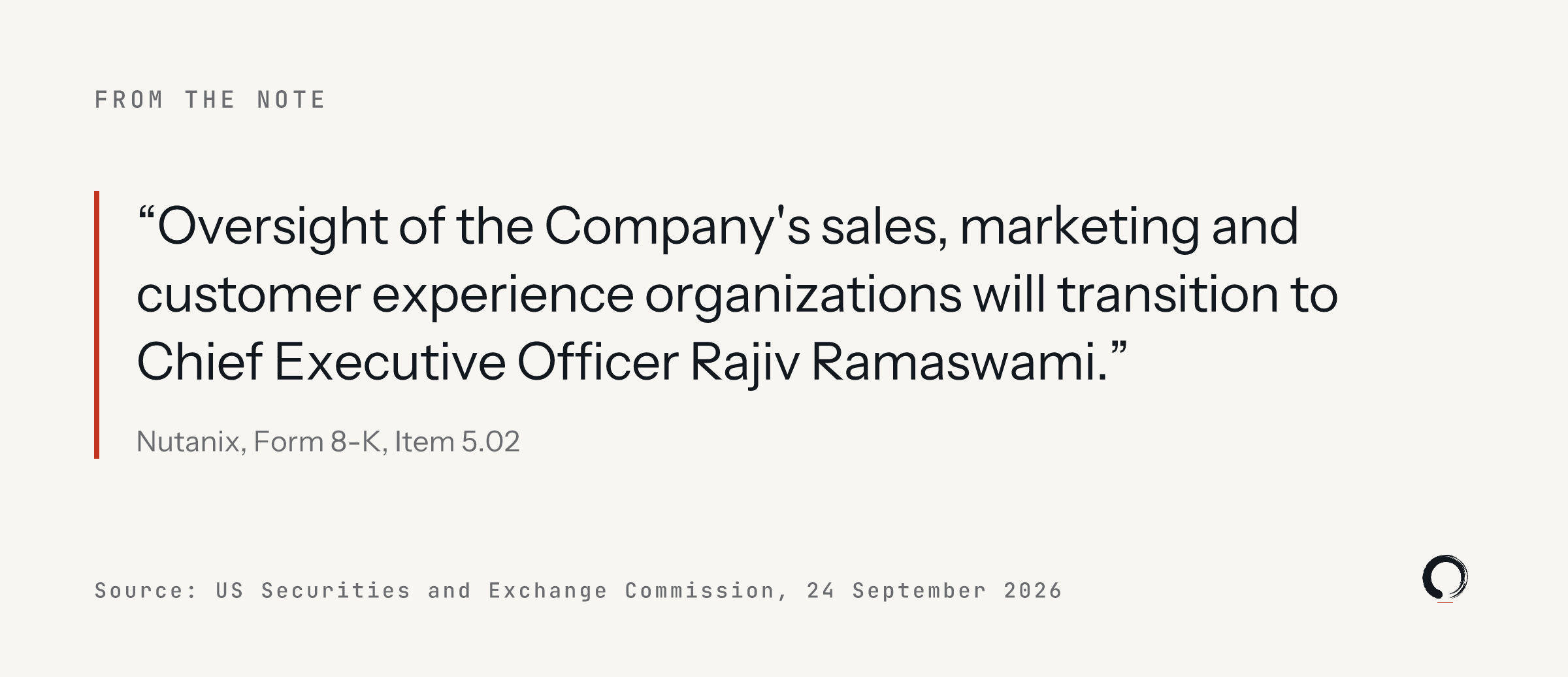
Nutanix removed a layer. A company with approximately 8,350 employees and $2.85 billion of revenue in the year to 31 July now has its whole commercial organisation reporting to Rajiv Ramaswami, who already runs the company. The filing says the departing president "intends to devote more time to his external board, industry leadership, and advisory activities" and that the two sides are discussing a senior advisor arrangement.
Zscaler kept the layer and filled it from inside. Ross Tackett, three years at the company and more than three decades in technology sales, became Chief Revenue Officer on 1 October. The outgoing CRO, Mike Rich, stays as a strategic advisor until 31 December. The hours stay where they were; the signature changes.
WOW! widened the seat. Christopher Sikora, previously chief revenue officer at Great Plains Communications, whose network spans 13 states, takes brand, marketing, digital, sales, pricing, product and call-centre operations, reporting to the CEO. Seven functions that usually have three or four owners now have one.
Where the hours go
An organisation chart is a map of who reports to whom. A diary is a map of who decides what, and when. The two drift apart the moment a reorganisation is announced, because the chart changes on the day and the diary changes over months.
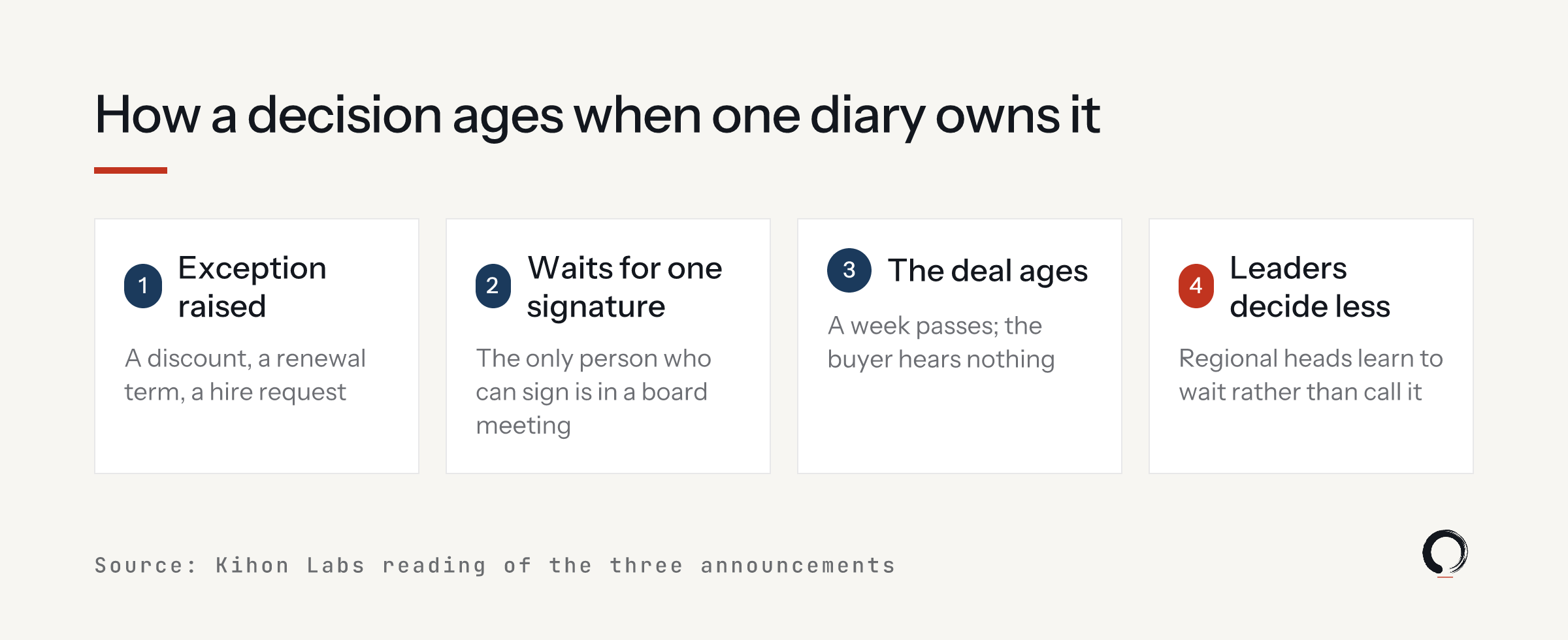
Take the smallest unit, one escalation. A regional head wants to approve a discount outside policy. Before the change, the request stopped one desk up, at a commercial officer whose week was built around requests like it. After the change it stops at the chief executive, whose week was built around the board, the investors, the product and eight thousand people. The request does not get a worse answer. It gets a later one.
Multiply that by the number of decisions a commercial organisation produces in a week: pricing exceptions, renewal terms, territory disputes, hiring requests, the forecast call itself. Each one now competes for the same hours as everything else the CEO does. Some wait. Some are decided by whoever is nearest, without the authority to decide them. Some stop being asked, because the people below learn that asking takes a week.
The cause is where senior hours go. The symptom is work that waits and decisions nobody takes. The bill is what did not happen, and I would price it the opposite way from most finance teams: a lost hour costs the margin it should have produced, which is far more than the salary of the person who lost it.
The bill, in the company's own units
None of the three announcements gives a number for this, and this note will not invent one for them. The method can still be shown on placeholders, labelled as such.
Suppose a commercial organisation sends twenty decisions a week to a diary that can take eight. Twelve wait. If each waiting decision holds a deal worth a week of pipeline, the organisation ages twelve weeks of pipeline every week, and the number compounds until someone changes who signs. Every input in that paragraph is a placeholder; the method is what carries over to your own numbers.
"A CEO closer to the customer is a good thing." For the customers he meets, yes. The question is what the rest of the commercial organisation does in the weeks he is meeting them.
What this does not establish
Whether Nutanix, Zscaler or WOW! have already answered the diary question in private. A filing usually tells you who reports to whom; it rarely tells you who decides what on a Tuesday. It is possible that Nutanix delegated the weekly cadence to regional leaders the same day, and I would not conclude otherwise from the outside. What would settle it is one quarter of decision latency, measured before and after: the time from a request to a signature, by type of request.
One thing to try this week
- Monday. List the ten decisions that moved with your last organisation chart, and the diary each now lands in.
- Wednesday. For each one, write how long it took before the change and how long it takes now.
- Friday. Put a name other than the top one on seven of the ten, in writing.
Three questions a CFO would ask
Is this a cost we can see in the accounts?
No. The salary of the person who now decides was already there. What moves is the margin on deals that waited and on decisions nobody took: what did not happen.
Does removing a layer not save money?
Usually it saves one salary and moves the work. Whether that is a saving depends on where the work lands; a commercial officer's week landing in a chief executive's diary is rarely cheaper per hour.
How would we know if this is happening to us?
Measure the time from a request to a signature for five kinds of decision, this quarter against last. If it grew after the reorganisation, the structure is paying for itself out of the pipeline.
Sources: Nutanix, Form 8-K, 24 September 2026; Nutanix, Form 10-K for the year ended 31 July 2026; Zscaler, Form 8-K exhibit 99.1, 24 September 2026; The Fast Mode, 30 September 2026; ISEOR (Savall and Zardet).
Your turn: in your organisation, which decision waits on one diary? Write to me at cemgorer@kihonlabs.com, or answer on LinkedIn. I read every reply.