
In August 2026 Siva Rajamani gave the keynote at Northstar '26, Everstage's summit in New York. He runs Everstage, which sells commission, quoting and planning software. He brought the answers of 195 revenue leaders.
Every one of the 195 had AI running in production. Half of them, 51%, said its biggest shortcoming is that it surfaces an insight without acting on it.
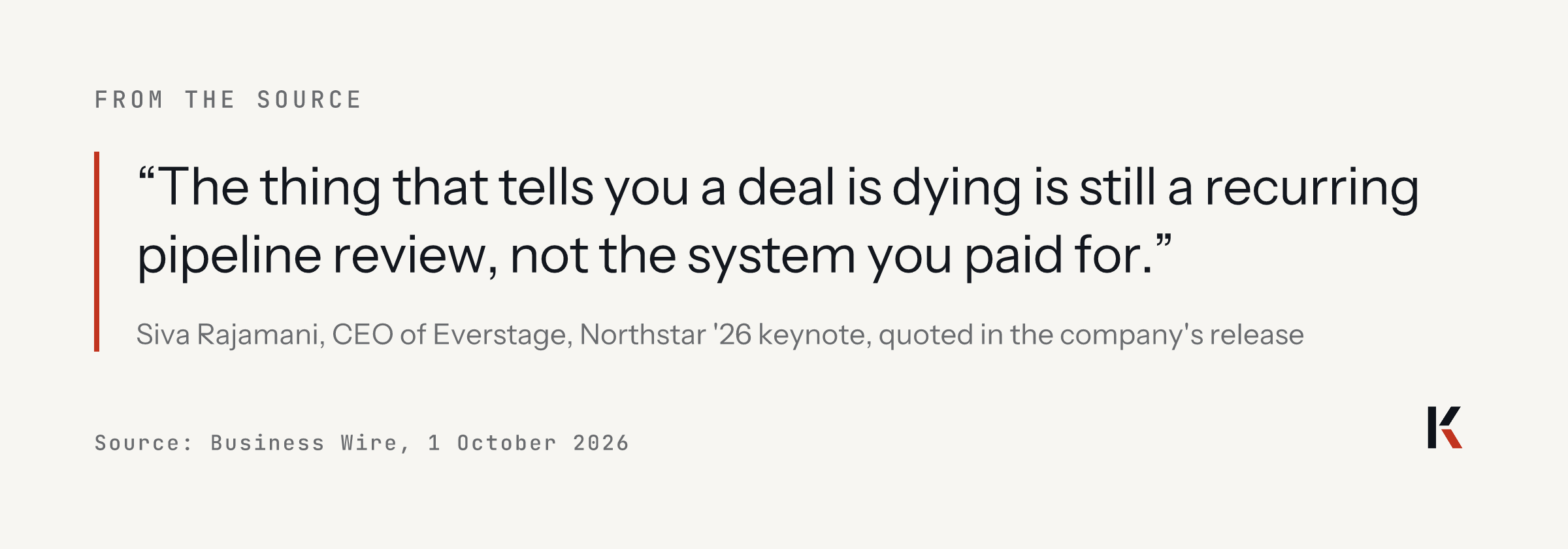
Then came the sentence that gives this note its subject. The thing that tells you a deal is dying "is still a recurring pipeline review, not the system you paid for".
Everstage put the findings out on 1 October through Business Wire; its own findings page carries more of them.
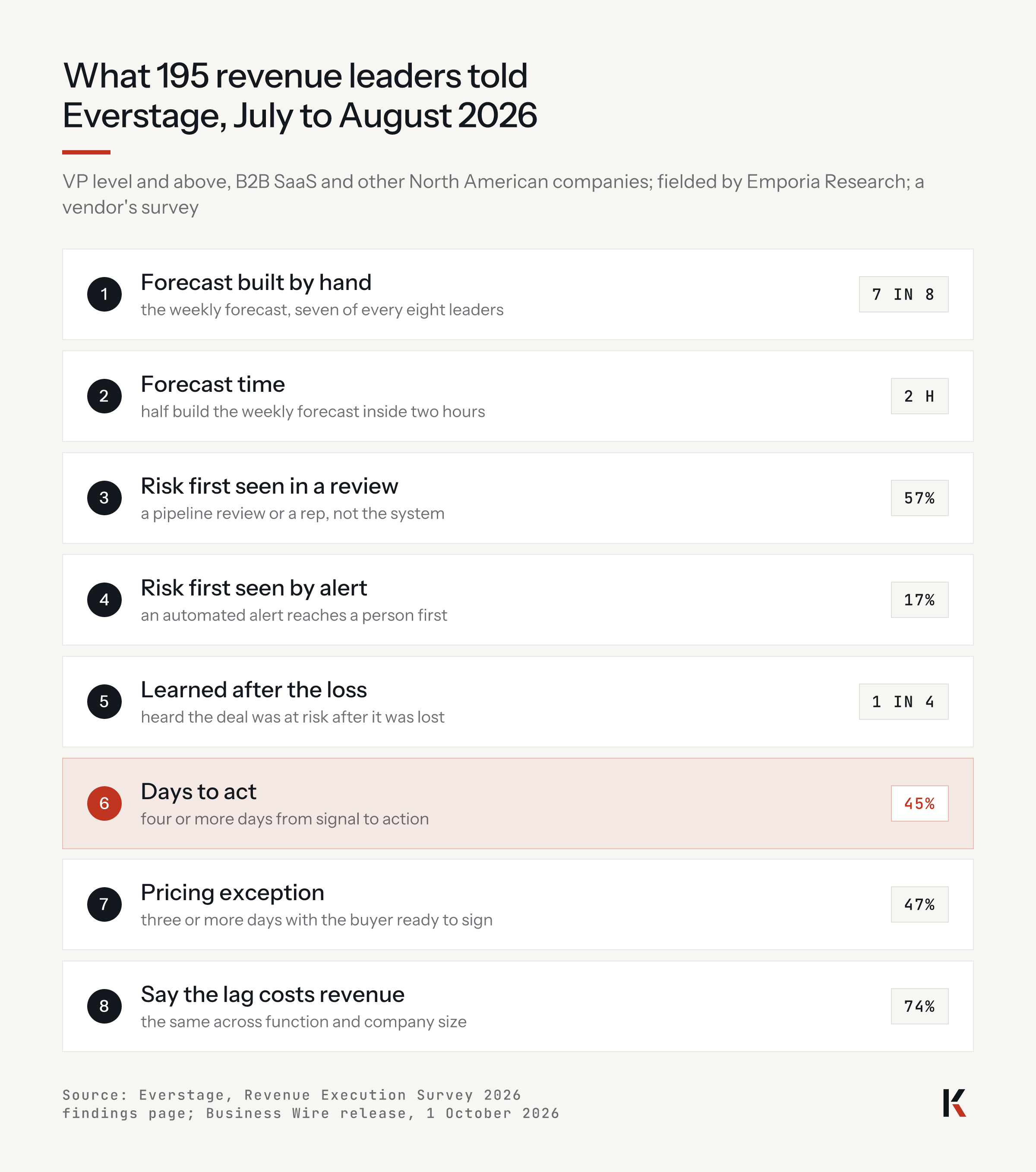
The page heads its forecast finding "Two hours to build a forecast, every week". Half of the leaders build the weekly forecast inside that window; the page does not give the time for the other half.
Seven in eight build it by hand.
The calendar, not the signal, decides when a deal gets attention, and the leaders' hours go to the report that feeds the calendar. That is a time-management problem: where a revenue leader's week goes, and how long a deal waits for it.
The short version
195 revenue leaders surveyed: seven in eight build the weekly forecast by hand, and half build it within two hours.
57% first learn a deal is at risk in a pipeline review or from a rep; 17% hear it first from an automated alert.
45% take four or more days to act on a risk signal, and 74% say that delay costs them revenue.
The review runs on a calendar
Emporia Research fielded the survey for Everstage in July and August 2026. The release describes the 195 as revenue leaders at VP level and above, at B2B SaaS and other companies across North America.
The findings page calls them VPs of revenue operations, CROs and VPs of sales, at SaaS and AI-native companies from mid-market to enterprise.
On the week. 57% first learn a deal is at risk in a pipeline review or from a rep. 17% hear it first from an automated alert. One in four learn a deal was at risk only after it was lost.
On the wait. 45% take four or more days to respond once a risk signal appears. 47% take three or more days to approve a pricing exception while the buyer is ready to sign.
The two documents do not give the hours the review itself takes, how the forecast hours were measured, how many deals were lost, or any money figure.
The full report is promised on the findings page and offered to the press on request.
One deal waits for Thursday
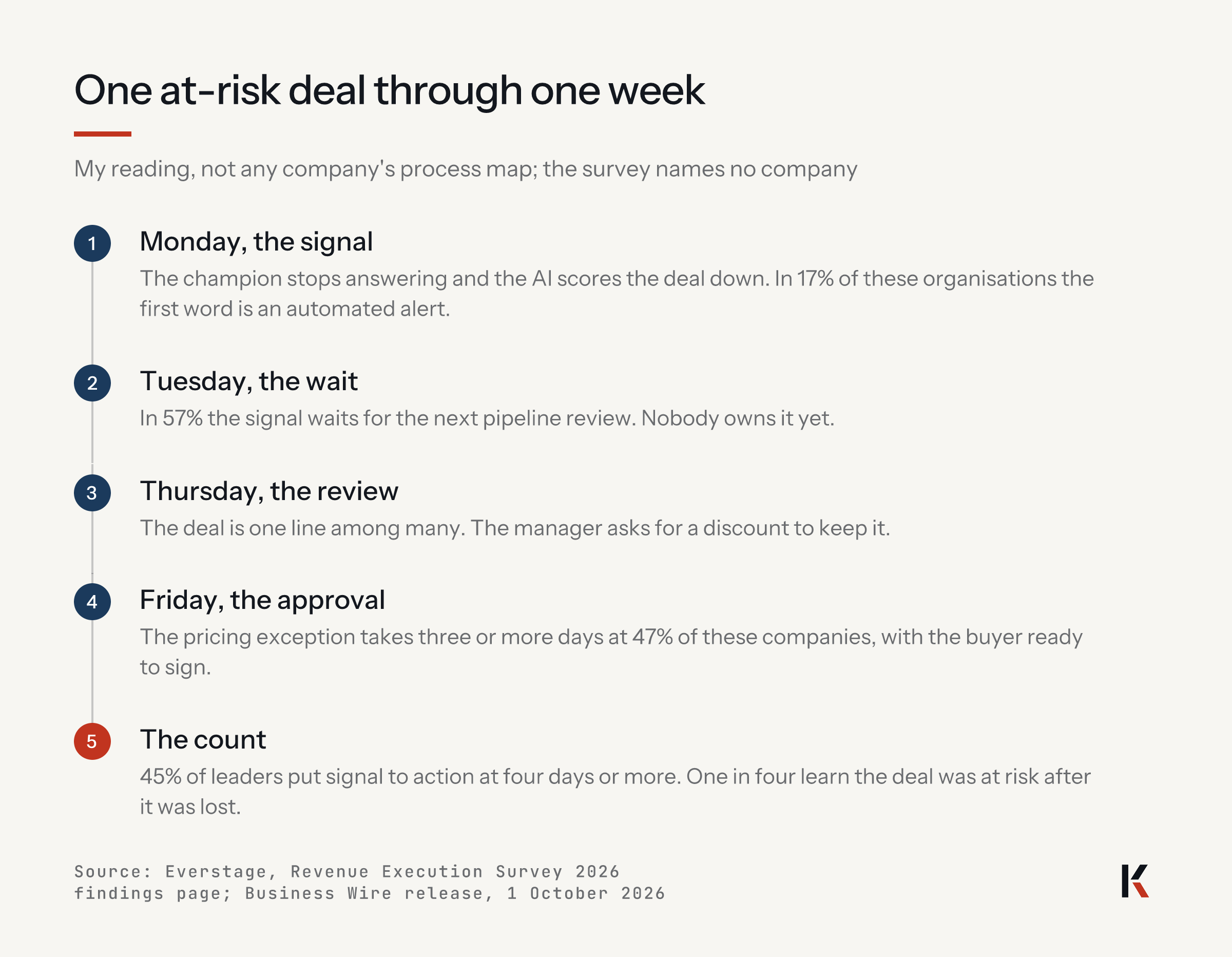
How a signal travels inside a revenue team is my reading from outside; the survey publishes no process map and names no company.
Monday, a signal appears. The champion stops answering and the AI scores the deal down.
In 17% of these organisations the first word is an automated alert. In 57% the signal waits for the next pipeline review.
Thursday, the review. The deal is one line among many. The manager asks for a discount to keep it, and the pricing exception goes to approval.
At 47% of these companies the buyer who is ready to sign now waits three days or more.
45% of the leaders put the time from signal to action at four days or more. In a five-day week, that is most of a working week for one deal.
I read the family as the cause. The week is organised around a recurring review, so a risk signal is read when the calendar says, not when it appears.
The symptoms are people's work. A leader builds a report by hand. A manager learns in a meeting what the system knew on Monday. A deal is lost before anyone was told.
The cost is what did not happen in those days: the deal still open when the signal appeared and lost by the review, the discount approved after the buyer's window.
The socio-economic approach, SEAM, developed by Henri Savall and the ISEOR team in Lyon, calls those symptoms lack of direct productivity and non-quality, and the cost non-production. It values the hours and the days at the margin they should have produced, not at the salary they cost.
Two hours, four days, one lost deal
No source gives money, so the cost stays in units you can count.
For a leader at the two-hour mark, that is about 100 forecast hours a year, my arithmetic on a 50-week year. For one at-risk deal, four or more days before the first action, at 45% of these companies. For one leader in four, a deal lost before anyone heard it was at risk.
The forecast hours are the visible side, paid in salary every month. The larger side is the deal.
My reading: a renewal still open on Monday and lost by Thursday costs its whole annual margin, and the accounts show it only as revenue that never came.
Marketing shows the same shape. PPC Land, reading DoubleVerify's 2026 survey of 2,020 marketing decision-makers, gives 9 hours 58 minutes a week on manual campaign optimisation, against 10 hours 12 minutes a year earlier. DoubleVerify sells the automation it measures.
GitLab's handbook gives its field team Focus Fridays: the guidance is to cancel or move standing Friday meetings, with customer, prospect and partner meetings as the exceptions.
The CRO presents the quarterly forecast to the CEO, the CFO and other company leaders once a month. The page, last modified on 30 September 2025, gives no hours saved.
A fair objection: the pipeline review is where coaching happens, and nobody wants to lose it. I agree, and the survey does not ask you to lose it. The problem is the queue in front of it: at 45% of these companies, four days or more pass between a signal and the first action.
The findings page also places the cause elsewhere: more than half say the information already existed somewhere in their systems, and Everstage calls the problem routing.
You may conclude that AI should act on its own. The survey does not show that, and its sponsor sells products that do exactly this.
It shows 195 leaders who describe a delay, say it costs revenue, and report their own hours and days, with no deal count.
You can measure it yourself: on your last twenty at-risk deals, the date of the first signal, the date of the first action, and the outcome.
A revenue team with AI in production and a four-day wait between signal and action has a system nobody designed: the tools arrived and the week stayed as it was. Kihon exists to catch exactly this before it reaches the P&L.
In Build we draw that path: which signal reaches which owner on which day, and what a day's wait on a pricing exception costs at margin. The 195 work at software and other B2B companies, from mid-market to enterprise. If your forecast is still built by hand, thirty minutes on your own numbers is where it begins.
What a CRO would do before the next review
- Time the next weekly forecast and write down who built it, in which tool, for how long.
- Date the first signal and the first action on your last ten at-risk deals.
- Give every pricing exception a same-day owner when the buyer is ready to sign.
Sources
- Everstage, Revenue Execution 2026 Report findings page (195 revenue leaders, Emporia Research), revealed at Northstar '26, August 2026
- Business Wire via FinancialContent, Half of Revenue Leaders Say AI Surfaces Insights but Fails to Act, Everstage's Research Finds, 1 October 2026
- GitLab Handbook, Field Team Meetings, last modified 30 September 2025
- PPC Land, Marketers still spend 10 hours a week on manual optimization, DV finds, 1 November 2026
- GlobeNewswire via Finviz, DV Research: 97% of Marketers Plan to Use AI, but Adoption Across Advertising Workflows Remains Uneven, 29 October 2026
Your turn: on the last deal you lost, how many days passed between the first signal and the first action? Write to me at cemgorer@kihonlabs.com, or answer on LinkedIn. I read every reply.