
On the 4 November earnings call, two days into the job as chief executive of MNTN, Tony Weisman started with the number the company had missed. Third-quarter revenue was $80.3 million, about €71 million. The guidance of 4 August had been $86 million to $89 million, about €76 million to €79 million.
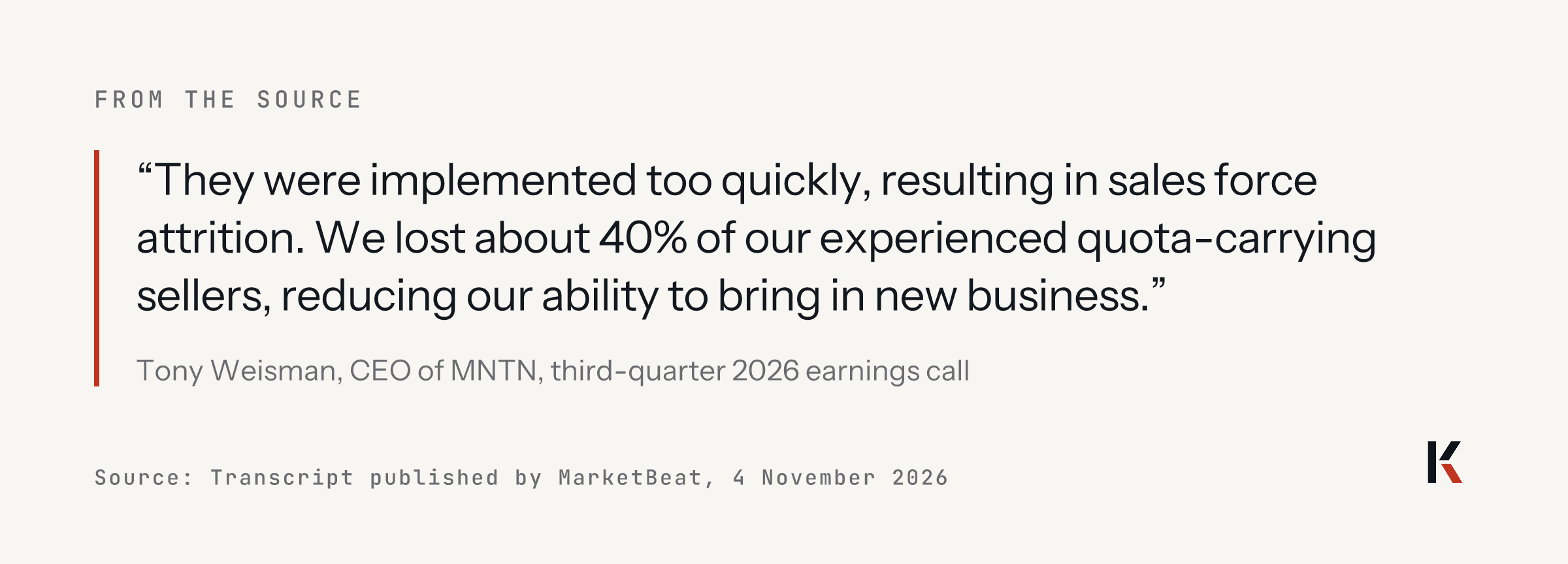
Then he gave the cause. MNTN had made changes in its sales team, most notably to the way its sellers were paid, modelled, he said, on Google and Meta. The team was told late in the second quarter; the plan took effect in July. About 40% of the experienced quota-carrying sellers left.
A pay plan is a decision until the day it reaches payroll; MNTN's reached its sellers in July and its revenue line by the end of September.
That distance, between a plan agreed at the top and the week it lands on the people who win revenue, is a strategy-implementation problem. The symptom is people leaving. What it costs is new customers never signed.
The short version
MNTN told its sellers late in the second quarter of three changes to how they were organised and paid, and switched them on in July.
About 40% of its experienced quota-carrying sellers left, and the quarter came in $5.7 million to $8.7 million under guidance, about €5.1 million to €7.7 million.
The 2026 revenue plan fell from $347 million to $357 million to $311 million to $314 million, about €280 million; the CEO has been replaced, and the COO and the chief revenue officer have left.
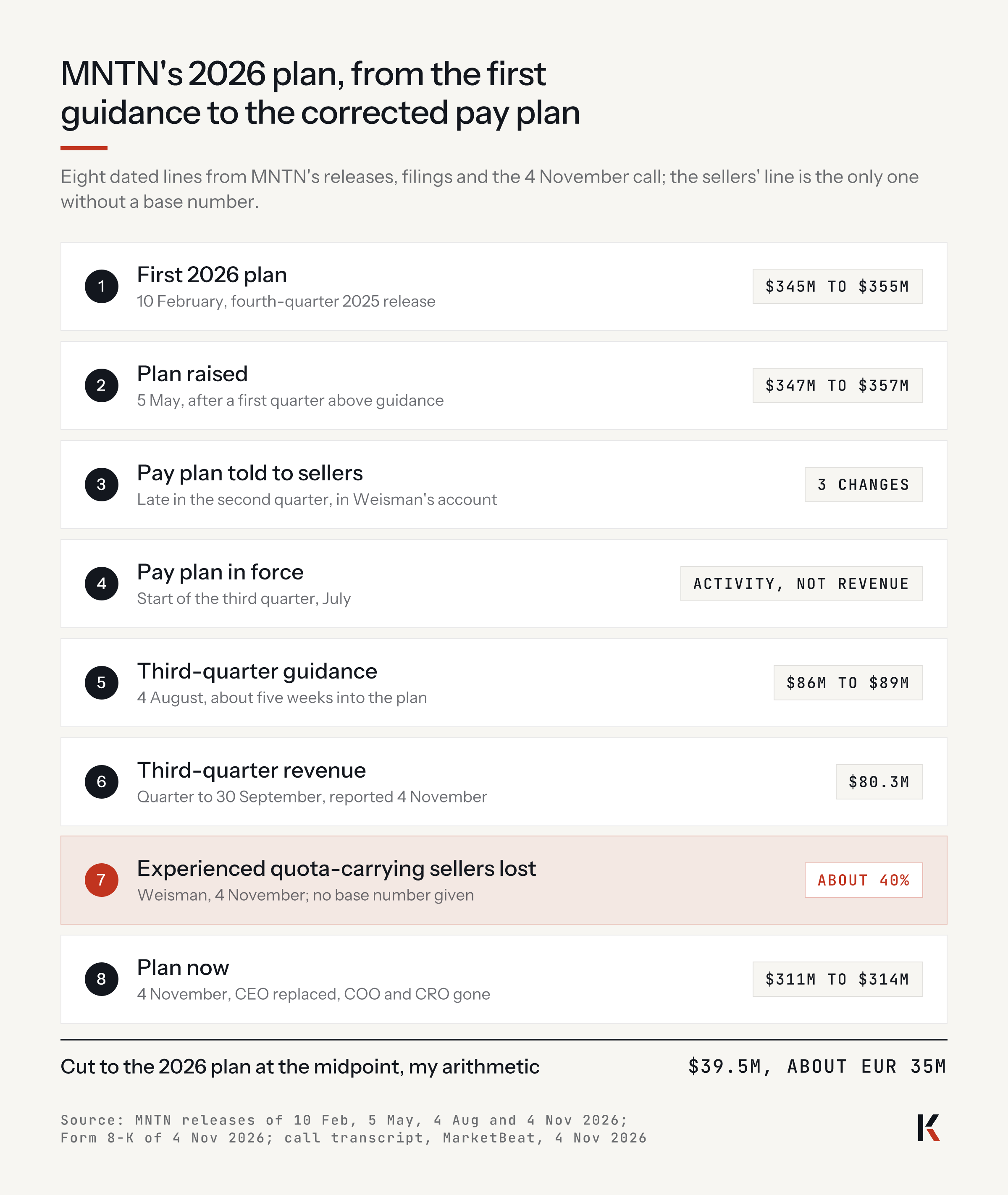
Nine months from the first plan to the corrected pay plan
MNTN sells a self-serve platform for performance advertising on connected TV, with a focus on small and mid-sized businesses. Its 10-K counts 534 full-time team members at the end of 2025.
On 10 February it guided 2026 revenue to $345 million to $355 million, about €310 million.
On 10 March Garland Hill joined from TikTok as its first chief revenue officer, to "oversee all revenue-driving initiatives". On 28 April the company approved a restructuring plan with a workforce reduction, completed by 30 June, for $1.5 million of charges, mostly severance, about €1.3 million; the 10-Q gives no headcount.
On 5 May, after a first quarter above guidance, the year was raised to $347 million to $357 million, about €310 million to €320 million.
The sales changes came next, in Weisman's account: "a verticalization that was deployed poorly and too quickly", incentives moved "from revenue to activity", and a new pay frequency. "These were told to the team in late Q2, but implemented at the beginning of Q3."
On 4 August, about five weeks into the plan, MNTN reported second-quarter revenue of $82.5 million, about €73 million, up 21%, and guided the third quarter to $86 million to $89 million. Mark Douglas, then CEO, spoke of "strengthening our go-to-market organization". The release did not mention the pay plan.
On 1 November the board appointed Weisman, a director, as CEO from 2 November. Christopher Innes ceased to be COO the same day. Douglas leaves on 3 December after 30 days of paid leave.
On 4 November Weisman said Innes and Hill "are no longer with MNTN", that the pay plans had been corrected and that 16 sellers had been hired.
Lynn Knaak from Salesforce now leads inside sales and Frank Lee from Snap agency sales.
The documents do not say how many quota-carrying sellers MNTN had, how many left or when, or what the old and new plans paid.
Pay moved from revenue to activity, and the activity fell
Take one experienced seller in July. How the three changes land on their week is my reading from outside; MNTN has described the plan in a few sentences on one call and nothing more.
Their accounts are re-cut by vertical, so some relationships move to a colleague. Their variable pay now follows activity instead of the revenue they close. Pay arrives on a new rhythm.
Weisman's words for the result: they "felt like their opportunity for earning had been diminished".
Now multiply by the four in ten who left. In MNTN's own account, demos "brought in from the team themselves fell well below the volumes that we had seen historically". Inbound sign-ups continued. Current customers kept expanding, at more than 115% of their spend a year earlier.
The hole was in net new business, where the front-line sellers had been.
The plan paid for activity. I read the result as a plan that got less of it, because the people who produced the activity left before it could pay them.
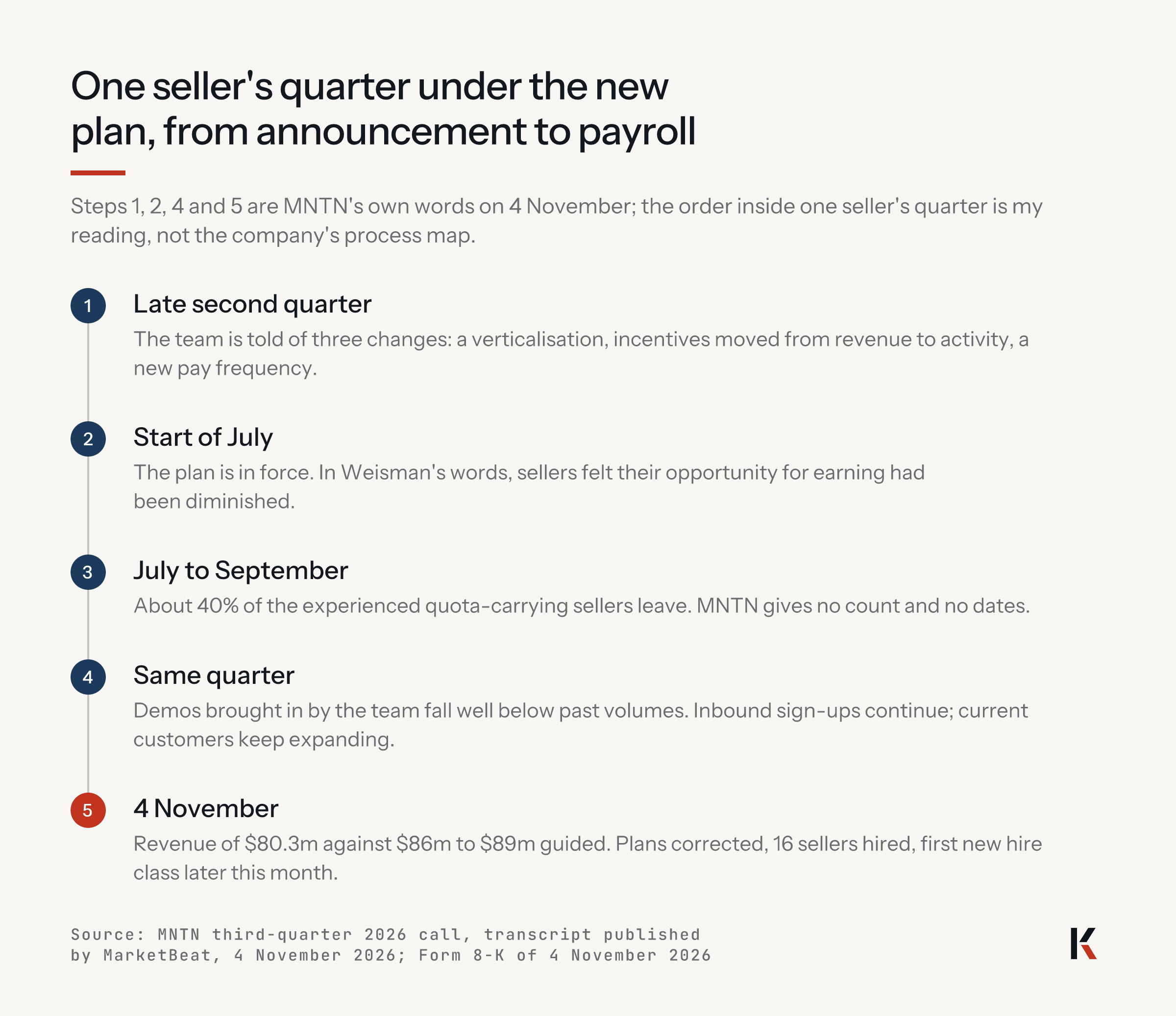
In plain words, the cause as I read it is how the plan was carried: three changes in one payroll cycle, no quarter between the announcement and the pay slip. The symptoms are people who leave, then a target missed.
The cost is the new customers a full team would have signed, priced at the margin they would have carried, not at the salaries saved.
$36 million to $43 million of plan, and 16 sellers to ramp
The arithmetic is MNTN's numbers and mine. The quarter missed guidance by $5.7 million to $8.7 million. At its 79% gross margin, that is $4.5 million to $6.9 million of gross profit, about €4.0 million to €6.1 million, that the quarter did not produce.
The year is larger. The May plan became $311 million to $314 million: a cut of $36 million to $43 million, about €32 million to €38 million. Adjusted EBITDA guidance fell by $31.5 million at the midpoint, about €28 million.
The visible costs are smaller. Sales and marketing expense, $23.8 million in the quarter, about €21 million, is expected to rise about 10% as experienced sellers are hired.
Sixteen sellers are hired, and "it will take time for these sellers to fully ramp". MNTN gives no number of months; as I read it, each of those months brings in less new business than a full team would.
You may object: "Sellers leave over pay everywhere. A 40% exit says the plan was wrong, not that it was rushed." Weisman names both: the verticalisation was "deployed poorly and too quickly", and the compensation plans have since been corrected. Whether a slower rollout would have kept the sellers is not in the documents.
I would not conclude that a pay change costs 40% of a sales team. The 40% is a rounded figure without a base number or dates. MNTN also cut staff in the second quarter, and its 10-K says most new customers arrive inbound. MNTN could show it with two counts: sellers on 30 June and on 30 September, and their demos each month.
If your 2027 pay plan is being written this month, read MNTN before it is announced. We run that handover as Operation: each change to pay, territory or rhythm gets a date, an owner and a test with the sellers before it reaches payroll, and demos per seller are counted monthly.
MNTN is a scale-up in software, 534 full-time people at the end of 2025, which hired its first chief revenue officer in March: the stage where a pay model taken from platforms as large as Google and Meta meets a much smaller sales team. Thirty minutes on your own plan, before it is announced: start here.
What a CRO would do before signing the 2027 pay plan
- Count your quota-carrying sellers today and write the number beside the plan before anyone announces it.
- Change one thing per payroll cycle, so the sellers can tell which change moved their earnings.
- Book demos per seller every month from the announcement, so the first fall shows before the quarter closes.
Sources
- MNTN, third-quarter 2026 results, Exhibit 99.1 to Form 8-K, 4 November 2026
- MNTN, third-quarter 2026 earnings call, transcript published by MarketBeat, 4 November 2026
- MNTN, Form 8-K, Item 5.02, appointment of Tony Weisman, 4 November 2026
- MNTN, second-quarter 2026 results, Exhibit 99.1 to Form 8-K, 4 August 2026
- MNTN, Form 10-Q for the quarter ended 30 June 2026, 10 August 2026
- MNTN, first-quarter 2026 results, Exhibit 99.1 to Form 8-K, 5 May 2026
- MNTN, fourth-quarter and full-year 2025 results, Exhibit 99.1 to Form 8-K, 10 February 2026
- MNTN, Form 10-K for the year ended 31 December 2025, 19 February 2026
- MNTN, "MNTN Expands Executive Team to Support Growth of Performance TV", 10 March 2026
Your turn: when your pay plan last changed, how many sellers did you have on the day it was announced, and how many one quarter later? Write to me at cemgorer@kihonlabs.com, or answer on LinkedIn. I read every reply.