
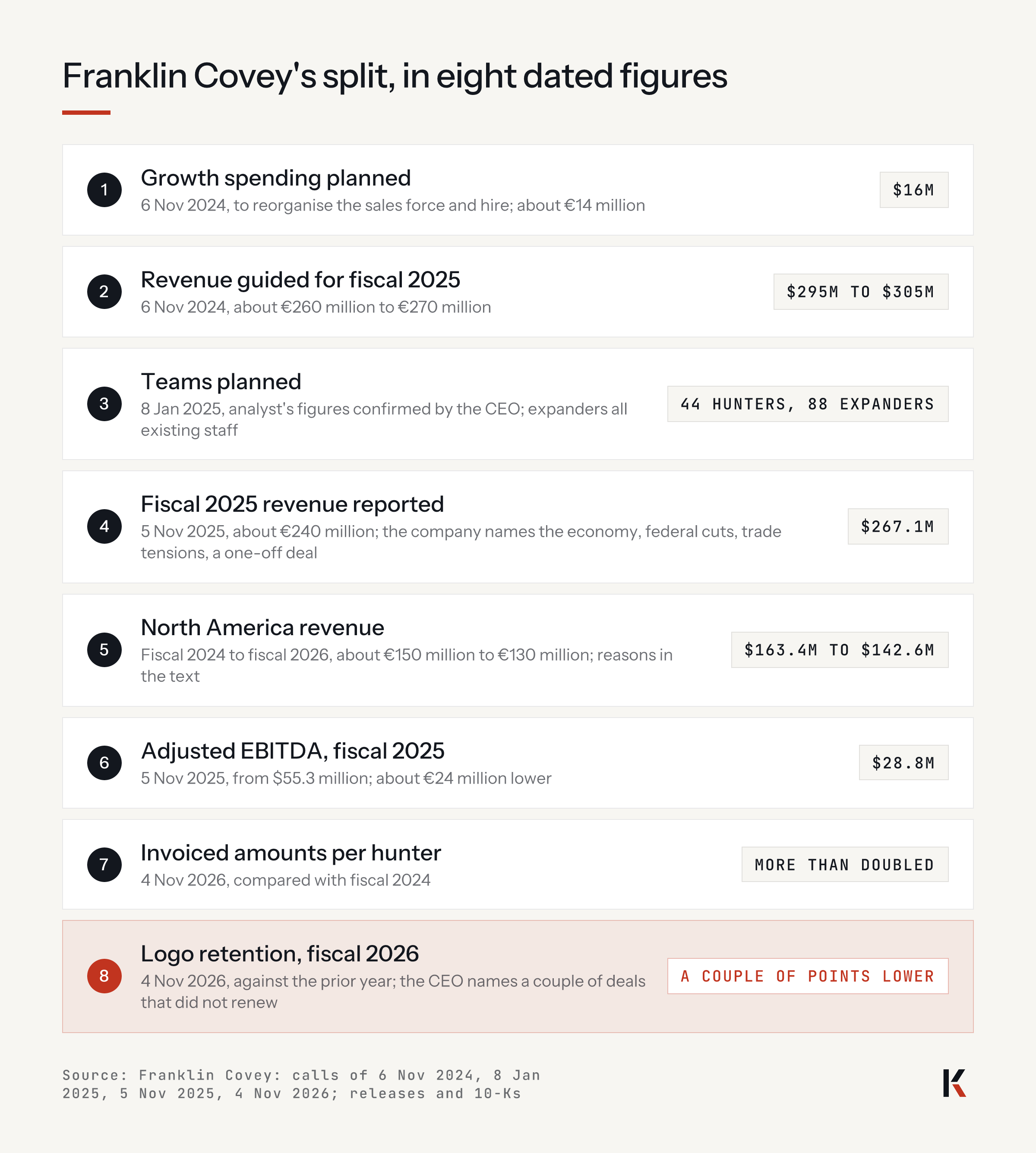
Paul Walker, Franklin Covey's chief executive, told analysts on 6 November 2024 what the next year would cost. About $16 million, around €14 million, to reorganise its sales force and hire sales and marketing staff. The annual report filed six days later said the same.
Before the change, one client partner did both jobs: win new clients and grow the existing ones. In January 2025 Walker called that "too big of a job for the same salesperson".
Pilots had run for about 18 months. On 1 December 2024 the company was fully in the new structure. Hunters win new clients. Expanders grow the clients already signed. A central sales hub supports both. On 8 January 2025 an analyst put the target at 44 hunters, with 88 expanders. Walker confirmed 42 hunters were in place and the 88 were all existing staff.
Franklin Covey split one job into two, publishes a number for each side, and has not published what happens to a client on the day it crosses from one team to the other. That is a work-organisation problem before it is a sales problem. Who owns the client, and on which date does the owner change?
The short version
Franklin Covey's North America sales force was fully split into hunters and expanders on 1 December 2024, with about $16 million of planned growth spending.
North America revenue fell from $163.4 million to $147.6 million, then to $142.6 million; the company names the economy, federal cuts, trade tensions, a one-off deal and revenue timing.
By November 2026 invoiced amounts per hunter had more than doubled; logo retention is a couple of points lower; the CEO names some deals that did not renew and sees no trend.
Two years of dates, in the company's numbers
6 November 2024. Walker announces "approximately $16 million of incremental net growth investments" and a sales force "organized" into "expanders and hunters". Fiscal 2025 revenue is guided to $295 million to $305 million, about €260 million to €270 million.
5 November 2025. "We successfully completed our go-to-market transformation," Walker says in the release. Fiscal 2025 revenue is $267.1 million, about €240 million, which the company reports as within its guidance range; the range of November 2024 was higher. North America revenue is $147.6 million, about €130 million, down 10%. The company names macroeconomic uncertainty, trade tensions, cancelled US federal contracts and a $6.2 million deal, about €5.5 million, that did not repeat.
Restructuring costs are $6.7 million, about €6.0 million, mostly severance, for the North America sales force and cost cuts elsewhere. Asked about "44 hunters and around 65 farmers", Walker says the sales force is "very, very close" to that. The January figure was 88; the company has not explained the difference.
4 November 2026. Fiscal 2026 revenue is $261.5 million, about €230 million. North America revenue is $142.6 million, about €130 million, $5.0 million lower. On the call, the company puts this mainly on lower subscription invoicing in fiscal 2025 and on services invoiced in fiscal 2026 that will be delivered in fiscal 2027. Invoiced amounts there rose 4% to $151.4 million, about €140 million. Deferred revenue rose 17% to $59.2 million, about €53 million.
"Invoiced amounts per hunter have more than doubled" since fiscal 2024, Walker says.
The client crosses a wall, and the hunter's count stops there
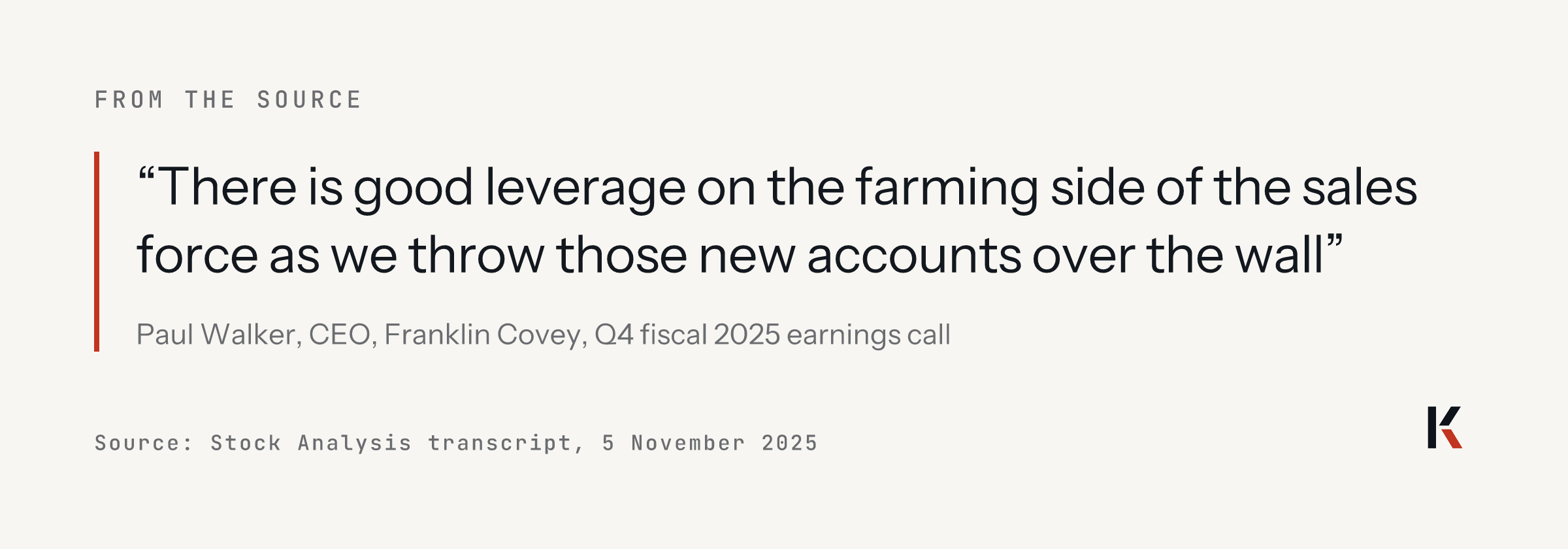
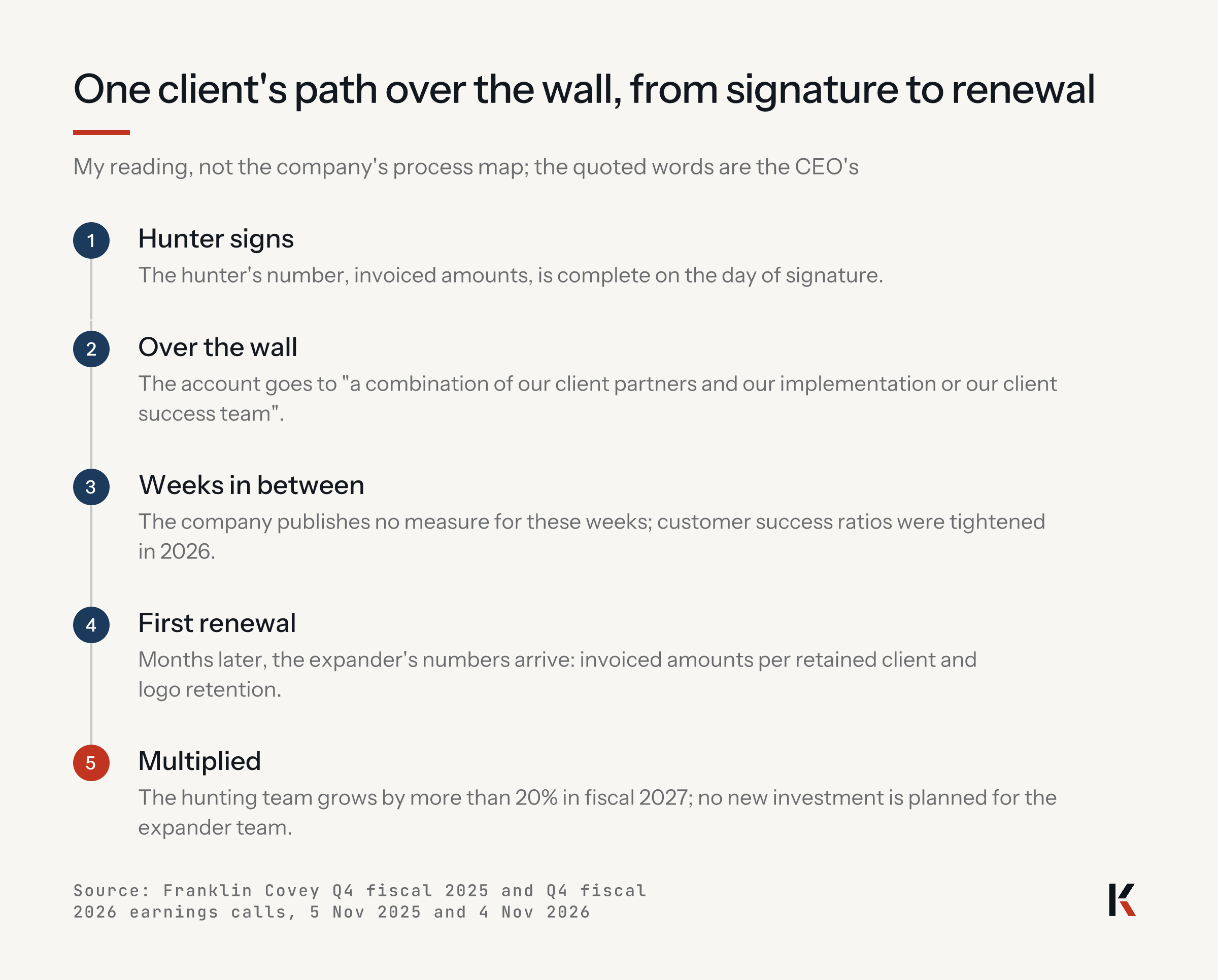
Take one client, signed by a hunter after the split. In the old model the same client partner kept it. In the new one, Walker said on 5 November 2025, the company throws "those new accounts over the wall" to "a combination of our client partners and our implementation or our client success team".
How the client travels after that is my reading from outside. The company has published no process map. The hunter's number is invoiced amounts, complete on the day of signature. The expander's numbers come later: invoiced amounts per retained client and logo retention.
In between sit weeks for which the company publishes no measure. Holly Procter, Franklin Covey's president, said on 4 November 2026 that customer success ratios had been tightened "as a key way to invest in that relationship". That is an answer to the gap, not a count of what it cost.
The hunting team grows by more than 20% in fiscal 2027, with about 30% more sales development representatives. The expander team, Walker said, "is already sized to support the growth our hunters are delivering". If the hunters keep winning, more clients cross the same wall each year.
The cause, as I read it, is how the work is organised: one job became two, with a wall between them. The symptoms are people's work. One person doing two jobs below full rate. Part of the sales force turned over. A second owner reading a file the first one knew.
The cost shows up as work that produced less than planned: revenue guided and not reported, and clients who did not stay. Each is priced at a renewed client's margin.
What the $16 million bought, and what is still uncounted
The visible side: $16 million of growth spending and $6.7 million of restructuring costs, mostly severance, in one year. Adjusted EBITDA fell to $28.8 million, about €26 million, from $55.3 million. That drop of $26.5 million, about €24 million, compares with a planned fall of about $15 million, about €13 million. The company says unexpected economic factors began in January 2025, among them tariffs and cuts in US federal spending.
Fiscal 2025 revenue landed $28 million to $38 million below the range of November 2024, about €25 million to €34 million. That is my arithmetic; the company's reasons travel with it.
The uncounted side is one line in the call. Logo retention in fiscal 2026 was "a couple of percentage points below where it had been in the previous year". Walker said he sees no trend, named a couple of deals that did not renew, and expects it to improve in fiscal 2027. The company has not said how many clients that is, nor whether a hunter had signed them.
In your subscription business, that point is a list of names with a renewal date.
You may object: "The hunters doubled their number; the model works, and the CEO says so." I take the per-hunter figure as the company gives it. The open number is the other half of the client's life. The company reports it down by a couple of points while revenue retention improved.
The conclusion you may jump to is that the split cost Franklin Covey two years of revenue. Only one table can answer that: logo retention by cohort, clients a hunter signed and handed over against clients kept by one owner. Until that table exists, the wall is a cost I can name, not one I can price.
A wall between two teams is the kind of place Kihon looks: the number on each side can be clean while the client in the middle belongs to nobody for a few weeks.
The Diagnosis finds and prices that crossing in your own numbers: who owned each new client on day 31 and day 365, and which did not renew, at margin.
Franklin Covey sells training on subscription, the kind of company on our professional services page. If your 2027 plan splits a team in two, thirty minutes on your own renewals is where I would start.
Three questions a CFO would ask before the split
Who owns a new client on day 31 after signature?
One name, written down, with the date it changes; at Franklin Covey the throw is named and the date is not public.
Which number does the second team carry, and from when?
Start it the day the client crosses, not only at the renewal, when Franklin Covey's logo retention number arrives.
What did logo retention do, by cohort of owner?
Ask for the renewals of clients signed in the first year of the new structure, beside clients that never changed hands. Only that list says whether your wall cost anything.
Sources
- SEC, Franklin Covey Form 8-K exhibit 99.1, results for the fourth quarter and fiscal 2026, 4 November 2026
- Stock Analysis, Franklin Covey Q4 fiscal 2026 earnings call transcript, 4 November 2026
- SEC, Franklin Covey Form 8-K exhibit 99.1, results for the fourth quarter and fiscal 2025, 5 November 2025
- Stock Analysis, Franklin Covey Q4 fiscal 2025 earnings call transcript, 5 November 2025
- SEC, Franklin Covey Form 10-K for the fiscal year ended 31 August 2025, 12 November 2025
- Stock Analysis, Franklin Covey Q1 fiscal 2025 earnings call transcript, 8 January 2025
- SEC, Franklin Covey Form 10-K for the fiscal year ended 31 August 2024, 12 November 2024
- Stock Analysis, Franklin Covey Q4 fiscal 2024 earnings call transcript, 6 November 2024
Your turn: for the clients your company signed this year, who owns each one today, and on which date did the owner change? Write to me at cemgorer@kihonlabs.com, or answer on LinkedIn. I read every reply.