
On 17 November, Richardson Sales Performance published a survey. The company sells sales training. It had asked 1,105 senior sales leaders between 12 and 20 October.
All of them work at companies with at least $750 million in revenue, about €680 million. They sit in North America or Europe, across 14 industries.
Richardson grouped them by the quota attainment they reported themselves. 497 were at 100% or more. 338 landed below 90%. The 270 in between are left out of the comparison.
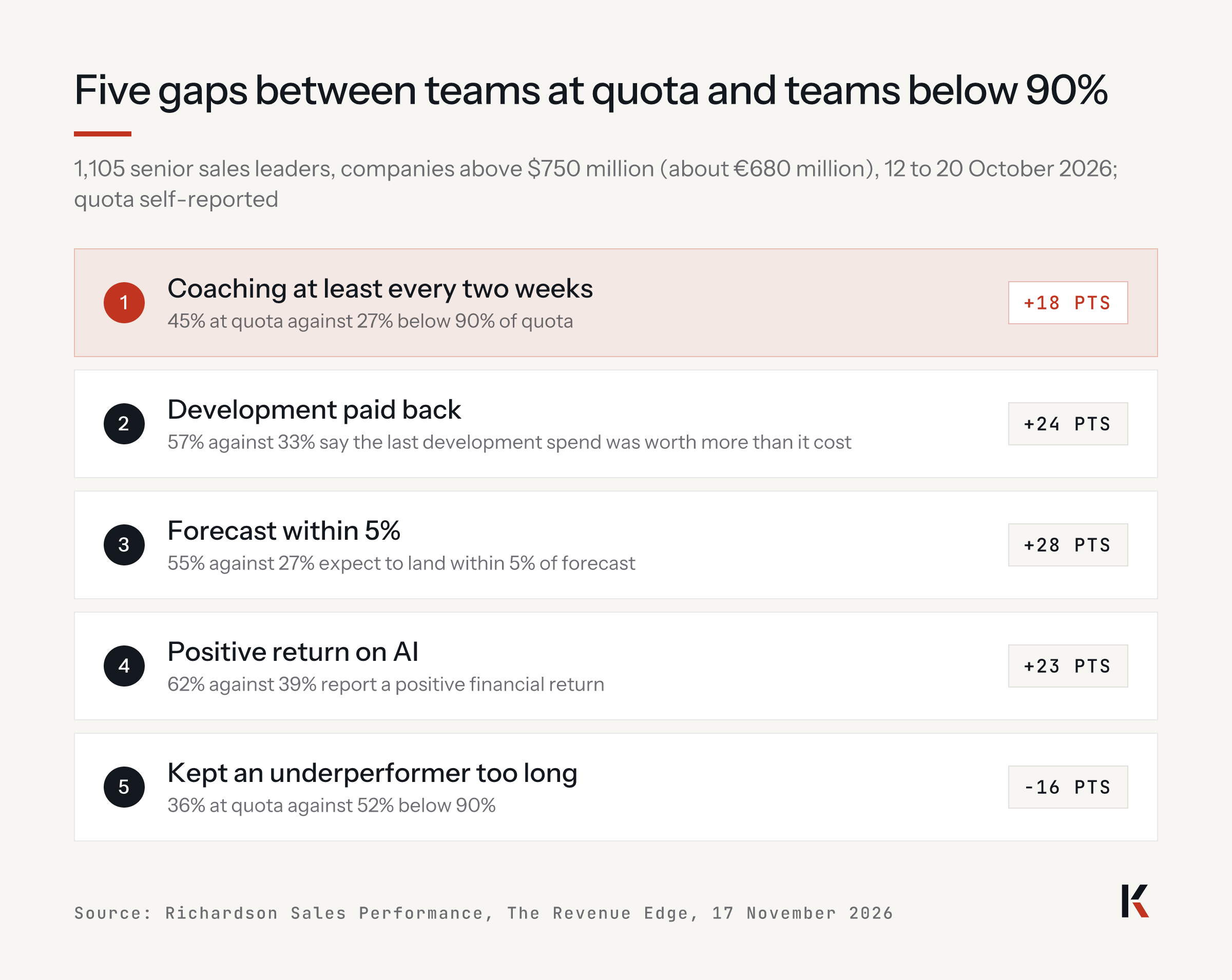
The gap I would show your CFO first is not the one about AI. Among the leaders at quota, 45% say their sellers are coached at least every two weeks. Among those below 90%, 27%.
The development that pays back is a rhythm a manager keeps every two weeks, not an event a company holds once a year. That is a training problem in the plain sense: what your people are taught, how often, and by whom.
The short version
Of 1,105 sales leaders, 45% at quota say sellers are coached at least every two weeks; below 90% of quota, 27%.
At quota, 57% say their last development spend was worth more than it cost; below 90%, 33%.
Quota is self-reported and the full report sits behind a form, so this is a vendor's pattern, not proof.
The five gaps Richardson published
The release of 17 November gives four comparisons; the report page adds a fifth.
Teams at quota are more confident in their forecast: 55% expect to land within 5%, against 27%. They report a positive financial return on AI more often, 62% against 39%. Fewer of them kept an underperformer longer than they wanted, 36% against 52%.
Two gaps belong to training. At quota, 57% say the value of their last development investment exceeded its cost, against 33%. And 45% say sellers are coached at least every two weeks, against 27%.
Richardson lists the coaching gap under a discipline it calls "Development is a discipline that sticks". Beside it sits a finding that most organisations have a common methodology, given without a figure.
The sources name no company.
They do not say how often the other 55% and 73% coach, or who does the coaching.
The report page shows seven more findings as "00%" until you fill in a form, which I did not. Nearly half of the respondents, 48%, are C-suite or executive and senior vice presidents.
So these are leaders' accounts of their teams, not sellers' accounts of their managers.
The rhythm breaks in the manager's second week
Richardson names no company and publishes no process.
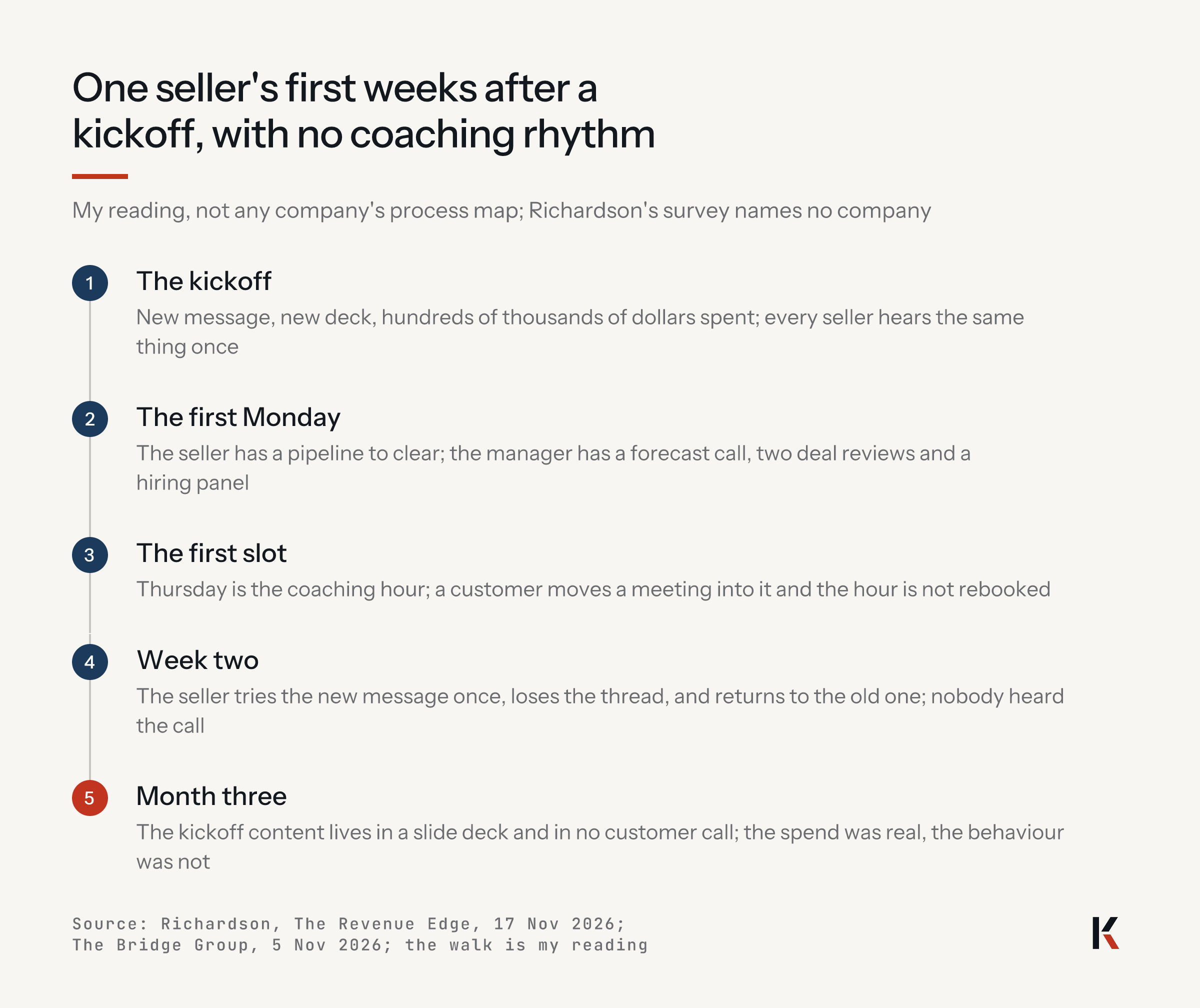
The walk that follows is my reading from outside.
Take one seller and one manager in the two weeks after a sales kickoff.
Monday: the seller has a new message to use and a pipeline to clear. The manager has a forecast call, two deal reviews and a hiring panel.
Thursday is the first coaching slot. A customer moves a meeting into it.
In week two the slot is not rebooked.
The seller tries the new message once, loses the thread, and goes back to the old one. Nobody heard that call.
By month three, the kickoff content lives in a slide deck and in no customer conversation.
The Bridge Group, a go-to-market consultancy, described the same pattern on 5 November, naming no company. A kickoff "can easily reach hundreds of thousands of dollars". Afterwards, "post-event reinforcement largely falls to frontline managers who are already stretched thin".
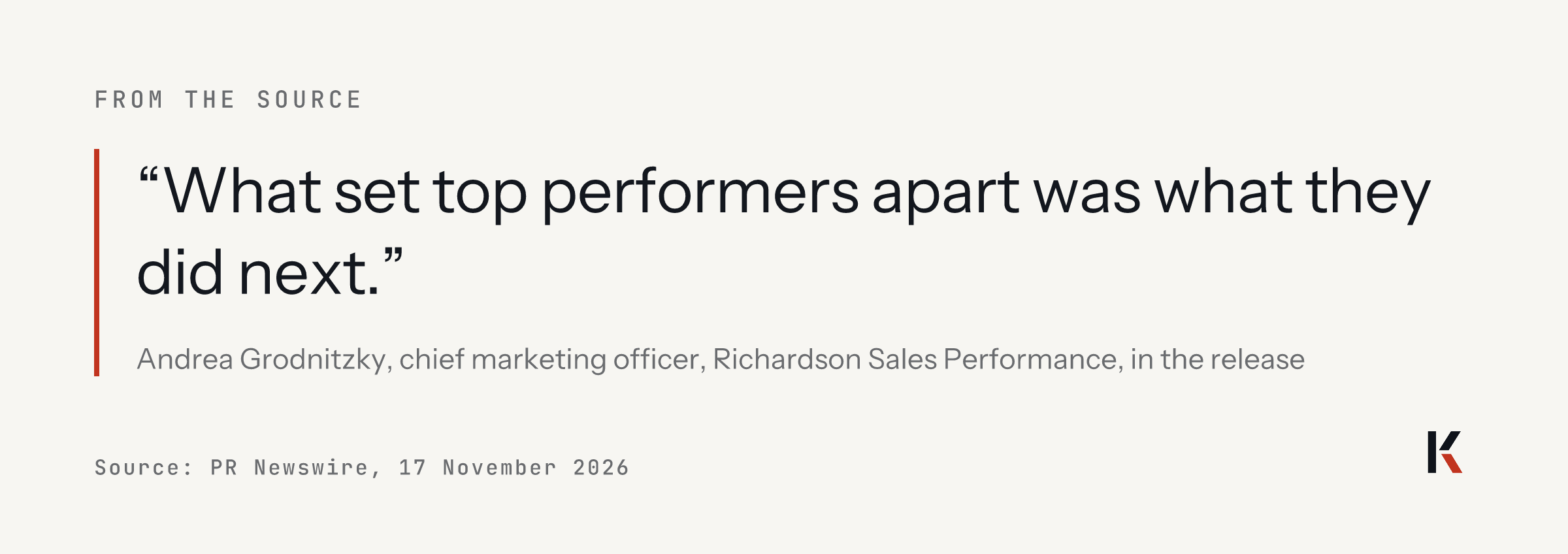
Its summary of what follows: "A few reminders during team meetings, some occasional coaching, and a whole lot of hope."
Read through the socio-economic approach (SEAM, developed by Henri Savall and the ISEOR team in Lyon), the family here is integrated training. What your people are taught, how often, and whether a manager is there when they try it.
The symptom is lack of direct productivity, a team below 90% of quota.
The underperformer kept on too long leaves later and is counted under staff turnover.
Most of the cost is the skill a seller never built because the second conversation never took place. The method calls that non-creation of potential.
I would price those lost hours at the margin they should have produced, not at the manager's salary.
The cost is counted in conversations, not in budget
Richardson gives no money figure for the gap, so I will not invent one.
The arithmetic it allows is on cadence.
A manager who coaches every two weeks holds about 26 conversations a year with each seller. The survey does not say how often the other 55% at quota, or the 73% below 90%, coach. Only that it is less often.
The second unit is your development spend itself. Below 90% of quota, two leaders in three did not say their last development investment was worth more than it cost. At quota, four in ten did not.
You can count both units in your own company this week. Coaching conversations per seller in the last 14 days, and your last training invoice beside the behaviour it was meant to change.
Ambition, a coaching software vendor, surveyed 312 revenue leaders in summer 2026. It describes "a widening gap between organizations that coach" and those "that coach consistently". Its figures also sit behind a form, so I take only that sentence from it.
The fair objection runs the other way: teams at quota may simply have the time to coach, and coaching may not produce quota. The survey cannot separate the two, which is why the first move below is a count, not a programme.
I would not conclude from this that coaching every two weeks produces quota. Quota is self-reported, the comparisons are correlational, and Richardson sells the training that fills the gap. The seven findings I could not read may change the picture.
You can test it in your own company: coaching conversations per seller per month, beside attainment, by team, over two quarters.
Richardson sells the training; Kihon counts what happens in the two weeks after it, when the invoice is paid and the habit is not yet formed. A kickoff compresses a year of commercial leadership into a few days, and the rhythm that makes it pay back is held or lost by managers week by week.
Holding a revenue system through a year like that is our Partnership work, with coaching slots counted monthly beside attainment. The 1,105 lead enterprises; a scale-up with its first three managers meets the same two weeks earlier and with less slack. Bring two of your managers' calendars and one quota sheet: thirty minutes is enough to see the gap.
What a CRO would do before booking the kickoff
- Count the coaching conversations each seller had in the last 14 days, from calendars, not from memory.
- Put that count beside each team's quota attainment on one page and look for your pattern.
- Move one fixed hour a week in every manager's calendar to coaching before the kickoff budget is signed.
Sources
- PR Newswire via Macau Business, The Revenue Edge: Survey of 1,105 sales leaders finds top performers are pulling ahead with AI, 17 November 2026
- Richardson Sales Performance, The Revenue Edge research report page, November 2026
- The Bridge Group, The SKO You Couldn't Run Before, 5 November 2026
- Ambition, The State of Sales Coaching in 2026, survey of 312 revenue leaders, summer 2026
Your turn: how many of your sellers had a coaching conversation in the last 14 days, and could you answer without asking? Write to me at cemgorer@kihonlabs.com, or answer on LinkedIn. I read every reply.