

On 5 November, near the end of Cloudflare's third-quarter call, an analyst from Citi asked Matthew Prince what the May restructuring had changed. The chief executive answered with a seller's week.
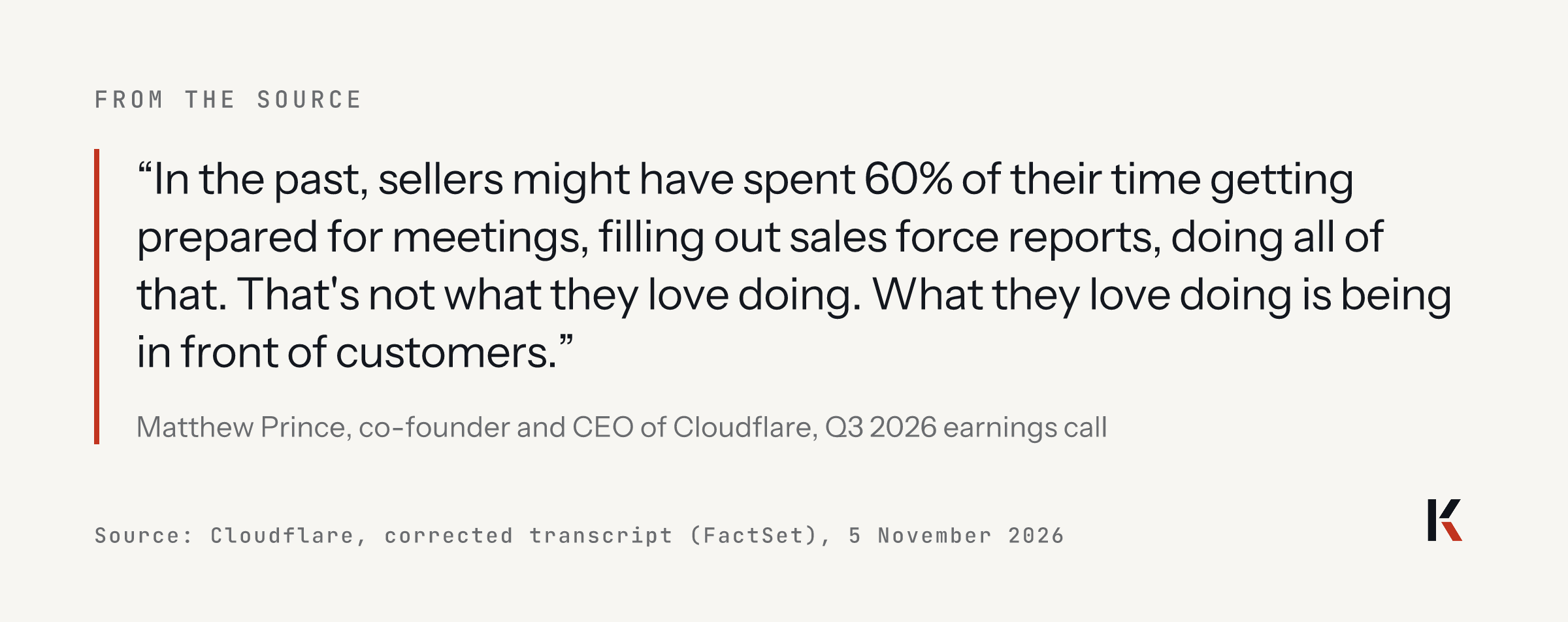
"In the past, sellers might have spent 60% of their time getting prepared for meetings, filling out sales force reports, doing all of that," he said. The company has since "dramatically" increased sellers' time in front of customers, he added, "and you see that in sales productivity."
The productivity figure came earlier in the call. Sales productivity set a record and rose year on year for the 11th quarter in a row. Quota attainment was the highest in more than five years.
Cloudflare does not say how it measures sales productivity. It gives no figure for the hours a seller now spends with customers.
Cloudflare says it moved its sellers' hours by letting AI do the measuring work; it booked severance for the change and has published no count of the hours. That is a time-management problem in the plain sense: where a seller's week went, and who decided it.
I read it through the socio-economic approach, SEAM, developed by Henri Savall and the ISEOR team in Lyon. The shape of the week is the cause, missed targets are the symptom, and the customer hours that did not happen are the cost.
The short version
Cloudflare's CEO says sellers in the past might have spent 60% of their time on meeting prep and reports, and now spend far more of it with customers.
Sales productivity has risen for 11 quarters in a row, and the company cut more than 1,100 roles in May while keeping its quota-carrying sellers.
No document gives the hours a seller now spends with customers, or the definition of sales productivity.
Two revenue chiefs rebuilt the same team
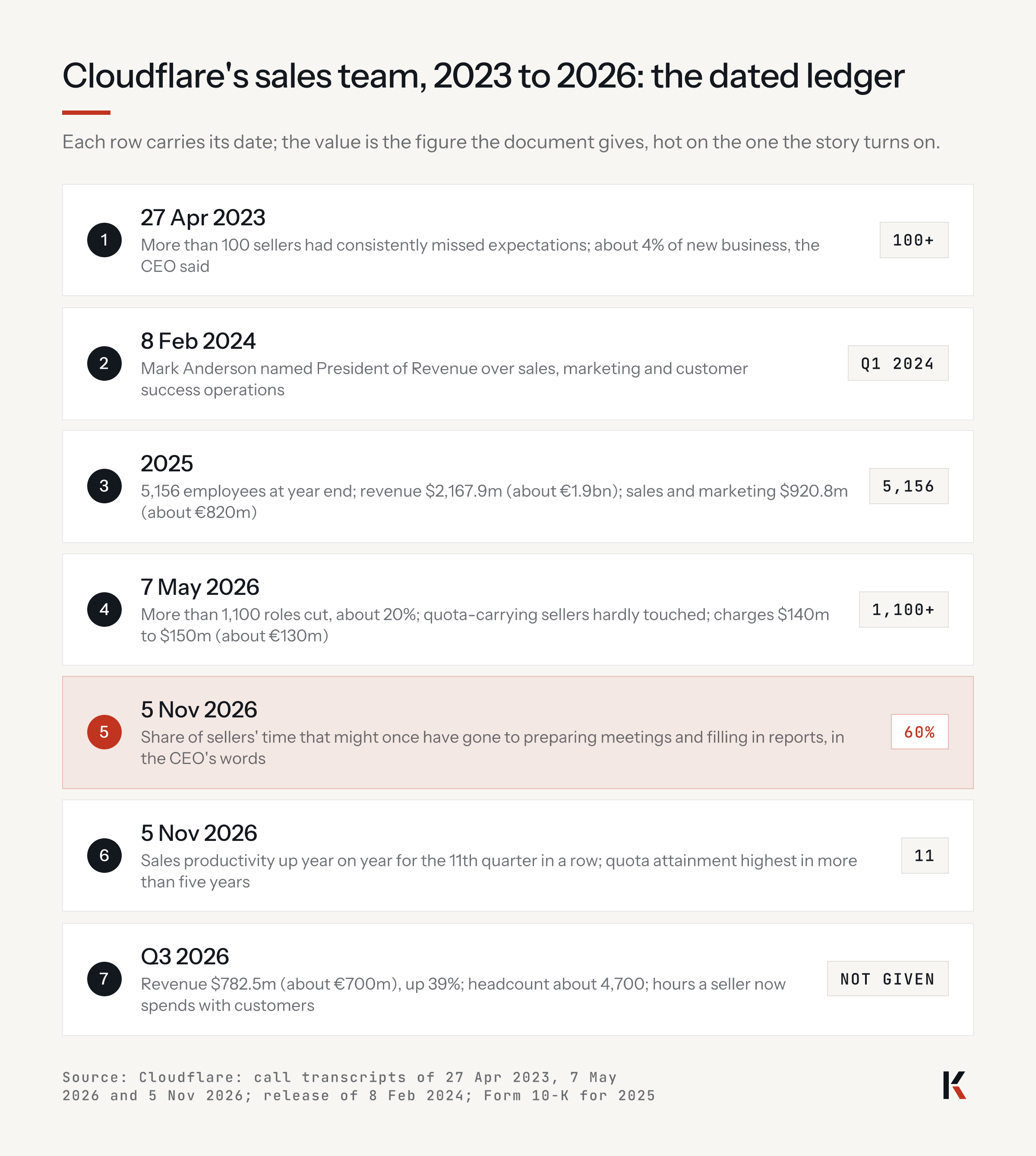
The week Prince described has a history. On 27 April 2023 he told analysts that he and Marc Boroditsky, then the new President of Revenue, had found "more than 100 people on our sales team who have consistently missed expectations". Those sellers had brought in about 4% of new business over the previous year, he said. The top 15% of sellers had reached 129% of quota.
On 8 February 2024 Cloudflare named Mark Anderson, a board member since 2019, President of Revenue over sales, marketing and customer success operations. Eleven quarters back from the third quarter of 2026 is the first quarter of 2024, the quarter he arrived. My arithmetic, not the company's claim.
On 7 May 2026 the founders wrote to staff that Cloudflare would cut more than 1,100 roles. That is about 20% of its people, across all functions and geographies, the chief financial officer Thomas Seifert said, and the quota-carrying sales force would still grow faster in 2026. Severance and restructuring charges were put at $140 million to $150 million, about €130 million.
On 5 November the company named Christian Smith President of Revenue, effective 2 November, over worldwide go-to-market; Anderson retires at the end of the year and stays on as an adviser.
Headcount ended the third quarter at about 4,700, from about 5,500 at the end of March and 5,156 at the end of 2025. Revenue was $782.5 million, about €700 million, up 39%.
The measuring left the seller's week
Prince named three kinds of people on the call: those who build, those who sell and those who measure. The measurers, he said, are where the change fell, because AI is "incredibly good at measuring things".
His example was the investor-relations pack: once a large team's quarterly work, now an agent costing under a couple of hundred dollars in tokens.
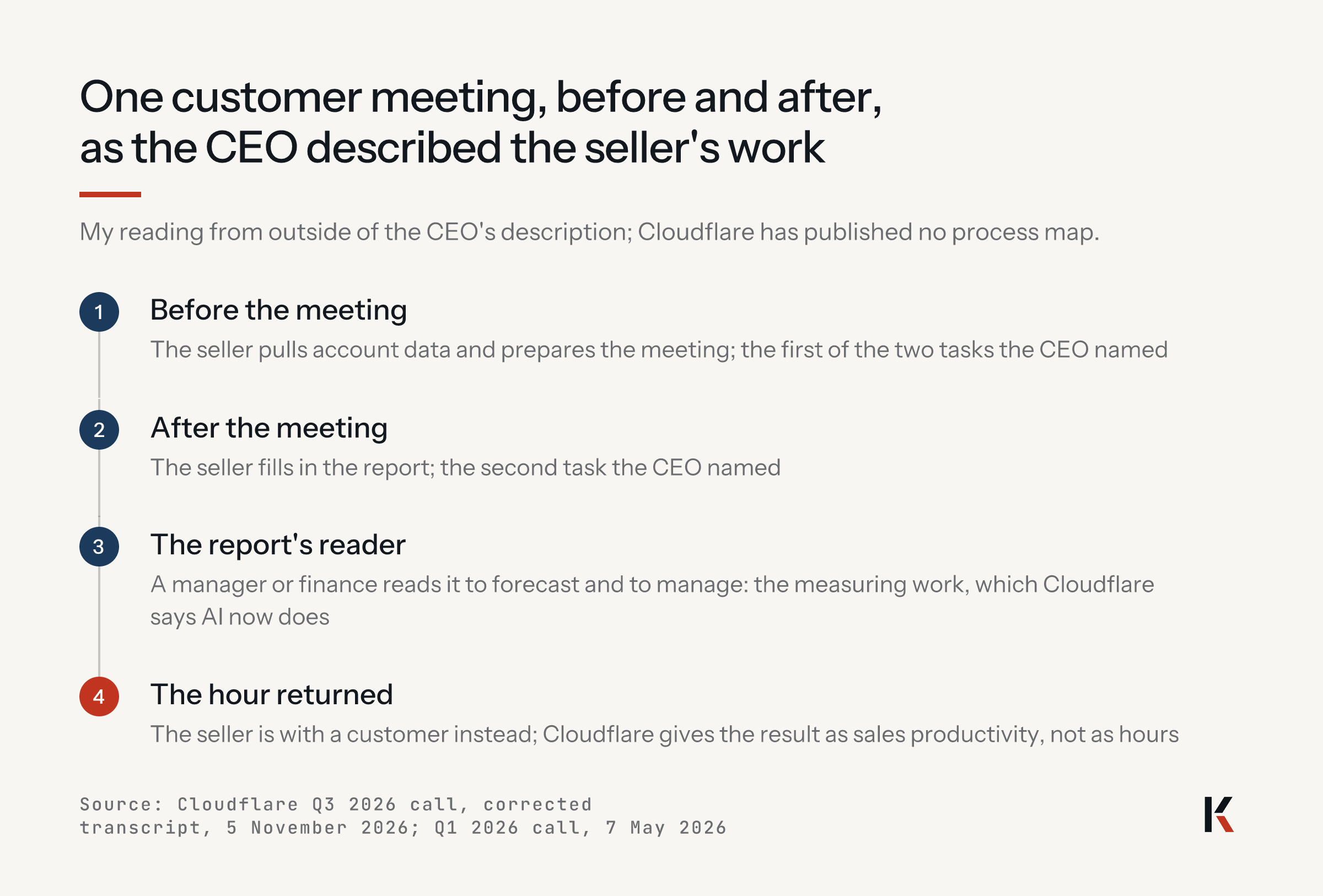
Now take one customer meeting. Cloudflare has published no process map, so the path below is my reading of what the CEO described.
Before the meeting, the seller pulls account data and prepares. After it, the seller writes the report. Someone up the line reads that report to forecast and to manage.
If 60% of a seller's time went to those two ends of the meeting, that is three working days out of every five.
Cloudflare's answer, on its own account, was to let AI do the measuring and keep the people in front of customers. Seifert said in May the cuts hardly touched quota-carrying capacity.
What you cannot find in any document is the share of the week a seller now spends with customers. The 60% stands alone, a before without an after.
The family here, on my reading, is the week itself, shaped around the people who measure it. The symptom in 2023 was 100-plus sellers missing targets, what the method calls lack of direct productivity. The cost is the customer hours that did not happen, priced at the margin a seller's hour should have produced, not at salary.
Cloudflare booked the severance, not the hours
The visible bill is in the filings. The third-quarter release puts restructuring and other charges at $11.0 million for the quarter, about €9.9 million, and $161.7 million so far this year, about €140 million.
Sales and marketing cost $920.8 million in 2025, about €820 million, as reported. In the third quarter of 2026 the reported line was $338.0 million, about €300 million; on the non-GAAP basis the CFO used on the call, it was $270.2 million, about €240 million, or 35% of revenue against 36% a year earlier.
The invisible side has no line. Cloudflare publishes no count of sellers, no hours per seller and no definition of its productivity series, so I give no euro figure for the hours.
You can count them in your own company. Take 60% of your sellers' week, at the margin a customer hour earns in your business, and you have the number this story asks for.
"Productivity rose because demand for AI and security rose, not because sellers' hours moved." Prince spent much of the call on that demand, so the objection has his support. By my count the productivity series began two years before this year's surge, and the call claims both causes.
You will want to conclude that cutting the measuring layer and giving sellers AI produces 11 quarters of rising productivity. I would not go that far. Cloudflare has published no seller hours, its productivity metric is undefined, and the quarter also carried a demand wave.
A seller time log by task, set beside bookings per seller for the same quarters, would decide it.
At Kihon we start with that seller week before anyone decides who is a measurer. Cloudflare did one thing most commercial teams skip: its CEO said in public where its sellers' hours had gone. The question for your leadership team is which reports feed a decision, which feed a habit, and what each costs in customer hours at margin. That is a session, not a study: the Executive Workshop puts a commercial team's week on one table, by role and task, before any restructuring is drawn. Our software and technology page shows how this leak looks in a software company; the same count fits forty sellers. Thirty minutes on your own numbers is where it begins.
Three checks before you copy Cloudflare
- Ask five sellers to log one week by task, and total the hours spent preparing and reporting.
- List every report a seller writes, and name who reads it and the decision it changes.
- Price the preparing and reporting hours at the margin a customer hour earns, beside any severance plan.
Sources
- Cloudflare, Q3 2026 earnings call, corrected transcript (FactSet), 5 November 2026
- Cloudflare, Form 8-K exhibit 99.1, third quarter 2026 financial results, 5 November 2026
- Cloudflare, Form 8-K exhibit 99.2, appointment of Christian Smith as President of Revenue, 5 November 2026
- Cloudflare, Q1 2026 earnings call, corrected transcript (FactSet), 7 May 2026
- Cloudflare, Building for the future, letter from the founders, 7 May 2026
- Cloudflare, Form 10-K for fiscal 2025, 26 February 2026
- Cloudflare, Cloudflare Appoints Mark Anderson as President of Revenue, 8 February 2024
- Cloudflare, Q1 2023 earnings call, corrected transcript (FactSet), 27 April 2023
Your turn: what share of your sellers' week goes to preparing meetings and writing reports, and who reads those reports? Write to me at cemgorer@kihonlabs.com, or answer on LinkedIn. I read every reply.