
In August 2026, Atlassian's research team sat down with eight of its own sales development representatives. It wanted to understand how AI had changed their job.
The company published the answers on 9 November.
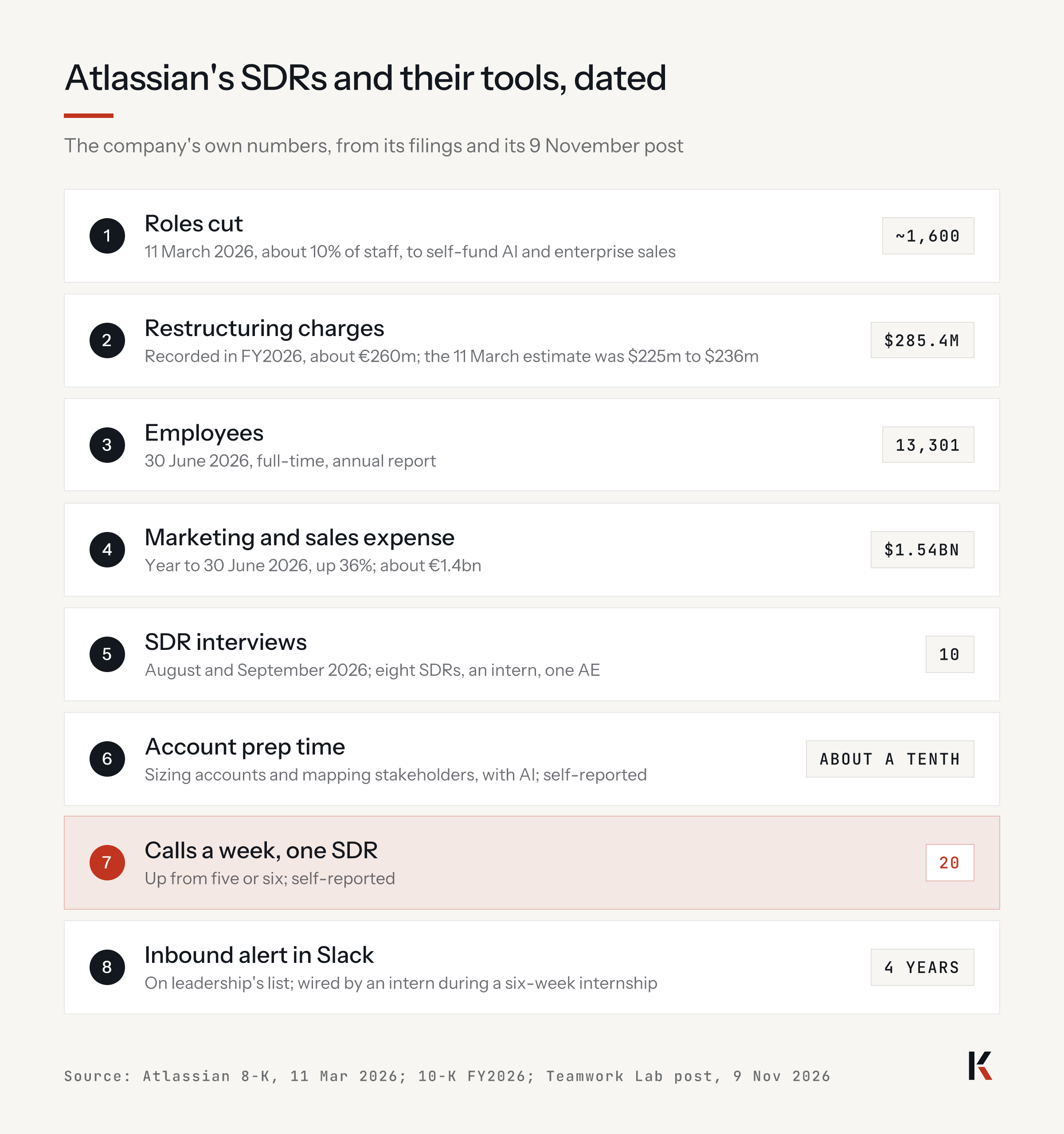
The eight work in mid-market, enterprise and strategic segments, across the US, EMEA, India and APAC. Ten interviews in all: the eight SDRs, an intern on an SDR team and one account executive.
The prep work moved first, by the SDRs' own count. Sizing up accounts and mapping stakeholders "now takes about a tenth of the time", the post says.
One SDR went from five or six calls a week to twenty.
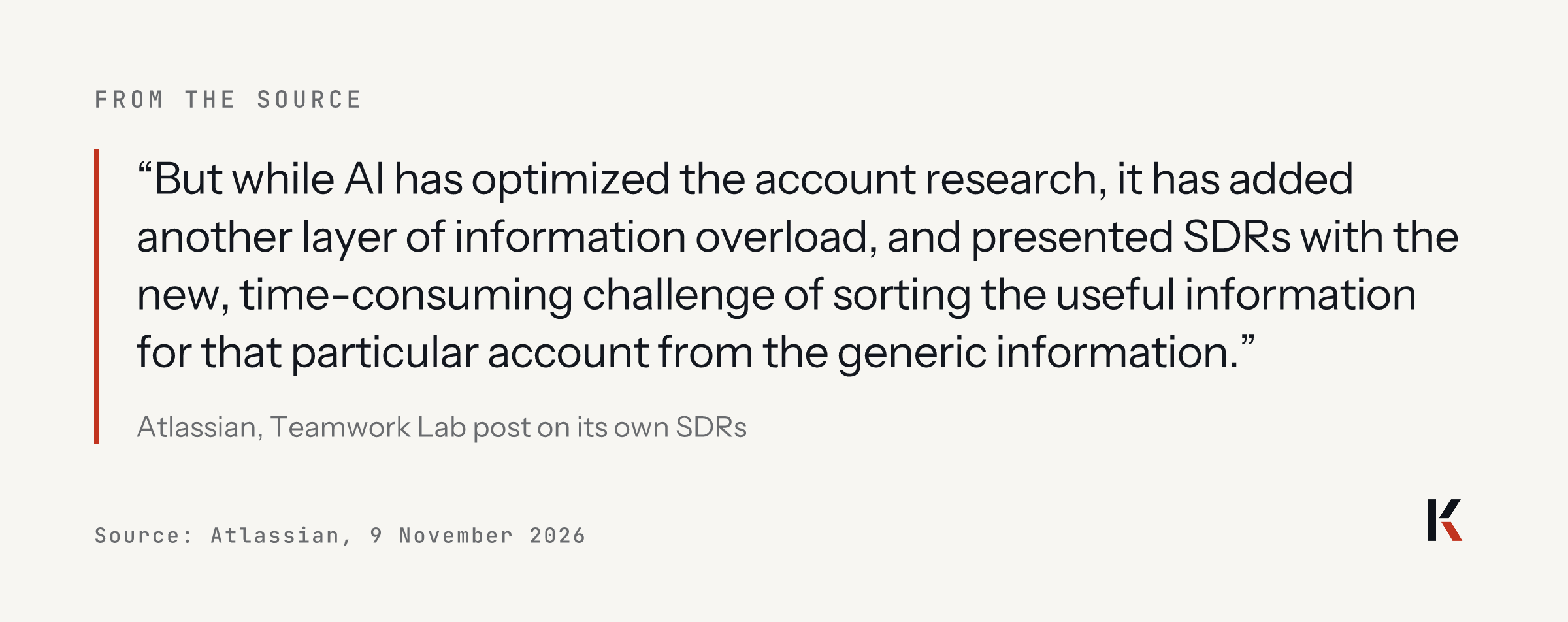
Then the post names what the tools added: "another layer of information overload".
At Atlassian, AI took the SDR's prep work and handed back a sorting job, and the company's own account says both. That is a working-conditions problem. The tools in the seat changed the shape of the work, and only one half of the change has a number.
The short version
Atlassian's own SDRs say AI cut account prep to about a tenth of the time; one went from five or six calls a week to twenty.
The same post says the tools added a time-consuming job, sorting useful information from generic; it gives no hour count.
Nothing AI writes reaches a customer or an account executive without a person's review; the SDRs set that rule themselves.
Eight SDRs described what the tools took and what they left
Atlassian had 13,301 full-time employees on 30 June 2026, its annual report says. Revenue in the year to that date was $6.57 billion, about €5.9 billion, up 26%.
New customers arrive mainly through a self-service "flywheel", the report says. The largest are expanded "primarily through our direct sales force". The SDR, in the post's words, "sits at the top of the sales funnel".
On 11 March 2026 the chief executive told staff the company would cut about 10% of its team, about 1,600 people, "to self-fund further investment in AI and enterprise sales, while strengthening our financial profile", and would reorganise to move faster. The filing of the same day estimated the charges at $225 million to $236 million, about €200 million to €210 million, with the work substantially complete by the end of June.
Whether any SDR seats were among the roles, no document says.
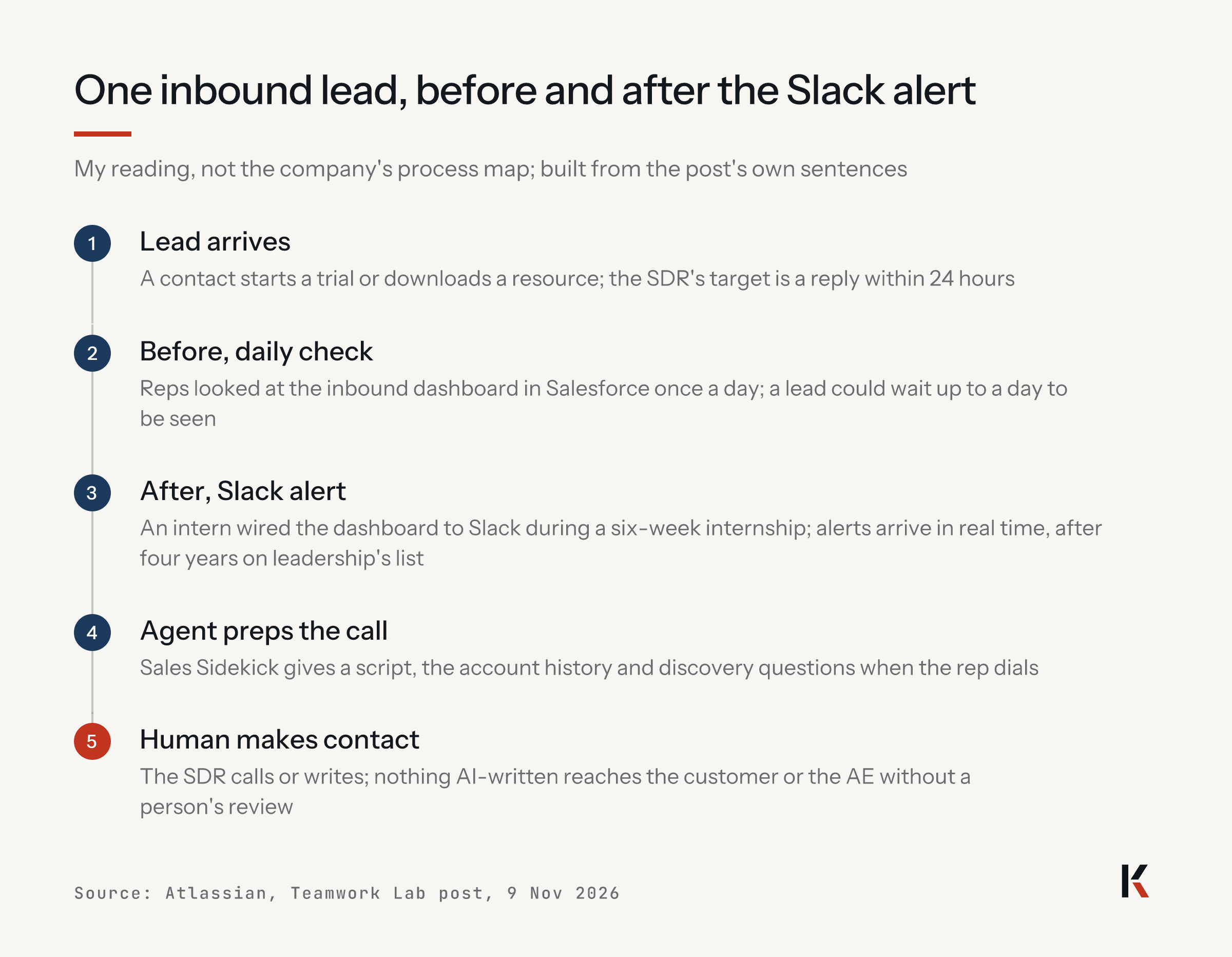
An internal AI engineering team built them an agent called Sales Sidekick. It produces a personalised call script, the account history and suggested discovery questions the moment a rep dials.
The post is precise about its limit: the agent "is the information layer and never the orchestration layer".
The SDRs' own hard line: "No AI written communications or artifacts reach customers or AEs without human review first."
One SDR stopped using AI for outbound email and wrote the way they would text a friend. They booked 10 meetings in a week.
The post also cites the Bridge Group's 2025 survey of 351 B2B companies: SDRs stay 1.9 years in the role on average.
One inbound lead, before and after a Slack alert
Follow one inbound lead. A contact starts a trial or downloads a resource. The SDR's target is a reply within 24 hours. Before, reps checked the inbound dashboard in Salesforce once a day.
The research the post cites says a reply within an hour sharply raises conversion. Getting those alerts into Slack had been on leadership's to-do list for four years. As one of the projects in a six-week internship, an intern wired the dashboard to Slack. The alerts now reach the team in real time.
With one check a day, a lead that arrived just after it could wait up to a day to be seen, against the one hour the research points to.
How many leads waited, and what the wait cost in conversion, the post does not say.
The path below is my reading, built from the post's own sentences; Atlassian publishes no process map.
Here is how I read it. The cause is the setting of the seat: which tools the SDR has, what they take and what they hand back. The symptoms are people's work: five or six calls where twenty were possible, hours spent sorting generic text from useful, a role people stay in for 1.9 years on average.
The cost is the conversations that did not happen in those hours, priced at the margin they should have produced, not at the SDR's salary. That reading is the socio-economic approach, SEAM, developed by Henri Savall and the ISEOR team in Lyon, applied to a company's own account.
Fourteen more calls a week, and a load with no number
Atlassian gives one before-and-after pair. One SDR made five or six calls a week, then twenty: at least 14 more calls a week for that one person, by the post's own two numbers.
The visible side is in the filings. Marketing and sales expense rose 36% to $1.54 billion, about €1.4 billion. The annual report puts the rise mainly on $225.3 million more compensation, about €200 million, and $78.5 million more advertising and marketing programmes, about €71 million. The restructuring cost more than the March estimate: the report records $285.4 million of charges for the year, about €260 million, including $80.0 million for offices it left.
The company's reasons travel with both: a sales team grown on purpose to expand large customers, and a restructuring to fund AI and enterprise sales.
The invisible side has no line. The hours an SDR now spends sorting what the agent brings back are named in the post and counted nowhere.
I read the second side as the larger one.
The post's value is one sentence a company blog rarely carries: the tool added a load. I would still not conclude from it that AI makes SDRs more productive, or that it burdens them. Eight people, self-reported, published by a company that sells AI, and no team-wide count of hours, calls or meetings.
One measurement would close the question: hours per week on sorting, per SDR, for one quarter, beside calls made and meetings booked.
Atlassian wrote down what its tools took and what they added; in my reading, most company posts on AI write down only the first half. Kihon works on the second half: the load a new tool puts on the people who face your customers, counted in their hours and priced at the margin those hours should have produced.
In the Executive Workshop, a leadership team puts one week of its own SDR or customer success seat on the table and finds the item that has waited years on a list. Atlassian sits where our software and technology readers sit, with tools arriving faster than the counting. Thirty minutes on your SDR week: the conversation starts here.
Three questions a CRO would put to their SDR team
What did the new tool add to your week?
Ask for the hours of sorting, checking and correcting, not the hours saved. Atlassian's SDRs named that load; yours will too.
Who reviews what reaches the customer, and when?
Atlassian's SDRs review every AI-written email before it leaves. Write down who holds that review, and the minutes per message.
Which alert has waited years on a list?
At Atlassian it was the inbound lead alert: four years on the list, then one project in an intern's six-week internship. Find the signal your team still checks once a day.
Sources
- Atlassian, Teamwork Lab, "In sales development, a human touch stands out", 9 November 2026
- Atlassian, Form 8-K exhibit 99.1, "CEO Update March 2026: An important update on our team", 11 March 2026
- Atlassian, Form 8-K, Items 2.05 and 5.02, 11 March 2026
- Atlassian, Form 10-K for the fiscal year ended 30 June 2026, filed August 2026
Your turn: what did the last tool you gave your SDRs add to their week, and who counted it? Write to me at cemgorer@kihonlabs.com, or answer on LinkedIn. I read every reply.