
On 16 June 2026 Zapier published a survey it calls Dropped Leads. Centiment had asked 404 sales and marketing managers at US B2B companies how often qualified leads are dropped.
The fieldwork ran from 3 to 17 April.
92% said every month.
In the same April, LXA asked 201 senior B2B leaders where their lead process breaks. Their companies have 2,500 people or more, in seven countries. 42% named poor alignment between marketing and sales on what counts as a qualified lead.
29% named a lack of visibility into what happens after the handoff.
Two surveys from one month put the lost lead in the same place: between marketing and sales. A communication-and-coordination problem: what one team knows about a buyer, the next does not receive. How that happens inside any one company is my reading from outside, because neither survey names one.
Both surveys were made for or with companies that sell a fix. Zapier connects software tools to each other. LeanData, LXA's partner on the report, sells software that routes leads to the right person.
The numbers are theirs, and so is the stake.
The short version
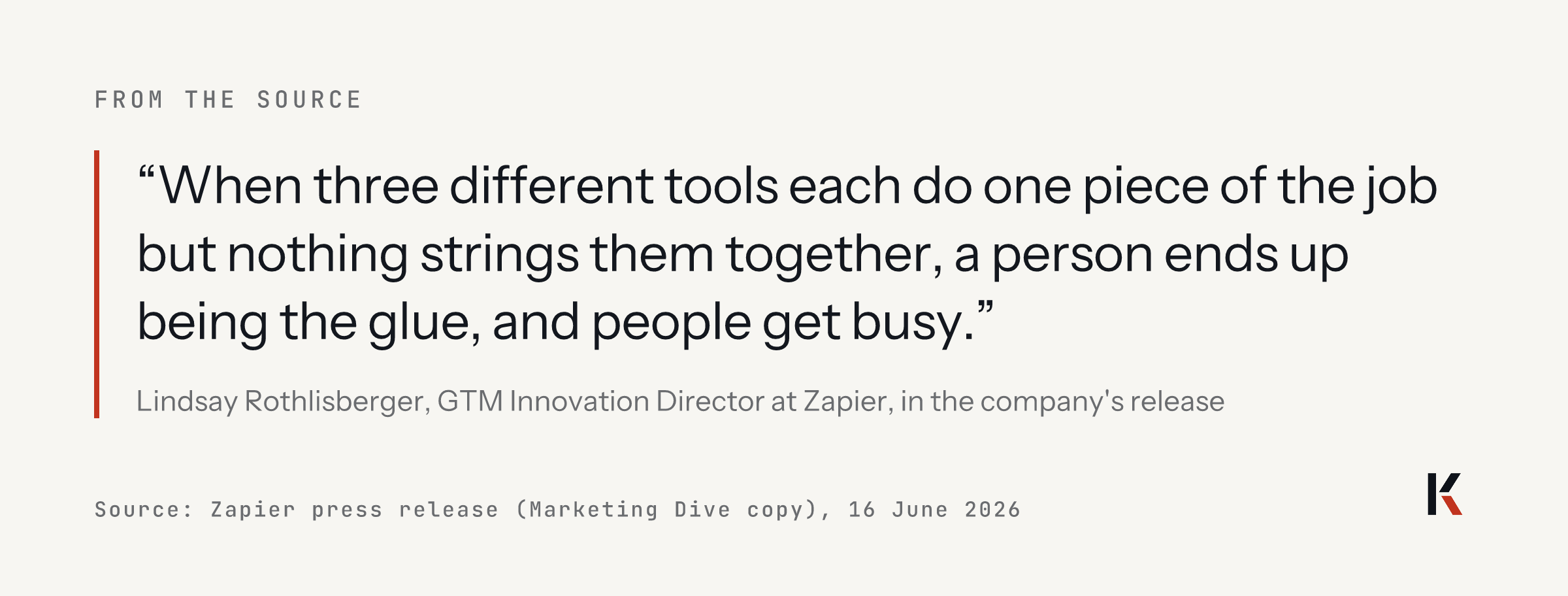
92% of 404 sales and marketing managers say qualified leads are dropped every month, and 37% say leads get stuck between marketing and sales or between their tools.
42% of 201 enterprise leaders cite poor marketing-and-sales alignment on lead qualification, and 29% name a lack of visibility after the handoff.
In those large companies AI is in use or on trial for content at 46%, and for lead routing at 11%, the lowest of ten uses measured.
Two surveys, one gap, both sides
Zapier's survey is the wider account. Companies of at least 50 employees with no upper limit, managers directly involved in the sales process, 404 answers, unweighted, a margin of error of about five points.
73% receive more than 50 qualified leads a week, and 11% receive more than 500.
92% say qualified leads are regularly dropped each month: 42% a few times a month, 38% several times a week, 12% nearly every day.
42% say their teams fail to make a second or third attempt after the first touch. 37% say leads get stuck between the marketing tools and the CRM, or between the marketing and sales teams.
68% say their people spend three to ten hours a week on CRM upkeep: entering leads, updating stages, fixing duplicates.
The survey gives no count of leads lost and no value for one.
LXA's report, written with LeanData and published in May, is the large company's account. A third of its 201 leaders are CMOs or VPs of marketing; 11% are CROs or VPs of sales.
Asked for their most significant gaps in lead management, 47% named manual processes that cannot scale. 45% named slow or missed follow-up on inbound leads.
42% named poor alignment between marketing and sales on lead qualification. 29% named no visibility into what happens after the handoff.
On routing, 39% use rules with no service-level clock and no escalation path. 37% are not confident that every lead is followed up by the right person at the right time.
This report gives no count of leads either.
One lead, five steps, one person carrying it
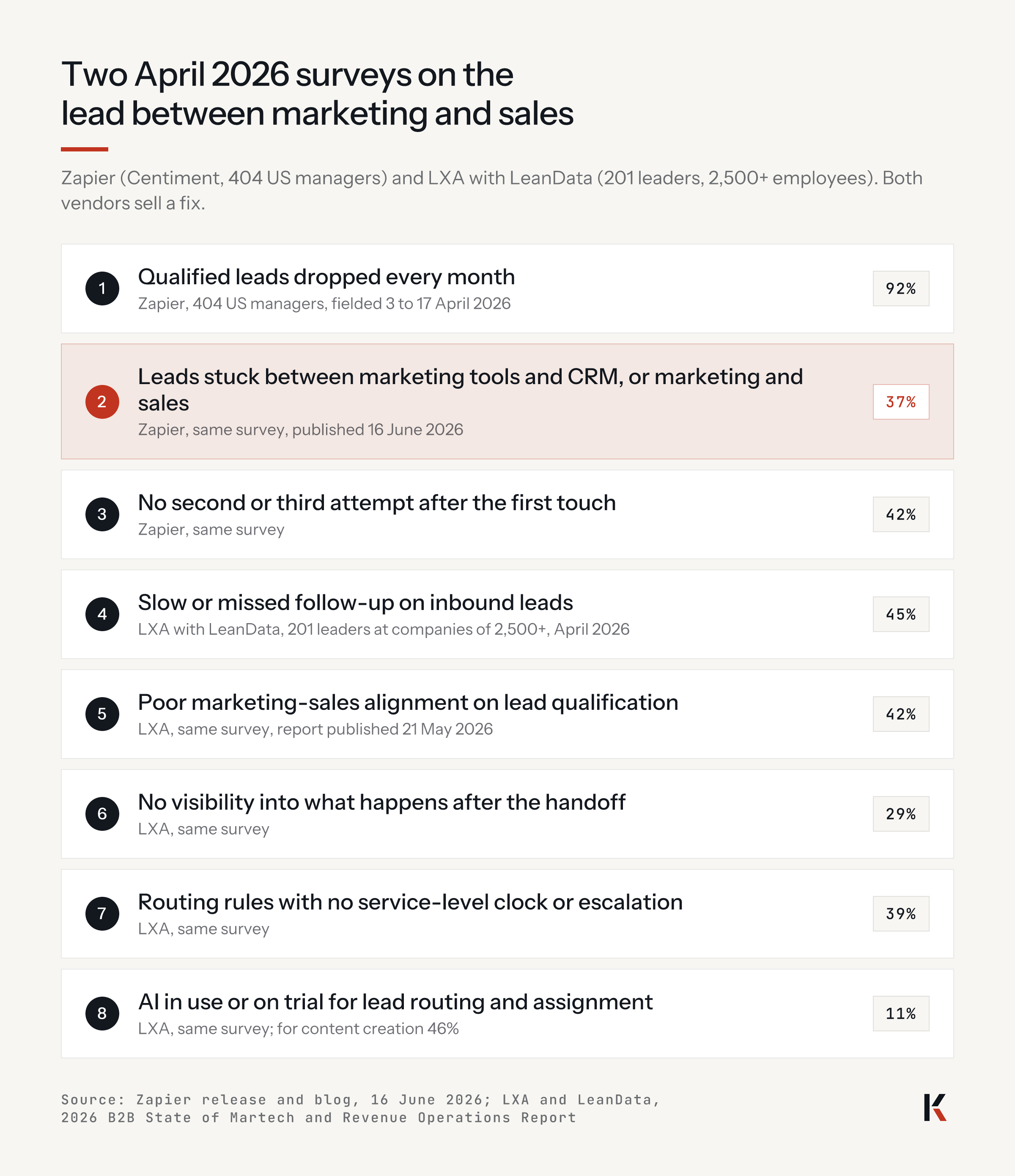
Take one qualified lead on a Tuesday morning. How it travels is my reading from outside.
A form is filled and the marketing tool scores it. The record now has to reach the CRM and an owner. 37% of Zapier's managers say this is where leads get stuck; 39% of LXA's leaders say the routing rule has no clock behind it.
The first touch is usually made.
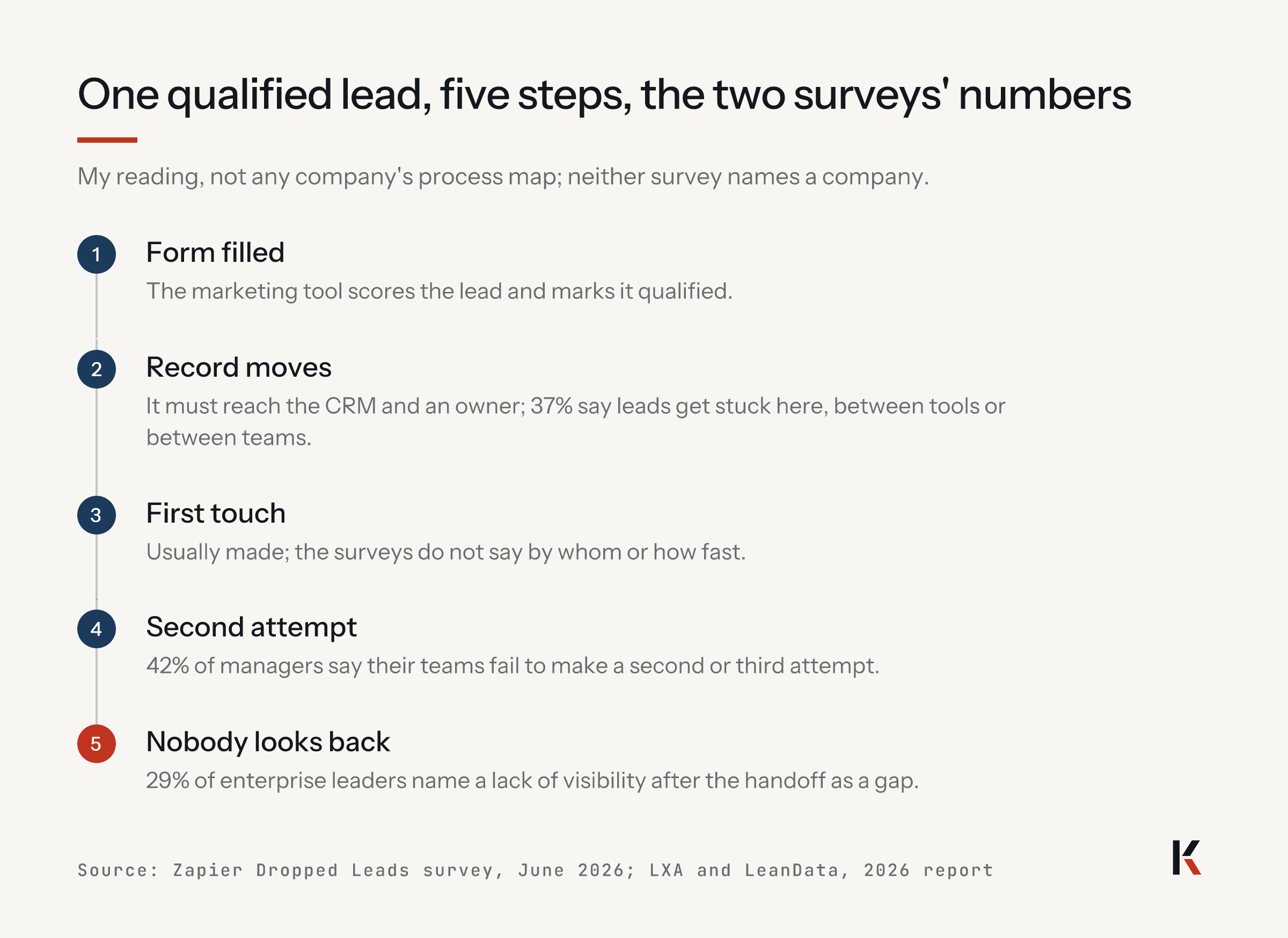
The second is the step that fails. 42% of managers say their teams do not make a second or third attempt. Zapier's blog puts that on a next action that is not created automatically, so people "prioritize whatever is loudest and closest and most on fire".
Then nobody looks back. 29% of the enterprise leaders name a lack of visibility after the handoff, so the lead that got one touch and no second is not a number you read on Friday.
My reading of the cause: marketing and sales hold two tools and no shared rule for the hour after a lead qualifies.
The gap does not close after the signature. Five Bain authors wrote on 9 November 2026 that customers complain vendors "ship their org chart" to them.
The symptoms show in your people's work. On my reading, a seller types in a lead that marketing's tool already holds: work done twice, which the socio-economic approach, SEAM, developed by Henri Savall and the ISEOR team in Lyon, calls non-quality. Hours go to CRM upkeep instead of calls: lost direct productivity.
The cost that counts is the lead that got no second attempt, priced at the margin that deal should have produced, not at the seller's hour.
Count the cost in leads and hours
Neither survey puts money on a dropped lead, so I give no euro figure; the units are yours to fill in.
Leads: 50 qualified leads a week is about 200 a month. 42% of managers say the second attempt is not made. The surveys do not say on how many; that count is yours to make, in your own CRM.
Hours: 68% of managers say each person spends three to ten hours a week keeping the CRM in order. That is up to a quarter of a 40-hour week, by Zapier's own arithmetic. At the top of that range it is ten hours per person a week, paid in salary.
You may object: "Our marketing-qualified leads are mostly noise; dropping some is triage." Possibly, and neither survey tested lead quality. But 42% of the enterprise leaders name poor alignment between marketing and sales on what qualified means. On my reading, the triage is then done by the team that did not write the definition.
The conclusion you will be tempted to draw is that 37% of your leads are lost.
Neither survey says that. Both report the share of managers who see a problem, not the share of leads affected.
A measurement settles the size: the qualified leads your marketing team created in one month, beside the number that received a second touch within seven days.
Two vendors measured one gap and each sells a tool for it. I think the gap is older than both tools: a lead needs an owner, and software cannot be one.
At Kihon we find that owner in your own numbers. Leads created in a month, leads that got a second touch, the days between, and the margin the rest would have carried: that is the Diagnosis.
The gap tends to open in a scale-up, when lead volume passes the one person who routed by hand. Thirty minutes on last month's lead list is enough to see which step has no owner: write to us.
Three counts before the next lead arrives
- Export last month's qualified leads from marketing and from the CRM, and count those that appear in only one.
- Date the first and second touch on every lead a seller received, and read the gap in days.
- Write one definition of a qualified lead that both heads sign, with the hour by which someone owns it.
Sources
- Zapier press release (Marketing Dive copy), Dropped Leads survey with methodology, 16 June 2026
- Zapier, 92% of sales teams drop qualified leads every month, survey findings, June 2026
- LXA with LeanData, 2026 B2B State of Martech and Revenue Operations Report, 21 May 2026
- LeanData, Kim Peterson, summary of the 2026 report, 27 June 2026
- Bain & Company, The Rebirth of Customer Success, 9 November 2026
Your turn: of the qualified leads your marketing team created last month, how many received a second touch within seven days? Write to me at cemgorer@kihonlabs.com, or answer on LinkedIn. I read every reply.