
One customer success professional answered a survey this year with a list. More than 100 accounts in the portfolio. Then "constant requests from multiple internal departments regarding marketing, VOC, expansion, testimonials, value frameworks", all at once.
The list sits in the Customer Success Collective's State of Customer Success 2026. The Collective describes its sample as hundreds of customer success professionals. The report came out on 1 July 2026. The capacity findings followed in an article on 29 September, the tenure findings in one on 15 July.
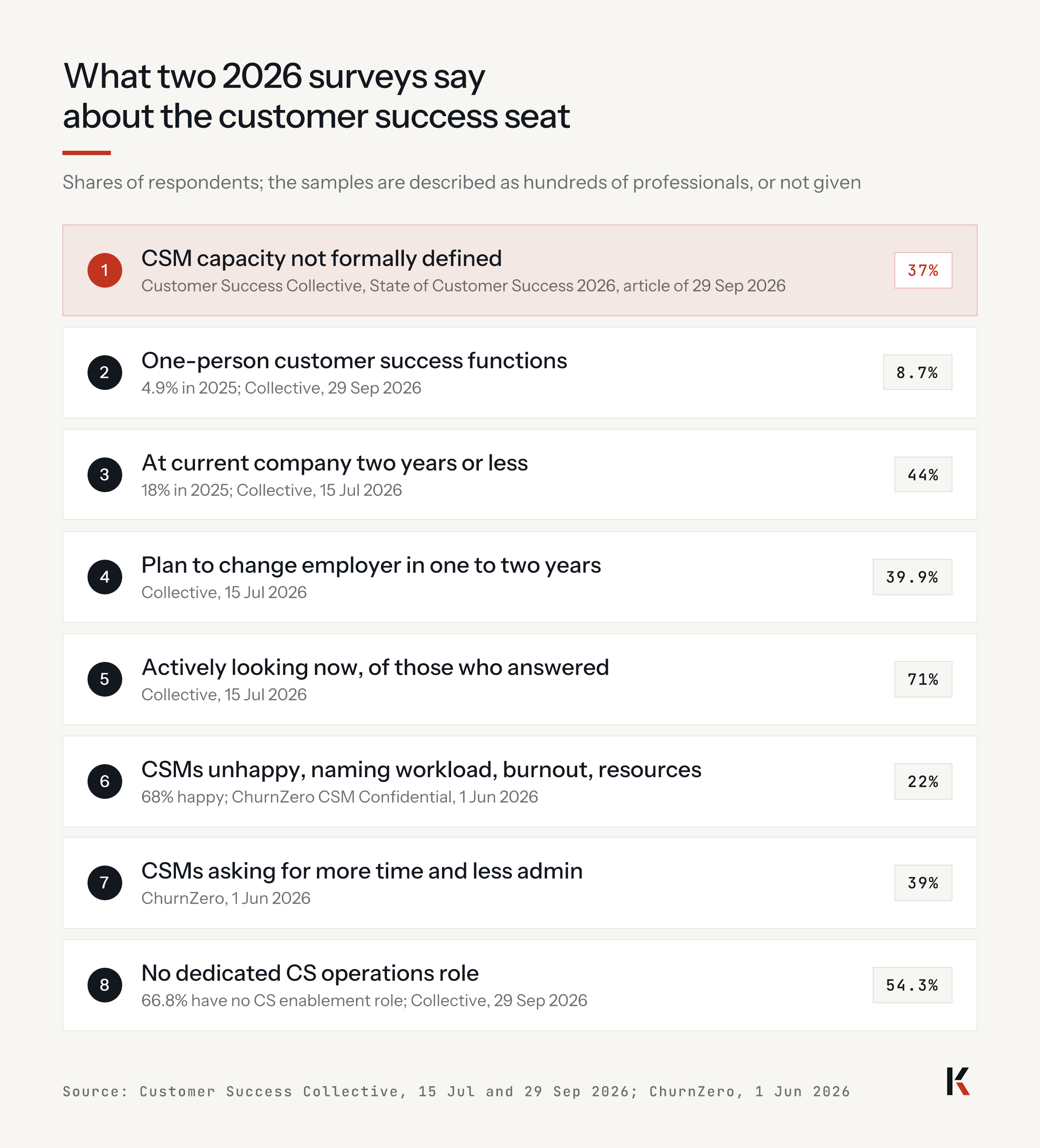
The number next to that list: 37% of respondents say CSM capacity is not formally defined.
Teams where the whole function is one person rose from 4.9% in 2025 to 8.7% in 2026.
Nearly four in ten customer success professionals surveyed say nobody has formally defined how much one CSM can carry, and four in ten plan to change employer.
I read this as a working-conditions problem: the load on one seat, before anything about skills or structure.
The short version
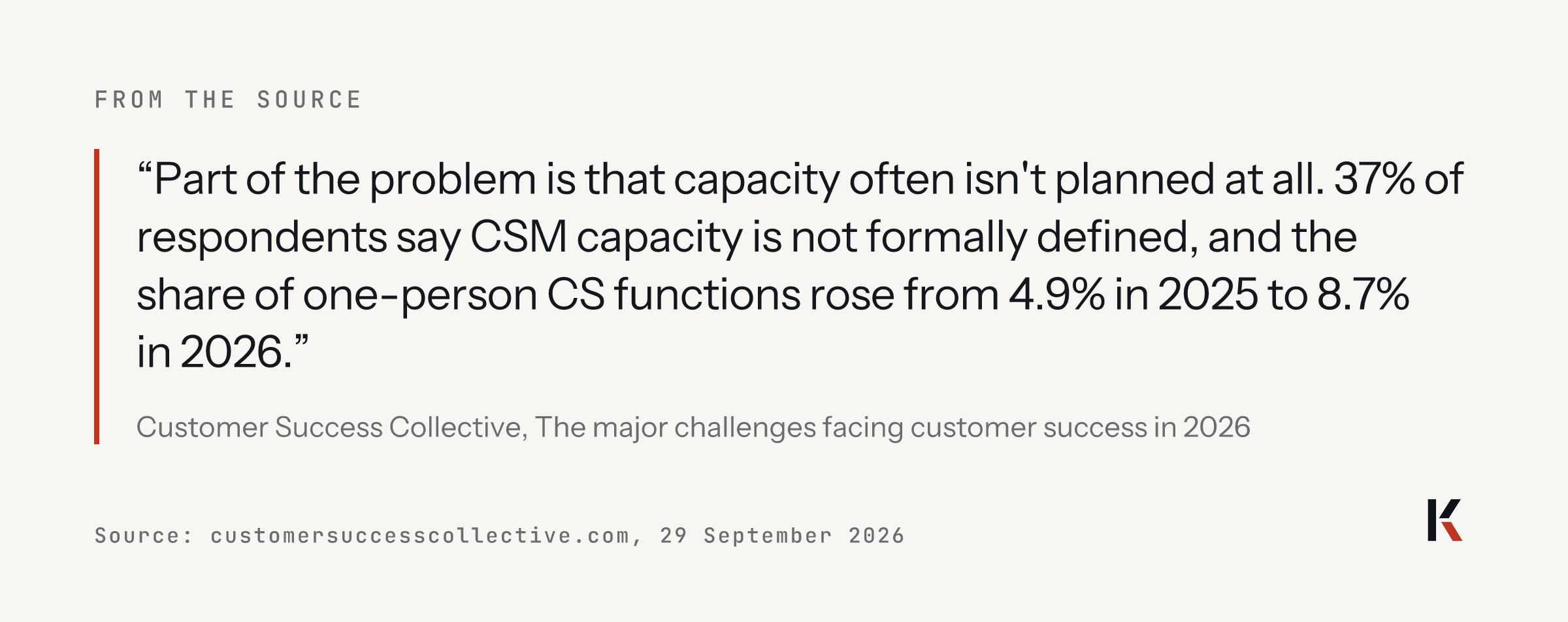
37% of surveyed CS professionals say CSM capacity is not formally defined; one-person functions rose to 8.7%.
44% of CS professionals have been at their company two years or less; 39.9% plan to change employer within two years.
Renewals are a core duty for 59.8% of respondents; neither survey puts a money figure on the people leaving.
Three studies describe the same seat
The Collective's article of 29 September ranks capacity and workload fifth of six challenges. Around 14% of respondents named it.
The answers it quotes are short. "Too many accounts for my segment." "Workload to CSM ratio." "My team is underpaid and stretched too thin, and expectations are unclear and constantly changing."
More than one respondent wrote only the word "capacity".
The article gives no average number of accounts per CSM, and the Collective states no sample size.
The load is getting wider.
Retention is a core responsibility for 81% of respondents, down from 87.2% in 2025; renewals for 59.8%, upselling and cross-selling for 56.5%. In 2024, 49.1% carried those commercial duties.
Yet 54.3% have no dedicated CS operations role and 66.8% no CS enablement role. Only 10.8% say budget and resources increased.
The article of 15 July carries the other half. 44% of CS professionals have been at their current company two years or less, up from 18% in 2025.
39.9% plan to change employers within one to two years. Among those who answered the question directly, 71% are actively looking now.
Six respondents explained why they are leaving customer success entirely; two cited burnout.
One wrote that "every day is a fire I need to put out."
ChurnZero, a customer success software vendor, published its 2026 CSM Confidential Report on 1 June. 68% of CSMs are happy in their roles. The 22% who are not trace it to workload, burnout and insufficient resources.
Asked what would help them own revenue, 39% chose more time and less admin, and as many chose better selling and negotiating skills. Neither the release nor the report page gives a sample size.
Gainsight, another vendor, wrote on 23 January 2026 from its 2025 Customer Success Index, which draws on more than 400 companies. Its customers support roughly 25% more accounts per CSM than non-customers, and nearly 70% more in SMB.
On the Index webinar, its chief customer officer Brent Krempges said: "You're seeing more decrease than increase in overall headcount."
That is a vendor's data on its own customers. It says nothing about what the extra accounts do to the person.
A book with no limit fills until someone leaves
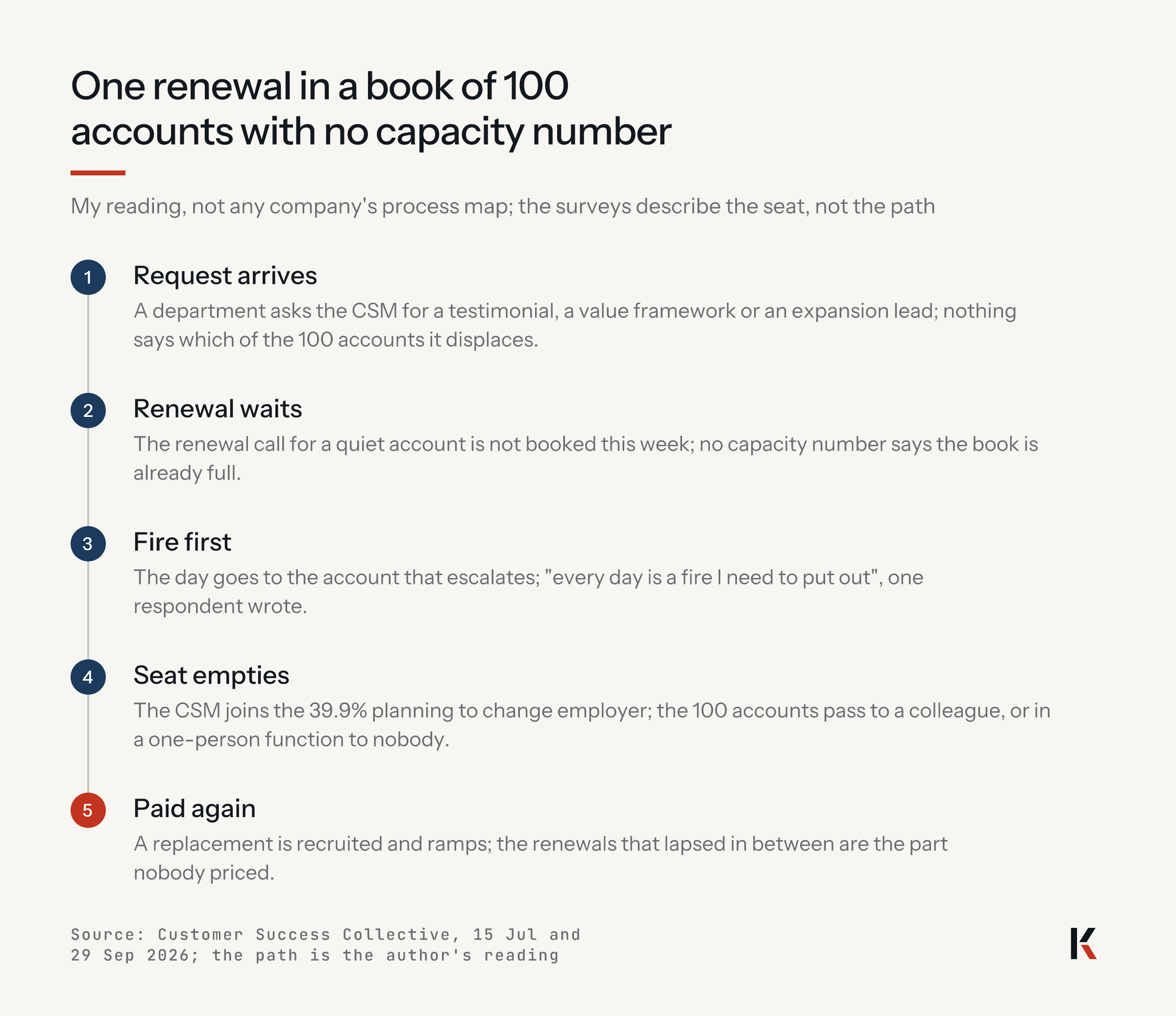
Take one renewal in a book of 100 accounts.
How it travels inside any company is my reading from outside; the surveys describe the seat, not the path.
A request arrives from marketing for a testimonial, or from sales for an expansion lead. Nothing says which of the 100 accounts it displaces, because no number says the book is full. The renewal call for a quiet account is not booked this week. The day goes to the account that escalates.
Now multiply. 59.8% of respondents own renewals and 56.5% own expansion; 39.9% plan to change employer. When the seat empties, the 100 accounts pass to a colleague who already has 100. For the 8.7% whose function is one person, they pass to nobody.
The reading, in plain words.
The cause is a working condition: a load with no written limit. The symptoms are people leaving, burnout named by leavers, and work not done the first time.
The cost shows up as work that never happened: renewals worked late, expansion conversations never held, the knowledge of 100 accounts gone with each resignation. The socio-economic approach, SEAM, from Henri Savall and the ISEOR team in Lyon, prices that lost time at the margin it should have produced, not at the salary.
The cost arrives as renewals, not as a payroll line
None of the sources gives a money figure, so I will not invent one.
On my reading, the units are these.
Every account above a capacity number that does not exist is a renewal worked late. Every CSM in the 39.9% who does leave is a book that changes hands and a ramp paid twice. Every one-person function is a renewal calendar with a single point of failure.
You can count your own version this week.
Write the accounts each CSM carries beside the renewal dates in their book. Then multiply your CSM headcount by 39.9%. If your team matches the survey, that is how many of your CSMs plan to change employer within two years, each with a book to hand over.
"Our CSMs are happy; ChurnZero itself says 68% are." They are, and that is the point.
The 22% who are not name the load, and 39% chose more time and less admin as the help they need to own revenue. Happiness and a book over its limit sit in the same person until the book wins.
You will want to conclude that undefined capacity causes the leaving. The data cannot carry that.
Neither survey states a sample size or how respondents were chosen, and an intention to change employer is not a resignation. The table that would answer it is one your team can build. Accounts and renewals per CSM, the capacity number if one exists, and who left, quarter by quarter.
A capacity number that was never written is a revenue system that was never designed, and that is where Kihon works. We put the number in: accounts per CSM by segment, hours per tier, the renewal calendar that follows. That is the Build work, done with finance and sales in the room. Thirty minutes on your numbers is enough to see your own table.
What a head of customer success would do first
- Count the accounts and renewal dates each CSM carries today, in one table.
- Write the capacity number per segment and have finance and sales sign it.
- Compare the two columns and move or refuse every account above the line.
Sources
- Customer Success Collective, The major challenges facing customer success in 2026, 29 September 2026
- Customer Success Collective, The customer success job market in 2026, 15 July 2026
- Customer Success Collective, State of Customer Success 2026 Report page, 1 July 2026
- ChurnZero, press release on the 2026 CSM Confidential Report, 1 June 2026
- ChurnZero, 2026 CSM Confidential Report page, 2026
- Gainsight, What customer success teams are prioritizing in 2026, 23 January 2026
Your turn: how many accounts does your busiest CSM carry today, and where is the number that says how many they should? Write to me at cemgorer@kihonlabs.com, or answer on LinkedIn. I read every reply.